Hospitals run on equipment that moves constantly, carries high value, and must be safe and available the moment a clinician reaches for it. Find Asset gives biomedical and facilities teams a single register for every infusion pump, patient monitor, ventilator, and imaging system across the site.
Tag assets with QR, barcode, or RFID labels, assign them to wards and departments, schedule calibration and preventive maintenance, and see where shared equipment is right now, so staff spend less time hunting for a wheelchair and more time with patients.
Look up any device from your phone
Everything biomedical, facilities, and ward teams need to keep equipment safe, traceable, and ready for use.
Maintain detailed records for MRI, CT, ultrasound, and X-ray systems, including location, service history, and assigned technicians, so your most expensive equipment is always accounted for.
Schedule calibration and safety inspections for each device, get reminders as due dates approach, and keep a complete log of every check performed against each asset.
Plan recurring maintenance for pumps, monitors, and life-support equipment, assign work to technicians, and track jobs from open to completed with full records.
Find wheelchairs, IV poles, and portable monitors fast. See which ward holds a device and record movements as equipment travels between departments.
Tag every asset and scan it at the bedside or in the biomed workshop to pull up its full profile, status, and history in seconds from a phone or scanner.
Give biomedical engineers, ward managers, and administrators the right level of access, so each team sees and updates only what belongs to their role.
Clinical environments demand equipment that is available, safe, and traceable. Find Asset supports the daily realities of running a hospital's equipment fleet.
Know what is available and where it sits so beds, pumps, and monitors can be brought to the point of care without a search across the building.
Keep calibration, inspection, and maintenance records organized and retrievable, helping your teams demonstrate that equipment is serviced and safe to use.
Shared devices rarely stay put. Record transfers and current custody so equipment does not vanish into a store room on the wrong floor.
Maintain accurate registers of imaging and lab equipment, reducing loss and giving finance and clinical engineering a shared source of truth.
Find Asset brings together the tracking, maintenance, and reporting tools that hospital equipment teams rely on.
Hospital asset tracking is the practice of giving every piece of medical equipment a tag, a register entry, and a recorded history, so that any staff member can answer four questions about a device in seconds: what is it, where is it, who is responsible for it, and is it safe to use. In a hospital those questions are asked constantly, at the bedside, in the biomedical workshop, and during inspections. Find Asset exists to make the answers instant and reliable.
A typical hospital carries far more trackable equipment than its asset list suggests. Infusion pumps and syringe drivers move between beds daily. Patient monitors, pulse oximeters, and suction machines travel with admissions. Ventilators and defibrillators sit in critical care and emergency units where readiness is a matter of life and death. Beyond the wards sit the heavy, expensive assets: MRI and CT scanners, X-ray and ultrasound systems, laboratory analysers, autoclaves, and the dental and ophthalmology chairs that few people think about until one fails.
There is also the mobile fleet that nobody counts but everybody borrows: wheelchairs, IV poles, drip stands, hoists, transport trolleys, and portable oxygen concentrators. These low-value items cause a disproportionate share of daily friction because they are shared, unlabelled, and nobody owns their whereabouts. A workable tracking programme covers the expensive machines and the humble wheelchairs alike, because both cost money when they disappear and both cost time when they cannot be found.
No single tag technology suits every device in a hospital, and pretending otherwise leads to wasted budget. QR and barcode labels are the practical starting point for most of the fleet. A laminated or polyester QR label on an infusion pump costs very little, scans with any phone, and links the person scanning straight to that pump's service history and ward location. For calibrated devices, the label can also carry the last calibration date so a nurse can see at a glance whether the unit is current.
RFID earns its cost on specific problems rather than across the whole fleet. Long-range RFID reading suits store-room doors and equipment gates: readers log which tagged assets entered or left a zone without anyone pausing to scan, which matters for high-value mobile equipment that tends to migrate. Metallic surfaces call for specialist tags, since a standard label will not read reliably on the aluminium shell of a monitor or the stainless frame of a trolley. The sensible pattern is QR or barcode labels on the majority of the fleet, RFID on the handful of zones and device classes where automatic logging genuinely changes behaviour, and durable aluminium tags on outdoor and engineering assets that must survive washing, weather, and years of handling.
Calibration is where hospital asset management differs most from ordinary asset tracking. A defibrillator is not simply present or missing; it is present, missing, present but out of calibration, or present and verified. Every regulated device carries a calibration interval set by the manufacturer and the biomedical engineering policy, commonly spanning six months to two years depending on the device class. Miss a date and the device is quietly unsafe to rely on, even though it looks ready.
A tracking system holds the calibration interval against each asset, counts down to the due date, and warns the biomedical team before it lapses, device by device and ward by ward. Preventive maintenance works the same way: service intervals for pumps and ventilators generate recurring work orders assigned to named technicians, each job recorded against the device with parts used, findings, and completion time. Over a device's life this builds a complete service file. When a technician opens the record on a ventilator, they see its entire maintenance past, not a guess from a paper folder, and the decision to repair, overhaul, or retire becomes an informed one.
Equipment accountability in a hospital runs through departments. The ICU is responsible for its monitors; theatre is responsible for its diathermy units; the laboratory holds its analysers. A register that records a current custodian for every asset, whether that custodian is a department, a ward, or a named sister or engineer, removes the ambiguity that lets equipment wander. When a portable ultrasound leaves radiology for the postnatal ward, the transfer is recorded, and the register reflects reality: the scanner now lives in postnatal, its custody has changed, and its history shows the move.
This matters most during stock-taking and inspections. Counting a hospital's equipment with paper lists takes days and produces disputes. Counting it with a scanned register takes hours, because each ward's assets are already recorded against that ward and discrepancies surface item by item rather than as a single alarming total.
Portable equipment creates its own problem: the device is not missing, it is on loan, and nobody wrote that down. A tracking system with check-in and check-out turns informal borrowing into a recorded transaction. A nurse takes a transport pump to another ward; the loan is scanned out against their name and due back. When the pump returns, it is scanned in, its status flips back to available, and the next ward can find it.
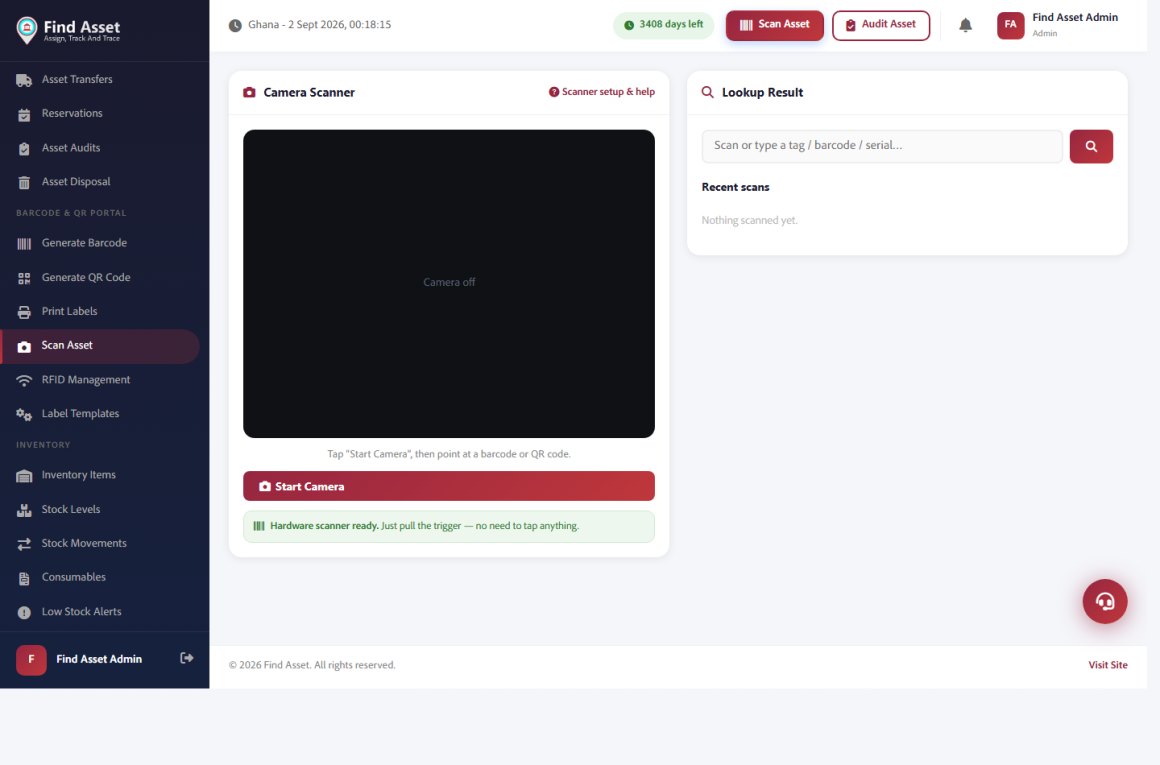
Bedside scanning is the habit that makes the whole system honest. When staff scan equipment as they take it and return it, the register's location data stays true without anyone filing paperwork. The scan takes seconds, works from the phone already in the nurse's pocket, and replaces the phone call to three wards asking who has the missing monitor.
Hospitals answer to inspectors, accreditation bodies, insurers, and their own quality units, and every one of them asks the same family of questions: show me the calibration certificates for these devices, show me the maintenance history of that autoclave, show me what happened to the equipment written off last year. A register built for this answers from the screen. Each device's record carries its inspections, calibrations, repairs, transfers, and eventual disposal, timestamped and attributable to a user.
Disposal records deserve particular care. Regulators and auditors increasingly ask hospitals to account for equipment that left the site, whether sold, donated, or scrapped. A register that recorded the disposal, its approval, and its date turns that query into a two-minute export instead of an investigation.
A pattern repeats in equipment-dense institutions: departments buy duplicates of devices they already own because the ones they own cannot be found when needed. The ward that cannot locate a spare monitor in the building orders another, the store room fills, and nobody can say what the true utilisation rate is. Over time the fleet grows while visibility of it shrinks.
A live register attacks that cycle from the data side. When every pump, monitor, and wheelchair is tagged and its movements recorded, the hospital can finally see utilisation by department: which devices sit idle in store rooms, which wards hold equipment bought by other units, and where one well-placed transfer could retire a purchase request. The register does not decide budgets, but it gives the people who do decide them facts they have never had before.
Running equipment tracking in Ghana adds specific realities worth planning for. Biomedical engineering units are often small relative to the fleet they serve, so the system has to carry scheduling, reminders, and record-keeping rather than adding admin work to a stretched team. Equipment arrives through donations and international procurement with different documentation standards, so the register needs to accept assets captured quickly at receipt and enriched later, rather than demanding a perfect record on day one. Power and connectivity vary between departments, which is why the mobile app is built to be light on the phones staff already carry, opening a device's record with one scan rather than a hunt through paperwork or phone calls. Public facilities, faith-based hospitals, and private clinics each answer to different oversight structures, but the register serves all of them the same way: it produces evidence. Whether the question comes from a ministry inspection, a church health services audit, or an internal management review, the answers live in the same system.
Implementation follows a plain sequence. First, the register is loaded, either by importing an existing spreadsheet of equipment or by capturing assets department by department, with custom fields for the details that matter to hospitals such as device class, manufacturer, serial number, and calibration interval. Second comes tagging day: each asset receives its QR, barcode, or RFID label and is scanned once to confirm the tag reads and the record matches the device. Third, wards and departments are set up with their custodians, and the teams who will scan daily are shown how; the mobile app is deliberately simple enough that a five-minute demonstration covers scanning, status, and lookup.
From then on the system runs on routine rather than effort. Calibration due dates and service intervals generate their own reminders. Transfers are recorded as they happen by the people doing them. Reports pull themselves together when inspection season arrives, and the biomedical team meets the auditors with a register instead of a search. Find Asset is web and mobile based, works across multiple sites from one account, and prices openly, with a free trial for the hospital to prove the workflow on its own equipment before committing to anything.
It is the tagging and registration of every medical device so the hospital can record where each asset is, who holds it, what condition it is in, and what service and calibration history it carries. Staff scan a tag with a phone or scanner and the device's full record opens immediately.
The dependable method is a shared digital register with a tagged fleet: every device carries a QR, barcode, or RFID label linked to its record, staff scan equipment as it moves or is serviced, and the system schedules calibration and preventive maintenance with reminders. Paper lists and spreadsheets fail in hospitals because they go stale the week after they are written.
Use laminated polyester or synthetic QR/barcode labels rated for cleaning chemicals, placed on a flat non-ventilated part of the housing away from controls and labels that clinical staff must read. The tag must survive the same wiping regime as the device itself. For metallic housings, use a tag rated for metal surfaces.
Intervals are set by the manufacturer and the hospital's biomedical policy, and they vary by device class: life-support and therapy equipment sits at the frequent end, while many monitoring and diagnostic devices follow six-monthly or annual cycles. The register should hold the interval per device and warn before each due date, because a missed calibration is a patient-safety issue, not a paperwork issue.
Most hospitals can run the majority of their fleet on QR or barcode labels scanned by phone, which is inexpensive and reliable. RFID adds value in specific places: automatic zone logging for high-value mobile equipment, gates at store rooms, and device classes where hands-free reading is worth the tag cost. A mixed fleet is normal: QR on most assets, RFID where it earns its keep.
Find Asset publishes its pricing openly on the pricing page, with plans covering small clinics through multi-site hospitals, and a managed service available where we design, print, and supply the tags and run the programme for you. Hospitals start with a free trial to test the workflow on their own wards before any commitment.
See how Find Asset helps your biomedical and facilities teams keep medical equipment tracked, maintained, and ready for care. Start tracking your hospital's assets today.
Start Free Trial