

Every physical asset an organization owns is quietly moving through the same five stages: it is bought, it is put to work, it is serviced, it loses value on a schedule, and eventually it leaves. Organizations that track those stages in one place make better decisions about repair, replacement, and budgets. Organizations that track them in fragments, a procurement file here, a repair log there, a depreciation spreadsheet somewhere else, keep rediscovering the same asset from scratch every time a question comes up. This guide walks through each of the five asset lifecycle stages, what belongs in the record at each one, and the decisions each stage feeds.
Stage 1: Acquisition
The lifecycle begins at the purchase. A complete acquisition record carries the asset name and description, a unique tag number, the purchase date, the cost, the vendor, the invoice or purchase order reference, and the warranty terms. Two of these matter more than organizations expect. The cost sets up every depreciation calculation that follows, so a missing or estimated cost contaminates the books for years. The warranty end date decides whether the first repair after year one is free or paid, and organizations without recorded warranty dates routinely pay for repairs their vendors owed them.
Registration is also where custom fields earn their place: engine numbers for vehicles, licence keys for software, calibration intervals for equipment. Whatever your organization will need later is cheapest to capture once, at entry.
Stage 2: Deployment and assignment
An asset earns nothing in the store room. Deployment moves it into service; assignment records who holds it, whether that is a person, a team, or a location. Each handover is an event with a date and a user, and the chain of those events is the custody history. When a laptop is issued in March, reissued to a new hire in August, and moved to a shared pool in December, the record reads as one clean story.
Custody history answers the expensive questions: who had this device when it was damaged, what does a departing employee still hold, how much of the fleet does each department actually carry. It also changes daily behaviour, because equipment moves less mysteriously once every move is recorded.
Stage 3: Operation and maintenance
The longest stage is also the noisiest. Every service, repair, inspection, and calibration belongs on the asset's own timeline, with parts, costs, findings, and the technician who did the work. Recorded this way, maintenance history becomes diagnostic: a printer that fails every quarter identifies itself, a vehicle whose repair spend climbs toward its resale value announces its own retirement. Recorded nowhere, the same failures stay invisible and keep being paid for one surprise at a time.
Preventive schedules belong in this stage too. Recurring service intervals generate due dates and reminders per asset, so the work the manufacturer expects happens on time, and the completed jobs join the same timeline the repairs live on.
Stage 4: Depreciation and financial reporting
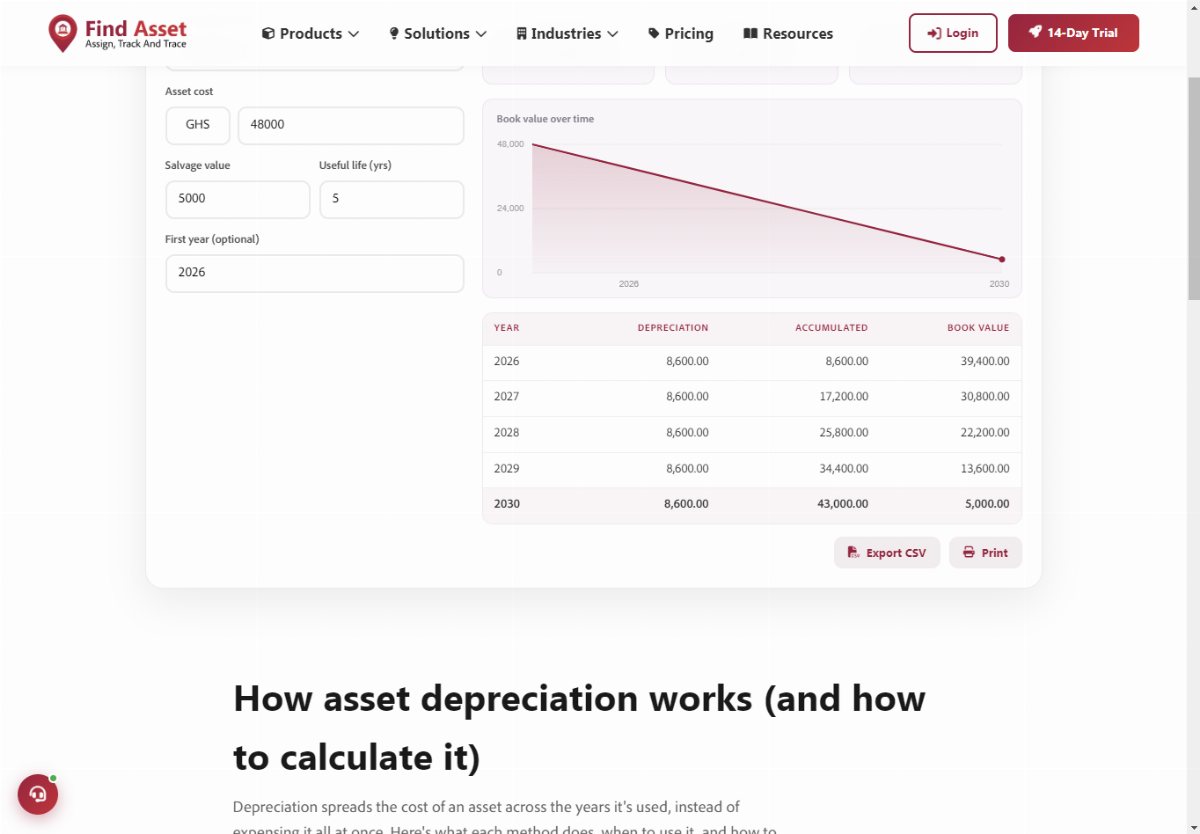
While operations sees condition and location, finance sees value declining on a schedule. Straight-line and reducing-balance depreciation run per asset or per category, and net book value updates continuously, so the register can answer what the fleet is worth today. At year end the numbers finance needs are already in the system, not buried in a reconciliation exercise.
The operational value of this stage is quieter: comparing physical condition against book value exposes the dead weight, fully depreciated machines still earning their keep, and half-depreciated ones nobody has seen in a year. Those comparisons feed write-offs, redeployments, and orderly disposals instead of balances that quietly rot. The schedules themselves are worked through in asset depreciation explained, and the free depreciation calculator on our tools page produces the same schedule for your own numbers.
Stage 5: Retirement and disposal
The end of the record is where auditors look hardest. A proper retirement captures the reason the asset left service, the disposal method, whether sale, donation, scrap, or transfer, any proceeds, and the date and the approver. The record then archives with its full history intact, because the organization may need to account for that asset years after it is physically gone. An asset that entered with a purchase order and leaves with a documented disposal closes the loop; anything less leaves a gap that audits, insurance claims, and leadership handovers eventually find.
Managing the stages in one place
The stages are only useful together. A lifecycle record that keeps acquisition, custody, maintenance, depreciation, and disposal on one timeline answers the compound questions no fragment can: what did this asset actually cost across its life, which assets are due for review, what is each department's fleet worth today. That is what dedicated asset lifecycle management software does, and our guide to asset lifecycle management software shows how Find Asset handles each stage on the same record. For the register that holds it all, start with what a fixed asset register is, and the register guide doubles as the capture checklist for stage 1.
What the five stages are really for
The stages are not paperwork. Each one exists to make a specific decision cheaper: acquisition records decide warranty claims, custody records decide disputes, maintenance history decides repair versus replace, depreciation decides budgets, and disposal records decide audits. Track the stages in fragments and every one of those decisions costs a hunt; keep them on one record and they cost a glance.