

Every asset your organisation owns is somewhere on the same journey. It was planned and paid for, brought into service and handed to someone, worked and maintained, and one day it will be retired and disposed of. That journey is the asset lifecycle, and whether you manage it deliberately or not, every laptop, vehicle, pump and projector is travelling through it right now.
The organisations that stay in control are the ones that treat the lifecycle as a single connected story rather than a series of unrelated events. A purchase decision made carelessly echoes for years; a disposal handled sloppily can cost more than the asset was ever worth. This article walks through each stage, why it deserves attention, and how a central register is the thread that ties them all together.
What the asset lifecycle actually is
The lifecycle is simply the full span of an asset's working life, broken into stages you can manage one at a time. Most people picture only the middle of it — the asset sitting on a desk or in a bay, doing its job — but that operational phase is bracketed by decisions at either end that shape everything in between. Planning and acquisition set the terms; deployment and assignment put the asset to work; operation and maintenance keep it useful; and retirement closes the book. Skip a stage in your thinking and you inherit its problems later.
What turns these stages from a tidy diagram into something genuinely useful is treating them as one continuous record rather than separate spreadsheets that never speak to each other. The purchase price recorded at acquisition, the custodian assigned at deployment, the maintenance logged during operation and the eventual disposal date all belong to the same asset, and their value multiplies when they sit together. Seen this way, lifecycle management is less a special discipline and more the natural consequence of writing everything down in one place and never losing the thread.
Planning and acquisition: the stage everyone rushes
The lifecycle begins before the asset exists on your premises, at the moment someone decides to buy it. This is the stage most organisations rush, because it feels like procurement's problem rather than asset management's. Yet the choices made here — what to buy, from whom, under what warranty, at what specification — lock in most of the cost and most of the risk you will live with for years. An underspecified machine bought to save money on day one becomes the one that breaks constantly and gets replaced early.
Getting acquisition right means thinking past the sticker price to the whole-life cost — purchase, running costs, maintenance, downtime and eventual disposal added together. It also means capturing the asset in your register the moment it arrives, complete with its purchase date, cost, supplier and warranty terms, rather than months later when half those details have been forgotten. An asset that enters the system properly at birth carries clean information through every stage that follows; one that slips in unrecorded starts life already invisible, and stays that way until something goes wrong.
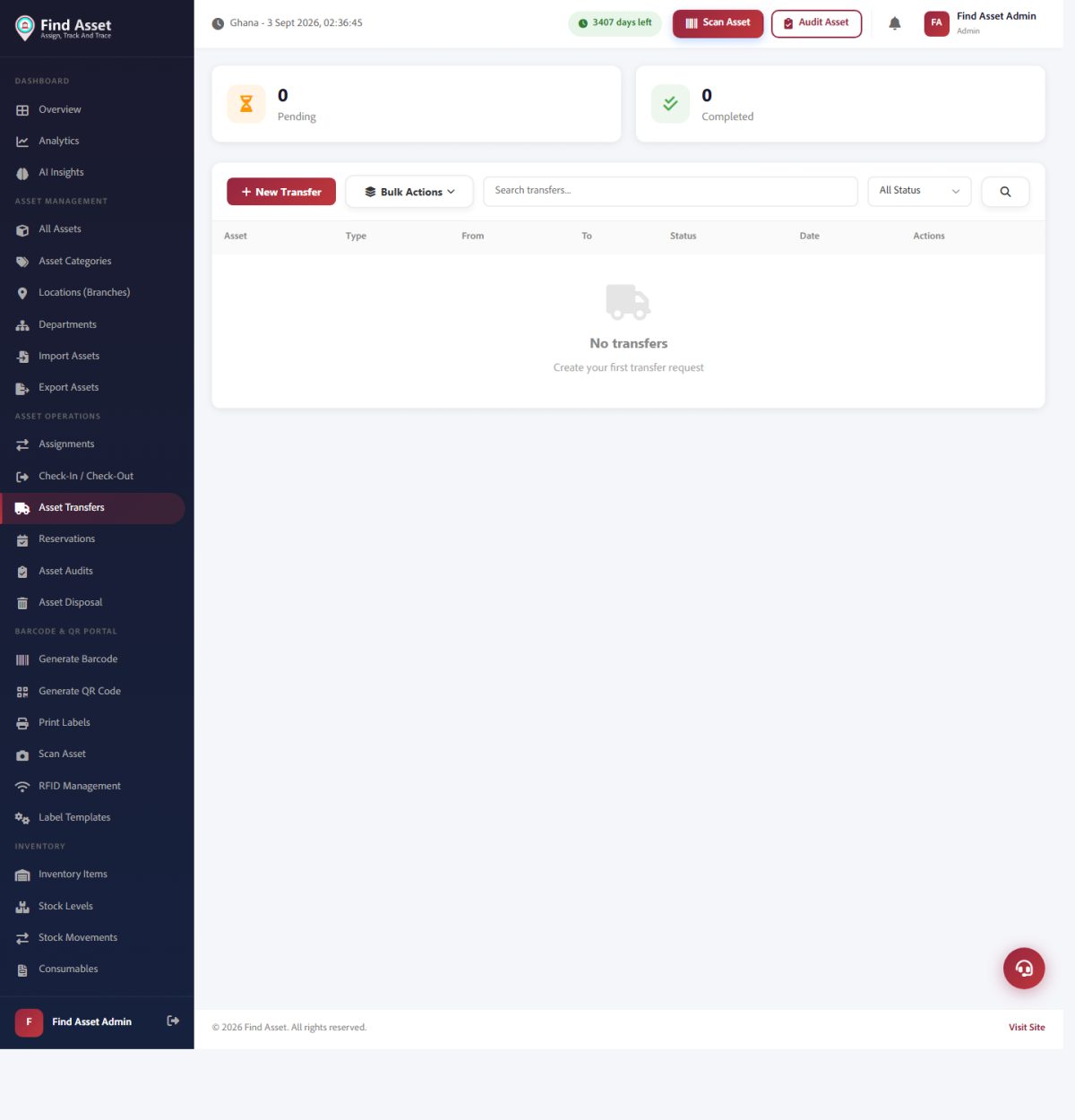
An asset's life is a sequence of moves: received, assigned, transferred, serviced, and eventually retired. Find Asset's transfers screen (above) records each relocation between locations or branches with a date and destination, so the register always reflects where a thing actually is — the backbone of real lifecycle management.
Deployment and assignment: giving the asset a home
Once an asset is received and recorded, it has to go somewhere and belong to someone. Deployment is the act of putting it into service; assignment is the record of who holds it and where it lives. This is where a surprising amount of loss quietly begins, because an asset issued without a documented custodian is an asset nobody is accountable for. When it goes missing, there is no one to ask and no trail to follow — it simply evaporates from the organisation's memory.
Handled well, deployment is a small ceremony that pays off for the asset's whole life. A tag goes on, a custodian is named, a location is set, and the register now knows exactly what this asset is and who answers for it. With Find Asset that assignment is a couple of taps, and the scan of a tag brings up the full record in the field, so a handover is logged the moment it happens rather than reconstructed later from memory. The discipline is not bureaucratic for its own sake; it is what makes every later stage — the audit, the maintenance visit, the eventual retirement — possible at all.
Operation and maintenance: the long middle
The operational phase is where an asset spends most of its life and earns its keep, and it is also where good management is quietest and most valuable. An asset in use drifts: it moves between locations, changes hands, wears down, breaks and gets repaired. Tracking that drift is what keeps your register honest, and it is why a scan-based check — walking the floor with a phone, confirming each tag against the record — matters so much. Without it, the register and reality slowly diverge until nobody trusts either.
Maintenance is the other half of this stage, and neglecting it is how a repairable asset becomes a write-off. A programme of preventive maintenance — servicing on a schedule rather than waiting for failure — extends useful life and prevents the expensive surprises that come from running equipment into the ground. Logging each service against the asset also builds a history that feeds directly into the retirement decision later: an asset with a thick file of costly repairs is telling you, in plain numbers, that its remaining life is short. This is the stage where the true total cost of ownership reveals itself.
Retirement and disposal: the stage everyone forgets
Every asset eventually reaches the end of its useful life, and how you handle that ending matters far more than most organisations expect. Retirement is the decision to take an asset out of service; disposal is what physically happens to it afterwards — sold, scrapped, donated or recycled. Neglect this stage and "ghost" assets accumulate: items long broken or gone that still sit in the register, inflating your asset count, distorting depreciation, and wasting audit time as people hunt for things that no longer exist.
Done properly, retirement is a clean, recorded close to the asset's story. The register captures why it was retired, what it was worth at the end, and where it went — which matters for accounting, for compliance, and sometimes for data security when the asset held sensitive information. A disposal that is documented protects you if anyone later asks what happened to a valuable item; one that is not leaves a gap that looks, to an auditor, indistinguishable from theft. Our guide on how to retire and dispose of an asset walks through doing this cleanly.
The register that ties every stage together
Read back through the stages and one thing appears in every single one: the register. Acquisition writes the first record; deployment adds the custodian and location; operation updates the movement and condition; maintenance appends the service history; retirement closes it out. The stages are not really separate systems at all — they are chapters in one continuous record, and the register is the book that holds them in order.
This is why lifecycle management falls apart the moment the record is scattered across spreadsheets, email threads and people's memories. When acquisition data lives in finance, assignment lives in a departmental sheet and maintenance lives in an engineer's notebook, no one can see an asset's whole life, and every stage loses the context the others would have given it. A central register like Find Asset exists precisely to keep that thread unbroken, so that scanning one tag tells you everything from purchase to present in a single view.
| Lifecycle stage | What goes wrong if you neglect it |
|---|---|
| Planning & acquisition | Underspecified buys and missing purchase data haunt the asset for years |
| Deployment & assignment | No custodian means no accountability — losses begin here |
| Operation & tracking | Register and reality drift apart until neither is trusted |
| Maintenance | Repairable assets become early write-offs |
| Retirement & disposal | Ghost assets inflate counts and look like theft to auditors |
Managing the whole lifecycle
- Treat the lifecycle as one connected story, not five unrelated events.
- Record an asset the moment it arrives, with purchase date, cost and warranty.
- Always assign a custodian and location — accountability starts at deployment.
- Track movement and log maintenance so the register stays honest.
- Close the book properly at retirement to avoid ghost assets.
From purchase order to disposal slip
The asset lifecycle is not a piece of theory to admire on a slide; it is simply the honest shape of what happens to everything you own. Plan and acquire deliberately, deploy with a named custodian, track and maintain through the long middle, and retire cleanly at the end — and the whole span becomes something you manage rather than something that surprises you. The cost of neglect always lands at the edges: a careless purchase at the start, or an undocumented disposal at the finish, each quietly more expensive than the operational middle everyone actually watches.
What holds it all together is the discipline of keeping one unbroken record from the first day to the last. If you would rather manage every stage in a single place — recording assets on arrival, assigning them with a scan, logging maintenance and closing them out properly — you can start a free 14-day trial and put your first assets through their whole lifecycle in an afternoon. Get the thread right early, and every later stage looks after itself.