

When an external auditor walks into a finance office at year end, one of the first things they ask for is the fixed asset register. Not the bank statements, not the payroll, the register. It is the single document that connects a line on the balance sheet to a physical object you can walk over and touch. And more often than not, the version that gets handed over is a spreadsheet that has not been reconciled to reality in eighteen months.
That gap is where audit findings, misstatements and awkward management letters come from. A fixed asset register is not a bureaucratic formality; it is the evidence that the value you are claiming for your property, plant and equipment actually exists, is owned by you, and is worth what you say it is. This guide explains exactly what belongs in that register, why auditors care so much about it, and how to build one that survives scrutiny rather than triggering it.
What a fixed asset register actually is
A fixed asset register is a structured record of every long-lived item your organisation owns and uses to generate value: laptops, vehicles, generators, laboratory equipment, furniture, land and buildings. Unlike inventory, which you buy to sell, these are assets you keep and depreciate over years. The register is the bridge between the physical world and the general ledger.
Crucially, it is not the same thing as your accounting system's asset module, though the two must agree. The accounting module knows an asset cost 42,000 cedis and has 18,000 of accumulated depreciation. The register knows that same asset is a Toyota Hilux, registration GT-4821-22, currently assigned to the Tamale field office, last physically verified in March. Auditors need both halves, and they need them to reconcile to the last pesewa.
Why auditors care so much
Auditors are not being difficult for its own sake. Under most reporting frameworks, including IFRS as applied across Ghana and much of Africa, an organisation must prove three things about the assets on its balance sheet: that they exist, that the entity controls them, and that they are valued correctly. The register is the primary evidence for all three.
Consider what happens without one. If you claim 2.4 million cedis of equipment but cannot produce a list showing what each item is and where it sits, the auditor cannot verify existence. They may propose a write-down, qualify their opinion, or expand testing at your expense. A well-kept register lets them pull a sample of twenty items, walk to twenty locations, scan twenty tags and sign off. It is the difference between a two-day audit and a two-week one.
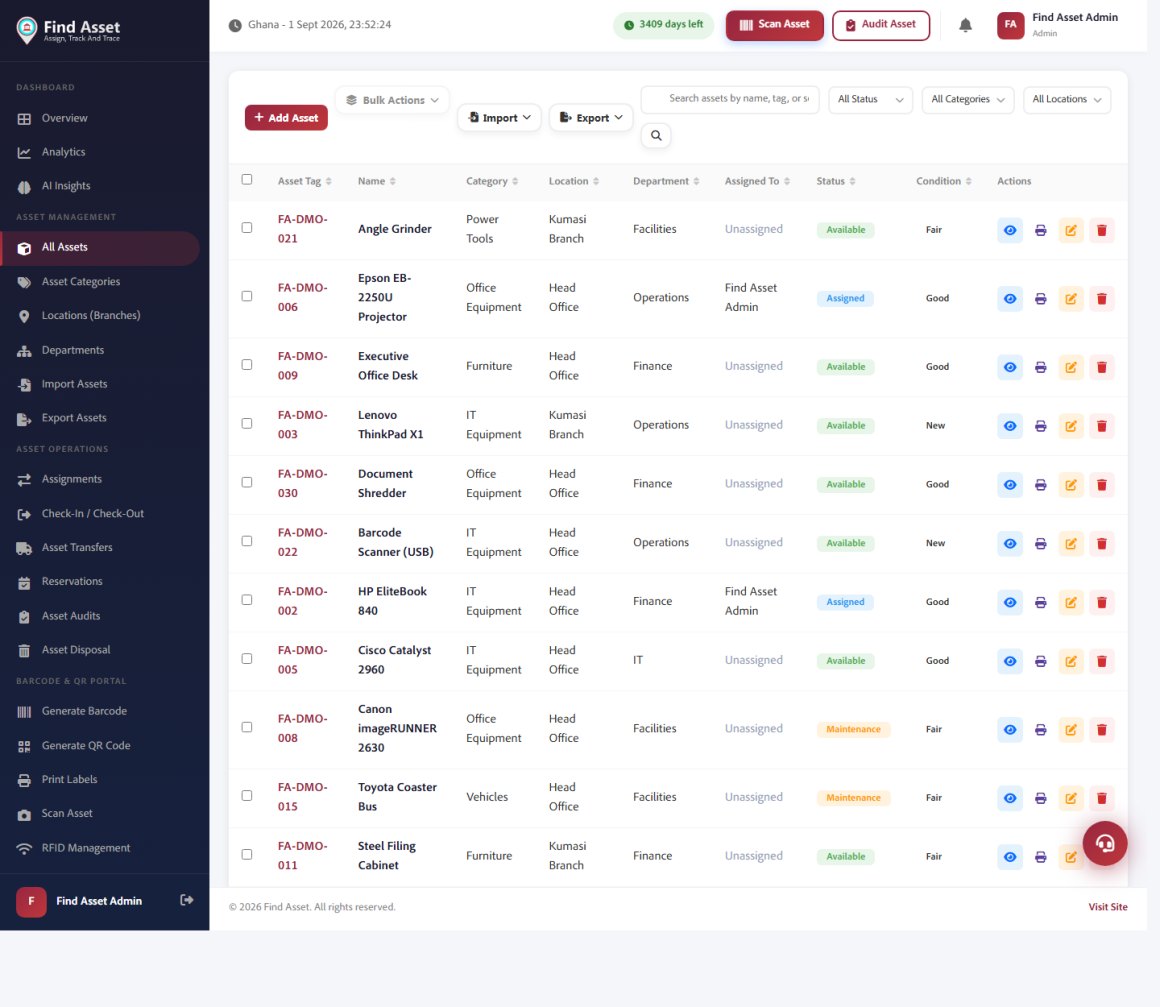
This is what that register looks like when it is live rather than sitting in a spreadsheet. In Find Asset, every item carries a unique tag (for example FA-DMO-021), a name, a category, the branch it lives in, the department that owns it, who it is assigned to, and its current status and condition — and every column is searchable and filterable. That is the difference a real register makes: one place your whole team can query, scan and trust.
What every register must contain
A register that satisfies an auditor goes well beyond a description and a price. Each asset record should carry enough detail to identify it uniquely, trace its financial history, and locate it physically. Skimp on any of these fields and you create the exact ambiguity that audits are designed to catch.
| Field | Why it matters | Example |
|---|---|---|
| Unique asset ID | Prevents the same item being counted twice or missed entirely | FA-2024-0413 |
| Acquisition date and cost | Anchors the depreciation schedule and proves ownership | 12 Feb 2024, GHS 42,000 |
| Depreciation method and rate | Lets the auditor recompute carrying value independently | Straight line, 5 years |
| Location and custodian | Makes physical verification possible | Tamale office, K. Mensah |
| Condition and status | Flags impaired, idle or disposed items | In use, good |
Notice that the last three fields are operational, not financial. This is where most spreadsheet registers fall apart: the finance team maintains the cost columns diligently but nobody updates location or custodian, so the register drifts from reality even as the numbers stay tidy.
Tag before you list
The most common mistake is building the register first and worrying about physical identification later. It should be the other way round. Before an asset earns a row in the register, it should earn a durable, scannable tag bonded to the equipment itself. A number that exists only in a spreadsheet is a claim; a barcode label on the chassis is proof.
This matters enormously at audit time. When the auditor picks item FA-2024-0413 from the register and asks to see it, a tagged asset is found in seconds with a phone scan. An untagged one sends three people rummaging through a store room. If you are still deciding what to put on the equipment, our guide on how to choose asset tags covers durability, adhesives and placement for African operating conditions.
Signs your register would fail an audit
- Assets are described inconsistently, so the same generator appears twice under different names.
- The register total does not reconcile to the general ledger figure for property, plant and equipment.
- Location and custodian fields are blank, generic ("IT"), or years out of date.
- Disposed and stolen items still sit on the register, inflating your asset base.
Keep depreciation defensible
Depreciation is where a register earns its keep in the financial statements. Every asset needs a method, a useful life and a residual value, applied consistently. Auditors will independently recompute a sample: if your register says a 42,000 cedi vehicle on a five-year straight line is in year two, they expect roughly 16,800 of accumulated depreciation, and they will check.
The register should also handle the messy edges honestly, including partial-year acquisitions, revaluations and impairments. When a piece of equipment is damaged beyond economic repair, it must be impaired or written off in the register, not quietly left carrying value. For the underlying mechanics, our explainer on asset depreciation explained walks through the common methods without the jargon.
Reconcile continuously, not once a year
The organisations that dread audits are the ones that treat the register as an annual chore. They rush a stock-take in the fortnight before the auditor arrives, discover forty missing items, and spend the audit explaining variances. The organisations that breeze through do the opposite: they reconcile in small, continuous cycles all year.
Cycle counting, where you verify a rotating slice of the register each month, spreads the workload and surfaces problems while they are still fixable. By the time year end arrives there is nothing to catch up on, because the register never fell out of step. If you have never run a structured verification, our walkthrough on how to run your first asset audit gives you a repeatable process.
Move it off the spreadsheet
A spreadsheet register works until it does not, and the failure is always the same: no version control, no audit trail, and updates that depend on one person remembering to type them in. The moment two people edit two copies, you have two versions of the truth, and an auditor can smell that within minutes.
A purpose-built system fixes this by making the register the single source of truth, with every scan, transfer and disposal logged automatically. The custodian who moves a laptop scans it into its new location on the spot, and the register updates itself. That audit trail, showing who touched what and when, is exactly the assurance an external auditor is looking for, and it turns the whole exercise from an interrogation into a formality.
There is a threshold at which the spreadsheet stops being a false economy and becomes a genuine risk, and most organisations pass it without noticing. Somewhere around a few hundred assets, or the moment items are spread across more than one site, a single shared file simply cannot keep up with the pace of movement. Branch staff email in changes that sit unread, two versions circulate with subtly different totals, and the one person who understood the layout goes on leave. Recognising that moment early and moving to a system built for the job is far cheaper than discovering the gap during an audit, when every unexplained variance costs you time, credibility, and sometimes a qualified opinion.
Bringing it together
A fixed asset register is not really a finance document or an operations document; it is the place where the two meet and have to agree. Auditors care about it because it is the only evidence that ties a number on your balance sheet to a real object with a real custodian in a real location. Get the fields right, tag before you list, reconcile continuously, and the annual audit stops being something to survive.
One register in Find Asset holds all of it: a permanent scannable identity per asset, depreciation and custodian tracked together, and a movement log that lets the audit trail write itself. If your assets still live across a scatter of spreadsheets, start a free 14-day trial and build a register your auditor will thank you for. For the wider accounting context, the background on fixed assets is a useful primer.