
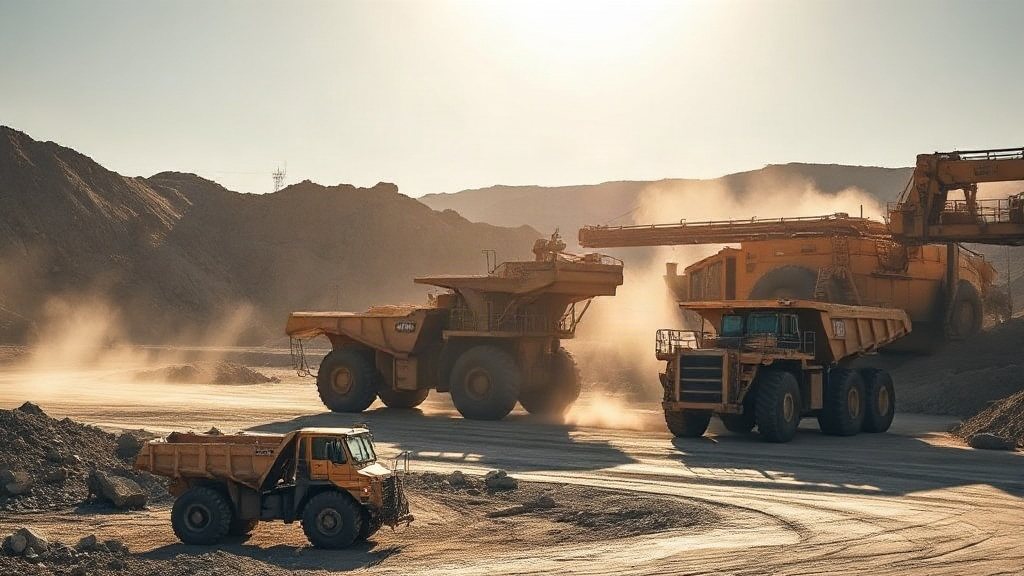
Few industries are as hard on their own equipment as mining. Dust coats everything, vibration loosens what it does not crack, water and processing chemicals eat at surfaces, and the sun does the rest. The plant that digs, hauls and crushes is enormously valuable, some of it is safety-critical, and almost none of it sits still in a tidy office where a paper sticker would last a lifetime.
Against that backdrop, keeping an accurate register of what you own, where it is and when it was last inspected stops being administrative housekeeping and becomes part of running the operation safely. A mine that cannot say with confidence which excavator carries which certified component, or when a gas detector was last calibrated, is exposed in ways that have nothing to do with paperwork and everything to do with people underground.
What a mine actually has to keep track of
Mining assets do not fall into one neat category, and that is the first thing a register has to accommodate. There is fixed plant that never moves — crushers, conveyors, mills, pumps and generators bolted into a processing line. There is mobile equipment that moves constantly and expensively — excavators, haul trucks, loaders, dozers and light vehicles. Then there are the smaller populations that are easy to overlook precisely because they are numerous: hand tools, portable instruments, spares held in the store, and the safety gear that regulators care about most of all.
Each of these behaves differently and needs tracking for different reasons. Fixed plant matters for maintenance scheduling and downtime; mobile equipment matters for custody, utilisation and very high replacement cost; safety gear — self-rescuers, harnesses, gas monitors, respirators — matters because an out-of-date or missing item is a compliance failure with real consequences. A register that treats all of them as one undifferentiated list quickly becomes useless. The trick is a single system flexible enough to hold every type, with the category, location and criticality recorded against each so the differences are visible rather than lost.
Why an ordinary label does not survive the pit
The label problem in mining is not a minor inconvenience; it is the difference between a register you can trust and one you cannot. A printed paper sticker under laminate, perfectly adequate on an office laptop, has no future bolted to a haul truck. Abrasive dust sandblasts the surface, diesel and hydraulic fluid dissolve adhesives, high-pressure washdowns lift edges, and constant vibration works a tag loose until it is gone. When the tag disappears, the asset effectively drops out of the register, and the count you took last quarter quietly stops meaning anything.
What survives is a different class of tag altogether. Metal or heavy industrial polymer plates, mechanically fixed rather than merely stuck, or laser-etched and engraved marks that cannot rub off because there is no coating to lose, are what hold up where equipment is worked hard. Choosing the right one is a small engineering decision in its own right, and it is worth reading up on durable asset label materials before committing a whole fleet to a tag that will not last a rainy season underground. The register is only as reliable as the physical link between the record and the machine.

Inspection and maintenance history that hangs off each asset
An asset record in mining earns its keep not on the day it is created but every time something is done to the machine afterwards. A haul truck is not simply a haul truck; it is a haul truck with a service due next month, a brake inspection signed off two weeks ago, and a certified lifting component with an expiry date that a regulator may ask about without warning. The value of the register lies in hanging that history off the asset itself, so the full story of any machine travels with its record rather than living in a maintenance supervisor's memory or a stack of paper in a site office.
Scheduled inspection is where this really pays. Safety-critical equipment carries fixed intervals — calibration, pressure testing, load certification, statutory examination — and missing one is not a clerical slip but a genuine hazard. When each asset carries its own schedule and its own log of past inspections, the system can surface what is due before it lapses, and an inspector or auditor can be shown a complete, dated trail on demand. This same discipline of maintenance-by-asset underpins other heavy-equipment sectors too, and the parallels with asset management for construction are close enough that the tooling largely transfers.
One register across pits, plants and remote sites
Mining operations are rarely a single location. A working mine sprawls across open pits or shafts, a processing plant, workshops, fuel bays, stores and often several satellite sites, some of them a long drive from the nearest office and patchy on connectivity. Equipment moves between them — a pump pulled from one line and fitted to another, a light vehicle reassigned across sites, a spare drawn from a central store to a distant pit. If each site keeps its own list, the lists disagree, and the moment an asset crosses a boundary its custody becomes a guess.
A single shared register cuts through that. When every site draws on the same system, a transfer is a recorded event rather than an item vanishing from one spreadsheet and, maybe, appearing in another. Custody stays clear because the record always names a current location and holder; compliance stays clear because inspection status is visible wherever the asset physically sits. The logistical discipline here echoes the wider world of moving valuable things between sites, which is why the thinking behind asset management for logistics and warehousing reads as surprisingly familiar to anyone managing a multi-pit operation.
Custody and accountability when equipment is worth a fortune
The sheer value concentrated in mining plant changes the stakes of getting custody wrong. A single haul truck or excavator represents a capital outlay that dwarfs an entire office of computers, and the fleet of them is often the largest asset on the books. When something that valuable is unaccounted for, the question is not merely where it went but who was responsible for it and when the trail went cold. A register that records custodian, location and movement history turns that from an argument into a lookup.
Accountability also matters for the smaller, more portable items that walk off far more easily than a dozer ever could. Instruments, power tools and safety equipment are the assets most likely to go missing and, being cheaper individually, the ones least likely to be chased — right up until an audit or an incident makes their absence expensive. Recording who holds what, and making transfers deliberate rather than casual, quietly raises the standard of care across the whole operation. People treat equipment differently when they know it is signed out in their name and the record does not forget.
Why this matters in a mining economy like Ghana
The case for disciplined asset management sharpens in places where the sector is large and long-established. In Ghana, where mining in Ghana is a significant part of the economy, operations run at scale across multiple regions, mixing heavy fixed plant, large mobile fleets and strict safety obligations. The conditions that punish ordinary labels — heat, dust, humidity and hard use — are exactly the ones found on the ground, and the regulatory expectation to demonstrate maintenance and inspection is real.
None of this requires anything exotic; it requires the same fundamentals applied consistently. A durable tag on every asset, a single register that spans every site, and an inspection history that travels with each machine will carry an operation a long way, whether it runs one pit or several. The point is not the software for its own sake but the confidence it buys: being able to answer, quickly and accurately, what you own, where it is, who holds it, and whether it is safe and certified to be in use.
The distinctive asset challenges of mining map neatly onto a short set of practices, and it is worth seeing them together before deciding where to start.
| Mining challenge | What the register needs to do |
|---|---|
| Harsh, dusty, high-vibration conditions | Durable metal or engraved tags that stay fixed and readable |
| Very high-value heavy plant | Clear custody, location and movement history per asset |
| Safety-critical equipment | Scheduled inspection with dated, auditable history |
| Remote, multi-site operations | One shared register spanning pits, plants and stores |
| Mixed asset types | Categories that separate fixed plant, mobile gear, tools and safety kit |
What keeps a mining register trustworthy
- Use durable, mechanically fixed or engraved tags that survive dust, vibration and washdown.
- Track every class of asset — fixed plant, mobile equipment, tools, spares and safety gear.
- Hang inspection and maintenance history off each asset so it travels with the machine.
- Run one shared register across every pit, plant and remote site.
- Record custodian and movement so accountability survives every transfer.
Bringing it together
Mining tests both the equipment and the systems meant to keep track of it. The environment is punishing, the assets are valuable and safety-critical, and the operation is spread across sites that do not always talk to each other. The response is not complicated, but it must be consistent: durable tags that survive the pit, a single register that spans every location, and an inspection history recorded against each asset so nothing safety-critical slips past its date unnoticed.
Get those foundations right and the harder questions — utilisation, replacement planning, audit readiness — rest on ground you can trust rather than a set of disagreeing spreadsheets. If you would rather build that register once and let the system carry the custody, scheduling and inspection trail for you, you can start a free 14-day trial and have your first assets tagged and tracked before the shift is out.