
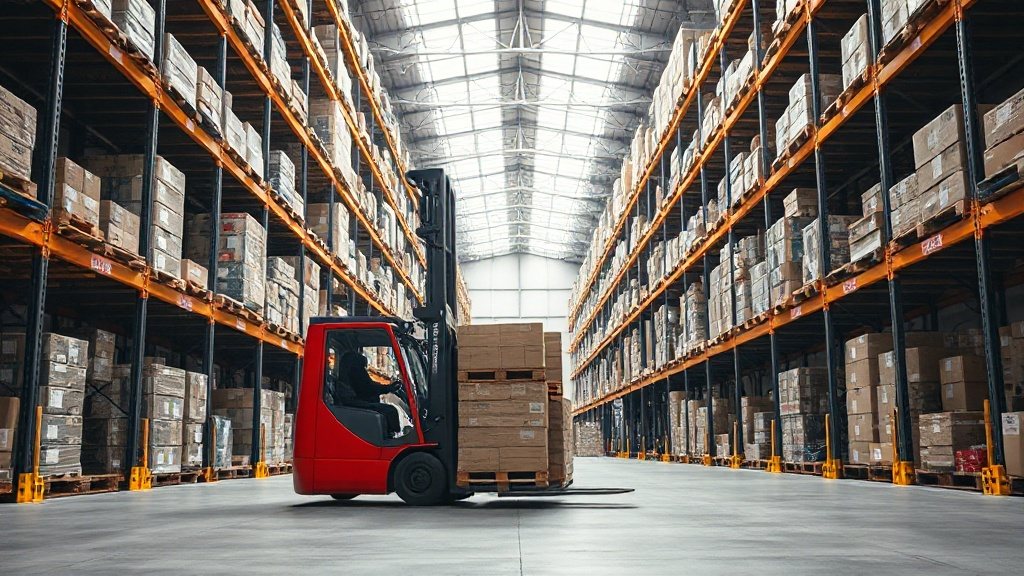
A busy warehouse can look, at a glance, like a single flowing system: goods arrive at one dock, move through picking and packing, and leave from another. But underneath that flow sits a quieter category of things that never leaves with the lorry. The forklifts, the racking, the handheld scanners, the pallets and cages that circulate between sites — these belong to the operation itself. They are the machinery of movement rather than the cargo being moved, and they are, in the truest sense, assets.
It is worth drawing that line clearly at the start. The stock flowing through your building — the pallets of goods you store and dispatch for customers — is inventory, and it is managed by a warehouse management system built for exactly that purpose. What we are concerned with here is different: the equipment your logistics or warehousing business owns and depends upon. That distinction matters, because the two are easy to conflate and yet demand very different discipline. Inventory is counted and shipped. Assets are maintained, inspected, moved between sites, and quietly relied upon until the day one of them fails.
The moving fleet inside your four walls
Materials-handling equipment is the beating heart of any warehouse, and it is rarely still. Forklifts, reach trucks, pallet jacks and order pickers travel thousands of small journeys a day, and in a multi-site operation they travel between buildings as demand shifts. A reach truck bought for one depot ends up covering a peak at another; a pallet jack borrowed for a weekend never quite comes back. Because this equipment is both valuable and constantly in motion, it is precisely the sort of asset that slips out of view — not stolen, just misplaced across a network that never stops moving.
Knowing what you own and where it currently sits is the foundation everything else rests on. When each machine carries a unique identity and a home location, the question "how many working reach trucks do we actually have at the Midlands site this morning?" stops being a phone-around and becomes a lookup. That visibility also changes how you buy. Operations that can see genuine utilisation across their fleet tend to discover they have been hiring extra machines to cover a shortage that was really a distribution problem — kit sitting idle at one site while another paid a premium for short-term cover.
Safety-critical equipment and the record that proves it
Handling equipment is not merely expensive; it is safety-critical. A forklift is a heavy, powerful machine operating around people on foot, and the law and good practice both expect it to be inspected, serviced and checked before use. Daily pre-use checks, periodic thorough examinations and scheduled maintenance are not optional niceties — they are the difference between a controlled operation and an accident waiting for its moment. The trouble is that these obligations generate paperwork, and paperwork scattered across clipboards and inboxes has a way of being unfindable on the one day it is needed.
This is where treating equipment as a tracked asset earns its keep. When every forklift, every piece of dock equipment and every powered machine has its own record, the inspection history, service dates and next-due reminders live in one place, attached to the thing itself. If an inspector asks, or if an incident needs investigating, the trail is complete and immediate. Building maintenance around the asset rather than around a spreadsheet also means the system can prompt you before a thorough examination lapses, rather than after. For a broader view of how to keep those routines consistent, our notes on tracking best practices are a sensible companion to this section.
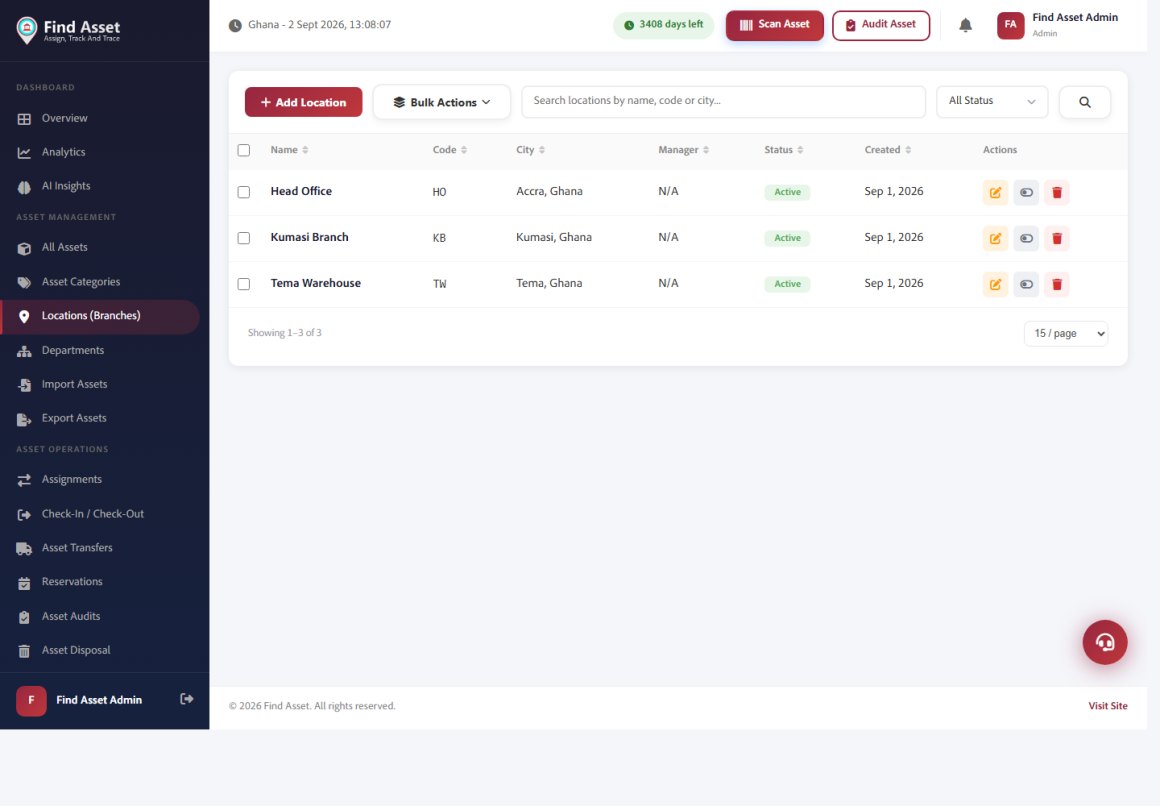
Logistics runs across sites, and Find Asset models that directly. The locations screen below defines each branch, warehouse and depot — code, city, manager and status — so every asset is pinned to a real place and can be filtered, transferred and audited by site. For a warehouse operation, knowing exactly what sits where, across every location, is the whole game.
Returnable transport items, where value quietly leaks
Ask most warehouse managers where they lose money on equipment and they will mention the machines. Ask them again, more carefully, and the answer is often the small stuff: the pallets, the cages, the roll cages, the totes and trays that circulate endlessly between your sites, your suppliers and your customers. These returnable transport items are cheap individually and enormous in aggregate. Because no single one feels worth chasing, the whole pool bleeds away — a cage that leaves on a delivery and never returns, a stack of totes absorbed into a customer's own operation, a set of pallets that simply vanishes into the churn.
The instinct is to write this off as a cost of doing business, but it rarely needs to be. Returnable items respond well to being treated as assets with an owner and a location, especially when they move in identifiable batches or pools rather than one by one. Assigning custody at each handover — this pool of cages went out with that consignment, to that customer, on that date — turns an invisible leak into a visible balance. You will not recover every last tote, but knowing the true rate of loss, and where it happens, lets you decide whether to deposit-charge, to reclaim more actively, or simply to size your pool honestly rather than endlessly topping it up.
Shared assets and the discipline of custody
A warehouse rarely sleeps, and the equipment that runs through a day shift is the same equipment the night shift picks up. Scanners and handheld terminals, in particular, are shared, portable and easy to walk off with — pocket-sized, valuable, and used by dozens of hands across a week. When nobody is accountable for a given device at a given time, two things happen: devices go missing without anyone noticing until the count comes up short, and faults go unreported because the person who broke it is long gone by the time the next shift finds it dead.
Clear custody is the antidote, and it is more a habit than a technology. When an asset is checked out to a named person or a station at the start of a shift and checked back in at the end, responsibility has a face. Handovers between shifts become a moment of reckoning rather than a shrug, and the small accountability of signing for a scanner tends to make people treat it with a little more care. The same logic extends to keys, radios and any tool that passes between hands — the goal is simply that at any hour you can say who holds what, and that the record survives the shift change.
| Asset type | Why it needs tracking | What the record should hold |
|---|---|---|
| Forklifts and reach trucks | High value, safety-critical, mobile across sites | Inspection and service history, next-due dates, current location |
| Pallet jacks and order pickers | Numerous, easily borrowed and not returned | Home site, assigned team, condition status |
| Returnable transport items | Value leaks quietly through everyday movement | Pool identity, custody at handover, loss rate |
| Scanners and handhelds | Portable, shared across shifts, easy to misplace | Current custodian, check-out and check-in times, fault log |
| Dock and cold-store equipment | Fixed but critical, failure halts throughput | Maintenance schedule, warranty, downtime history |
| Vehicles and trailers | Move between yards and public roads | Location, compliance dates, assigned driver |
Across sites and out into the yard
Few logistics operations live in a single building. Equipment spreads across depots, hubs and cross-dock facilities, and beyond the walls lies the yard, where trailers, swap bodies, cages and vehicles sit in a space that is neither fully inside nor properly out. The yard is a notorious blind spot: assets parked there are technically on site but practically invisible, and a trailer in the wrong bay might as well be in another county for all the time it takes to find. Multi-site working multiplies the problem, because an asset's absence at one location and its unexpected presence at another are two halves of the same untracked movement.
A single record that spans every site closes that gap. When location is a first-class part of each asset's identity, moving a machine from one depot to another is a deliberate, logged event rather than a quiet disappearance. You can see the true distribution of your fleet across the network, spot the site that is always short and the one that is always hoarding, and treat the yard as a real location with its own contents rather than a car park you hope is full of the right things. The same principles that govern equipment on a busy site apply here, much as they do in other heavy-equipment worlds — our piece on asset management for construction covers the multi-site movement problem from a different but familiar angle.
What good looks like
- Every machine, scanner and returnable pool has a unique identity and a known location.
- Inspection and maintenance records live with the asset, with next-due dates that prompt you in advance.
- Shared equipment is checked out to a named custodian and reconciled at each shift change.
- Returnable transport items are tracked in pools so loss becomes a visible, decidable number.
- One record spans every site and the yard, so movement is logged rather than guessed.
Scanning for a fast-moving floor
None of this discipline survives if capturing it is slow. A warehouse floor moves at pace, and any system that asks a picker or a driver to stop and type is a system that will be quietly abandoned by lunchtime. This is why barcode and RFID scanning suit the environment so naturally: a scan is a single, near-instant gesture that records identity, location and custody without breaking stride. Barcodes are inexpensive and reliable for deliberate, line-of-sight checks — signing out a scanner, confirming a forklift's location, logging an inspection. RFID goes further where volume and speed demand it, reading tagged items in bulk as they pass a portal, which is exactly the sort of thing a busy dock or a returnable-item pool benefits from. For the wider industry context, it is worth remembering how much of this discipline underpins modern warehousing as a whole.
Choosing between the two is less a doctrine than a fit to the task, and most operations end up using both — barcodes where a considered scan is right, RFID where the sheer flow of items makes individual scanning impractical. What matters is that the method matches the tempo of the floor, so that recording an asset's movement costs seconds rather than minutes and therefore actually happens.
Bringing it together
The equipment that runs a logistics or warehousing operation is easy to take for granted precisely because it is always there — until a forklift fails an inspection you cannot evidence, a scanner goes missing between shifts, or a season's worth of cages quietly disappears into the network. Treating that equipment as a managed asset, with identity, location, custody and a maintenance history, turns each of those failures from a surprise into something you saw coming. If you are ready to put a single record under your fleet, your returnables and your handhelds, you can start a free 14-day trial and begin with whatever is causing you the most pain today.
Start small and let the discipline earn its place. Tag your machines and give them a maintenance schedule; put your scanners on a check-out routine; bring one returnable pool under proper custody and watch the loss rate come into focus. A sensible first step for many operations is simply to establish what they truly own and where it sits, and our guide on how to run your first asset audit is a calm place to begin. From there, the flow through your building looks the same to a customer — but the machinery of movement beneath it is finally something you can see.