
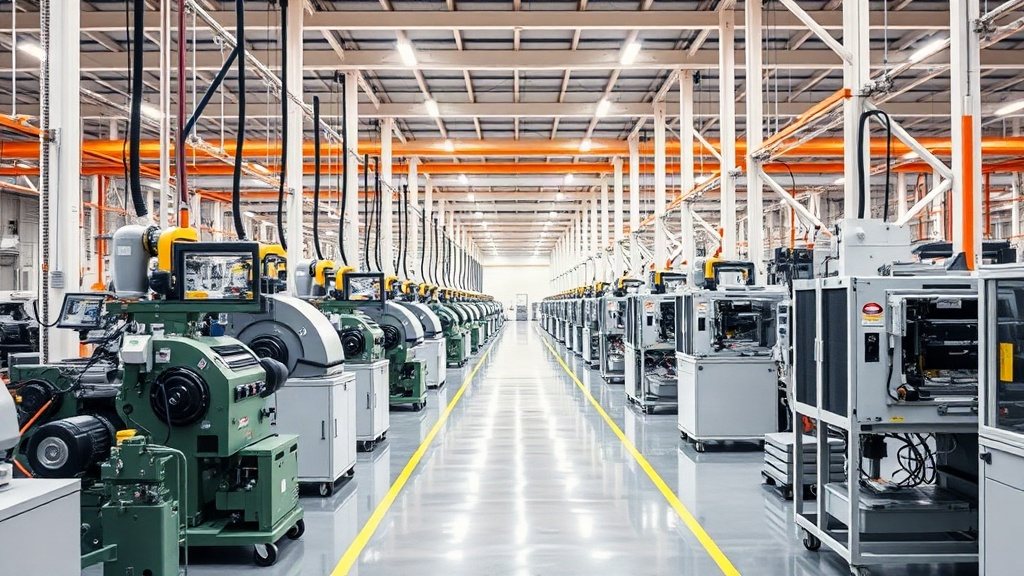
On a manufacturing floor, an asset is rarely just a thing on a register. It is a machine that, when it stops, stops everything downstream of it — a line idled, an order slipping, operators standing around while a fitter hunts for the right spare. Manufacturers do not track assets for the tidiness of it; they track them because a missing tool, an overdue service or an out-of-calibration gauge translates directly into lost hours and scrapped product.
That is what makes asset management in a factory a different discipline from managing a fleet of laptops. The assets are heavier, the consequences of losing sight of one are sharper, and the whole system has a single overriding enemy: unplanned downtime.
Downtime is the enemy everything else serves
Ask a plant manager what keeps them awake and the answer is rarely the value of the machinery on the books — it is the machine that fails without warning halfway through a shift. Unplanned downtime is expensive in ways that never appear neatly on an invoice: idle labour, missed delivery windows, the rushed repair that costs more than a planned one would have. Every other part of a manufacturer's asset system exists ultimately to keep that from happening.
The honest truth is that you cannot eliminate downtime, only shift more of it from unplanned to planned. A machine serviced on a schedule you chose is an inconvenience; the same machine seizing mid-run is a crisis. So the goal here is not perfection but predictability — knowing what you own, what condition it is in, and when each machine is due, so you can act before the line tells you the hard way. Find Asset gives you the register and the maintenance calendar that make that shift possible, without pretending any software can promise a downtime figure it cannot know.
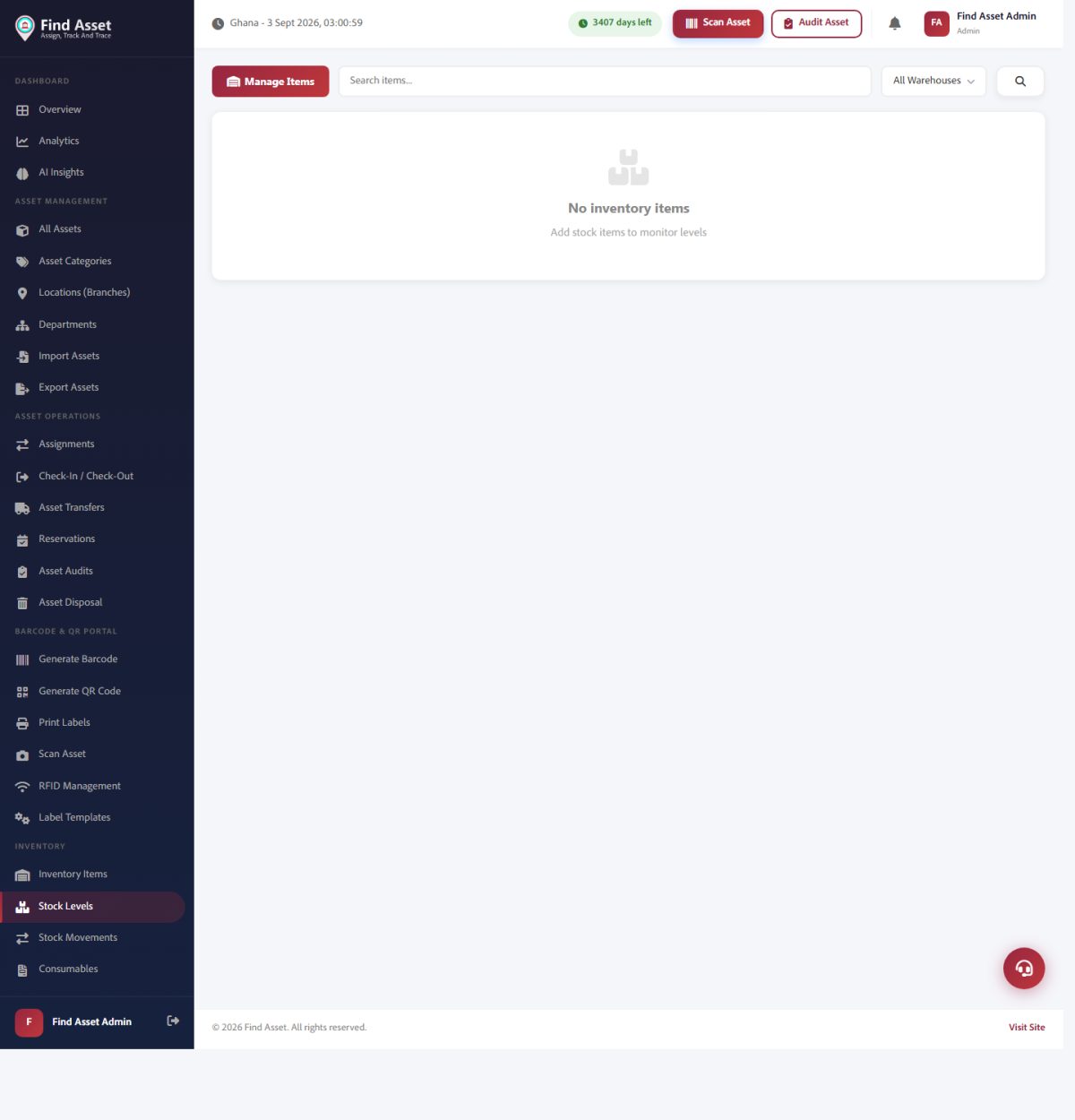
A factory tracks both machines and materials. Find Asset's stock levels (above) give the materials side the same visibility as the equipment side, which is why manufacturers tend to use both halves of the system together.
Every machine on a maintenance schedule
Production machinery is the natural centre of a manufacturer's asset register, and the most valuable thing you can attach to each machine is a maintenance schedule of its own. A press, a lathe and a conveyor do not wear at the same rate, so a one-size calendar helps nobody. When each asset carries its own preventive-maintenance plan — this bearing greased monthly, that filter changed quarterly — the work stops depending on whoever happens to remember it and starts happening because the system raised it.
This is the discipline that formal total productive maintenance is built around: treating upkeep as scheduled, owned work rather than something you do once a machine has already failed. In Find Asset each machine is a record you can hang a recurring maintenance task on, so the service that was due gets flagged, assigned and logged rather than forgotten. The lasting value is a maintenance history that shows what has actually been done to each machine — exactly what you reach for when a recurring fault needs diagnosing.
Tooling, moulds and the things that wear out quietly
Machinery gets attention because it is large and obviously expensive. Tooling and moulds are trickier precisely because they are not — a die that has run past its expected number of cycles can start producing subtly out-of-spec parts long before anyone thinks to inspect it. Treating tooling as tracked assets, with their own usage counts and inspection intervals, turns an invisible source of scrap into something you can see coming.
The same logic runs through the whole category of semi-consumable equipment: cutting tools, jigs, fixtures, and the moulds that define your product's shape. Each has a working life, and the difference between a smooth operation and a firefighting one is often whether that life is tracked or merely hoped about. Recording tooling as assets — with condition, location and a replacement schedule — means the decision to refurbish or replace is made on evidence rather than at the moment a run goes wrong.
Spare parts: knowing what you have before you need it
The worst time to discover you are out of a critical spare is the moment a machine has just failed. Spare-parts management sits at the awkward junction of asset tracking and inventory: too little stock and a small failure becomes a long stoppage; too much and you have expensive metal sitting on a shelf tying up cash. Knowing what you hold, where it lives, and which machine it belongs to turns that shelf from a hopeful guess into a genuine safety net.
You do not need a full warehouse system to get most of the benefit. Recording your critical spares as assets — tagged, located, and linked to the machines they serve — means that when a breakdown happens the fitter knows within seconds whether the part is on site and which shelf to walk to. It also makes the quieter decision easier: seeing which spares you actually consume tells you which ones are worth holding and which were bought once and never touched.
Calibrated instruments and the record quality demands
In any plant that answers to a quality standard, calibrated instruments are a category of their own. A torque wrench, a pressure gauge or a coordinate measuring machine is only trustworthy while its calibration is current, and an auditor will want to see the record proving when it was done, by whom, and against what reference. An instrument that has drifted does not announce itself — it quietly passes bad parts as good until someone notices downstream.
This is where asset management overlaps directly with compliance. Tracking each instrument with its calibration interval, its due date and its certificate history means the gauge coming due gets pulled and recalibrated before it can compromise a measurement, and the paperwork an auditor asks for is already assembled. Find Asset lets you attach those inspection and calibration records to the instrument itself — the same habit that underpins good asset tracking best practices everywhere, where the record travels with the thing.
Shared tools, shift handovers and equipment that walks off
Not every asset stays bolted to the floor. Portable tools, test equipment and shared instruments move between operators, between cells and — most testingly — between shifts, and this is where things quietly disappear. A tool signed out on the day shift and never signed back in is not stolen so much as untracked; it is on a bench somewhere, and finding it costs the next shift real time. Tagging portable equipment and recording who holds it turns "has anyone seen the torque tester?" into a lookup rather than a search party.
Shift handovers are the moment most manufacturers feel this pain, because responsibility changes hands without anyone owning the transfer. A simple check-out and check-in habit — scan the tool, record the custodian — gives you a clear line of who had what and when it came back. With Find Asset's mobile app the scan happens where the tool is, on the floor, rather than at a desk after the fact. The same problem shows up in asset management for construction, where tools cross sites the way they cross shifts here.
| Asset on the floor | What to track |
|---|---|
| Production machinery | Preventive-maintenance schedule, service history, running condition |
| Tooling and moulds | Usage count, inspection interval, remaining working life |
| Spare parts | Quantity on hand, storage location, the machine each part serves |
| Calibrated instruments | Calibration due date, certificate history, responsible person |
| Shared portable tools | Current custodian, check-out / check-in, last known location |
What matters on a manufacturing floor
- Shift downtime from unplanned to planned — predictability, not perfection, is the goal.
- Give every machine its own preventive-maintenance schedule and a logged service history.
- Track tooling and moulds by usage and wear before out-of-spec parts appear.
- Keep calibration and inspection records with the instrument, ready for an audit.
- Check shared tools in and out at handover so equipment stops walking off.
Production that never waits on a lookup
Asset management for a manufacturer comes down to a single idea worn many ways: know what you own, know its condition, and act before it fails rather than after. Machinery needs a maintenance schedule, tooling needs its wear tracked, spares need to be found in seconds, instruments need their calibration current and provable, and shared tools need an owner at every moment. None of this eliminates the bad day entirely, but it moves the balance steadily toward the planned and away from the panicked — the only lever that reliably keeps a line running.
The plants that manage this well are not the ones with the most software; they are the ones where every asset has a record, every record is current, and the person on the floor can update it where they stand. If you want to put your machinery, tooling, spares and instruments on one register with maintenance and calibration schedules attached, you can start a free 14-day trial and have your first line of equipment tagged the same afternoon. The point is not the tags or the app; it is the quiet confidence of knowing, at any moment, that nothing critical is drifting toward a failure you never saw coming.