
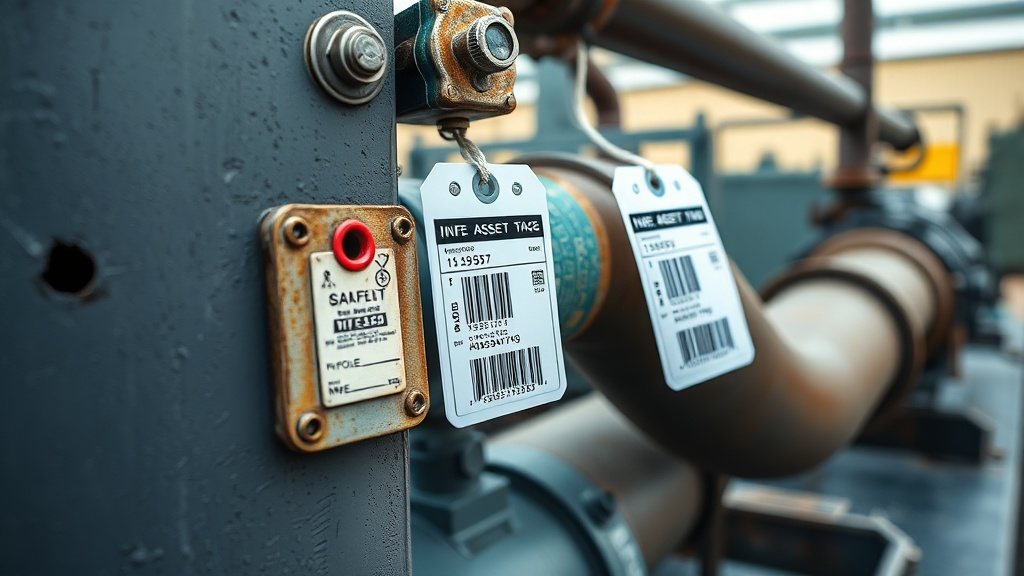
A label is a promise. It promises that months or years from now, someone will walk up to a pump, a laptop, a scaffold tower or a chest freezer, glance at a small rectangle of material, and read exactly what you meant them to read. The trouble is that the promise is only as strong as the material underneath the print. A beautifully designed tag on the wrong face stock will curl, fade, peel or smear long before the asset it names is retired.
Choosing durable label materials is not really a design decision; it is an engineering one. You are matching a thin laminate of face, adhesive and finish against heat, sunlight, solvents, abrasion and the simple mechanical stress of being handled by people who are in a hurry. Get that match right and the label disappears into the background, quietly doing its job. Get it wrong and you inherit a slow, expensive campaign of re-labelling.
Start with the environment, not the label
The most common mistake is to choose a label first and hope the environment forgives it. The durable approach runs the other way around. Before you think about face stock or adhesive at all, describe the place the asset lives: indoors or out, wet or dry, warm or freezing, clean or greasy, still or constantly rubbed. Every one of those conditions is an attacker, and the material you choose is the defence you are fielding against it.
An office laptop and a hydraulic ram in a wash-down bay could not have less in common. The laptop label faces fingertips, the occasional wipe and a stable room temperature; almost anything survives that. The ram faces pressure washing, degreasers, heat and knocks, and it will strip a paper label within a week. When you write down the environment honestly, the right material usually narrows itself down before you have looked at a single sample. This is also the moment to think about where you place the label, because a durable material applied to a bad surface still fails.
Face materials: paper, synthetics and metal
The face is the visible layer that carries your print, your barcode and your logo, and it sets the ceiling on how tough the whole label can be. Paper sits at the bottom of that ceiling. It is cheap, prints crisply and is perfectly adequate for indoor, low-stress assets, but it tears when wet, yellows in sunlight and abrades easily. For anything that leaves a clean, climate-controlled room, paper is usually a false economy.
Above paper sit the synthetics, and this is where most durable labelling actually lives. Polyester (often called PET) is the workhorse: dimensionally stable, resistant to moisture, chemicals and moderate heat, and available with hard-coat topcoats that shrug off abrasion. Polypropylene and vinyl are more flexible and suit curved or slightly textured surfaces, with vinyl bending easily around cables and small radii. At the top sit the metals, chiefly anodised aluminium and metal foil laminates, where the image is sealed beneath or within the metal surface itself. These survive years of sunlight, heat and solvents, which is why they turn up on outdoor plant, vehicles and heavy industrial equipment.

A durable label is a physical pointer to a digital record. Find Asset lets you export that register (above) at any time, so even if a harsh-environment tag is destroyed, the data behind it is never trapped or lost.
Adhesive is half the decision
People obsess over the face and forget that the adhesive is doing the quiet, thankless work of staying attached. A perfect face stock that lifts at one corner is a failed label, and lifting is almost always an adhesive problem. Adhesives divide broadly into permanent and removable. Permanent adhesives build bond strength over time and are the default for asset tags you never intend to move; removable adhesives are for temporary marking or surfaces you must not damage, and they trade staying power for a clean peel.
The subtler variable is tack against the specific surface. Low-energy plastics such as polypropylene and powder-coated metals resist ordinary adhesives, and cold, rough, dirty, curved or oily surfaces make everything worse. For those you want a high-tack or aggressive acrylic adhesive designed to wet out into the texture and grip low-energy materials. Temperature matters twice over: the application temperature, because most adhesives will not key properly onto a freezing surface, and the service temperature, because a label applied warm can still be asked to survive a cold store or an engine bay. Match the adhesive to both, or the toughest face in the world will simply fall off.
Protection: lamination, UV and abrasion
Even a good synthetic face benefits from a protective layer, and for harsh settings that layer is not optional. Over-lamination is a clear film bonded on top of the print, and it is the single most effective upgrade for durability. It puts a sacrificial, chemically resistant shield between your barcode and the world, taking the abrasion, the solvents and the scuffing so the ink beneath stays intact. Where the print method allows, sealing the image between layers rather than leaving it on the surface is always the more durable choice.
Sunlight deserves special mention because its damage is invisible until it is done. Ultraviolet light breaks down dyes and many inks, quietly fading a crisp black barcode to a washed-out grey over a season outdoors. UV-stable inks, pigment-based rather than dye-based printing, and UV-resistant topcoats all push that failure further into the future. For genuinely long outdoor or wash-down life, combine a synthetic or metal face, a UV-stable image and an over-laminate; each layer covers a different attacker, and together they last.
Matching material to the working environment
Once you think in terms of attackers and defences, matching becomes almost mechanical. The table below is a starting map rather than a rulebook, but it captures the pairings that hold up in practice. Treat it as a way to shortlist, then confirm with samples in the actual conditions before you commit to a large print run.
| Environment | Sensible material choice |
|---|---|
| Office and indoor IT | Coated paper or basic polyester, permanent adhesive |
| Warehouse and stores | Polyester with hard-coat or over-laminate, permanent adhesive |
| Outdoor and yard equipment | Anodised aluminium or UV-stable laminated polyester |
| Industrial and wash-down | Metal plate or laminated polyester, high-tack adhesive |
| Cold store and freezers | Polyester with cold-temperature (deep-freeze) adhesive |
| Healthcare and cleanroom | Synthetic face with chemical-resistant, wipe-tolerant topcoat |
Why the material decides whether the barcode scans
It is easy to treat durability and readability as separate problems, but they are the same problem seen from two angles. A barcode is only data if a scanner can resolve the contrast between the dark bars and the light spaces. Every form of wear you have been defending against, fading, abrasion, yellowing, chemical hazing, is an attack on that contrast. When a label degrades, the first casualty is usually not the human-readable text but the machine-readable code, and it fails silently until someone stands at a shelf unable to check an asset in.
This is why material choice is a scanning decision as much as a survival one. A matte, non-reflective topcoat keeps the code readable under the harsh lights of a warehouse; a UV-stable ink keeps the bars black in the sun; an over-laminate stops a solvent from smearing the print into an unreadable grey. If your codes are already giving you trouble, it is worth walking through a barcode won't scan checklist before you blame the scanner, because the fault often traces back to a face stock or finish that was never rated for the environment in the first place.
What to nail down before you order
- Describe the harshest condition the label will face, not the average one.
- Choose the face stock for that condition: paper indoors, synthetic for stress, metal for the extremes.
- Match the adhesive to the surface energy, texture and both application and service temperatures.
- Add over-lamination and UV-stable ink wherever sunlight, solvents or abrasion are in play.
- Test a sample in the real environment before committing to a full print run.
Security, tracking and special-purpose materials
Some assets need the material to do more than survive. Destructible vinyl, sometimes called tamper-evident or eggshell stock, is engineered to shatter into tiny fragments when anyone tries to peel it, so a removed or reapplied tag is instantly obvious. It is the material of choice for high-value or security-sensitive equipment where you care not just that the label lasts, but that it cannot be quietly transferred to something else.
Tracking technology brings its own material considerations. Smart labels carry an RFID inlay sandwiched inside the face stock, and metal surfaces, moisture and tight curves all interfere with how well that inlay performs, so the material and the mounting have to be chosen together rather than as an afterthought; the RFID smart label encoding guide covers that pairing in detail. A brief word on print method is worth adding here: thermal transfer with resin ribbons onto synthetic stock is a durable, sensible default, while dye sublimation can seal an image beneath a coated or metal surface for exceptional longevity. Whichever you use, the principle holds, the further the image sits from the surface, the longer it survives.
A simple way to decide
When the options start to blur, collapse the decision into three questions asked in order. First, what is the single worst thing the environment will do to this label, heat, sunlight, solvents, abrasion or cold? Second, which face and adhesive combination is rated to survive that specific attack? Third, what protective layer keeps the barcode readable for the whole life of the asset, not just the first month? Answer those three honestly and you will rarely choose badly.
It also helps to keep durability tied to the discipline of your wider records. A tag that outlives the asset is only useful if its code still resolves to a clean, well-structured identifier in your system, which is why a sensible asset tag numbering system and a durable material are two halves of the same idea. The physical label and the digital record either both last, or neither does.
Bringing it together
Durable labelling is unglamorous work, and that is precisely why it pays off. Nobody notices the tags that quietly survive a decade of sunlight, wash-downs and cold mornings; they only notice the ones that curled, faded or fell off at the worst possible moment. By starting from the environment, choosing a face stock and adhesive matched to its real stresses, and adding protection where sunlight and abrasion demand it, you turn labelling from a recurring chore into a one-time decision.
The reward is a register you can trust, because every tag in it is still readable by both a person and a scanner. If you want a system that keeps those durable tags tied to accurate, searchable records, you can start a free 14-day trial and see how the physical and digital sides of asset tracking hold together. Choose the material once, choose it well, and let the label keep its promise.