

Every asset needs a name, and the name you give it will outlive almost every other decision you make about it. Get the numbering system right and your tags are readable, unique and future-proof for decades. Get it wrong and you end up with codes like HOF41 where nobody remembers what the 41 means, duplicate IDs that break your reports, or a scheme that collapses the day you open a second branch.
Designing an asset tag numbering system takes an afternoon; living with a bad one takes years. The good news is that a handful of durable principles cover almost every situation.
Two philosophies: dumb numbers versus smart codes
There are broadly two schools. The sequential school gives every asset a plain running number — 000001, 000002 — and stores all the meaning in the database beside it. The smart-code school builds meaning into the tag itself, so the code reads something like HOF-FIN-LAP001: Head Office, Finance, Laptop, number one. Neither is wrong. Sequential numbers are simple and never need changing; smart codes are instantly readable by a human holding the tag. Most organisations lean toward smart codes because a person reading a shelf of equipment can understand the tags at a glance.
The choice is less about which is superior and more about who reads the tag and how often. If your assets rarely leave a controlled store and everything flows through the software anyway, a pure sequential number costs you nothing and spares you every argument about what the letters should mean. If, on the other hand, staff routinely stand in front of equipment and need to make sense of it without opening an app, the extra characters of a smart code earn their keep many times over. A useful compromise many teams settle on is a light smart code — just a category prefix and a running number — which gives a hint of meaning without trying to encode the entire org chart into a label.
The case for meaningful codes
A code like HOF/FIN/LAP012 does real work before you ever open the system. A storekeeper reading it knows immediately it is a Head Office, Finance-department laptop. During a physical count, meaningful codes let staff sort and group by eye. This readability is why the location–department–category pattern, followed by a running number, has become a quiet standard — and it depends entirely on having tidy categories, locations and departments underneath it.
There is a second, quieter benefit that only shows up under pressure. When something goes wrong — a missing projector, a maintenance ticket with a half-remembered code scrawled on it, an insurance claim after a break-in — a meaningful code lets a person reason about the asset from fragments. Even a partial read such as HOF/FIN/LAP… narrows the search to a handful of records instead of a whole register. Plain sequential numbers give you none of that; a digit lost or transposed points nowhere. In day-to-day life the difference is invisible, but in the awkward moments where accuracy matters most, readable codes repay the small effort of designing them well.
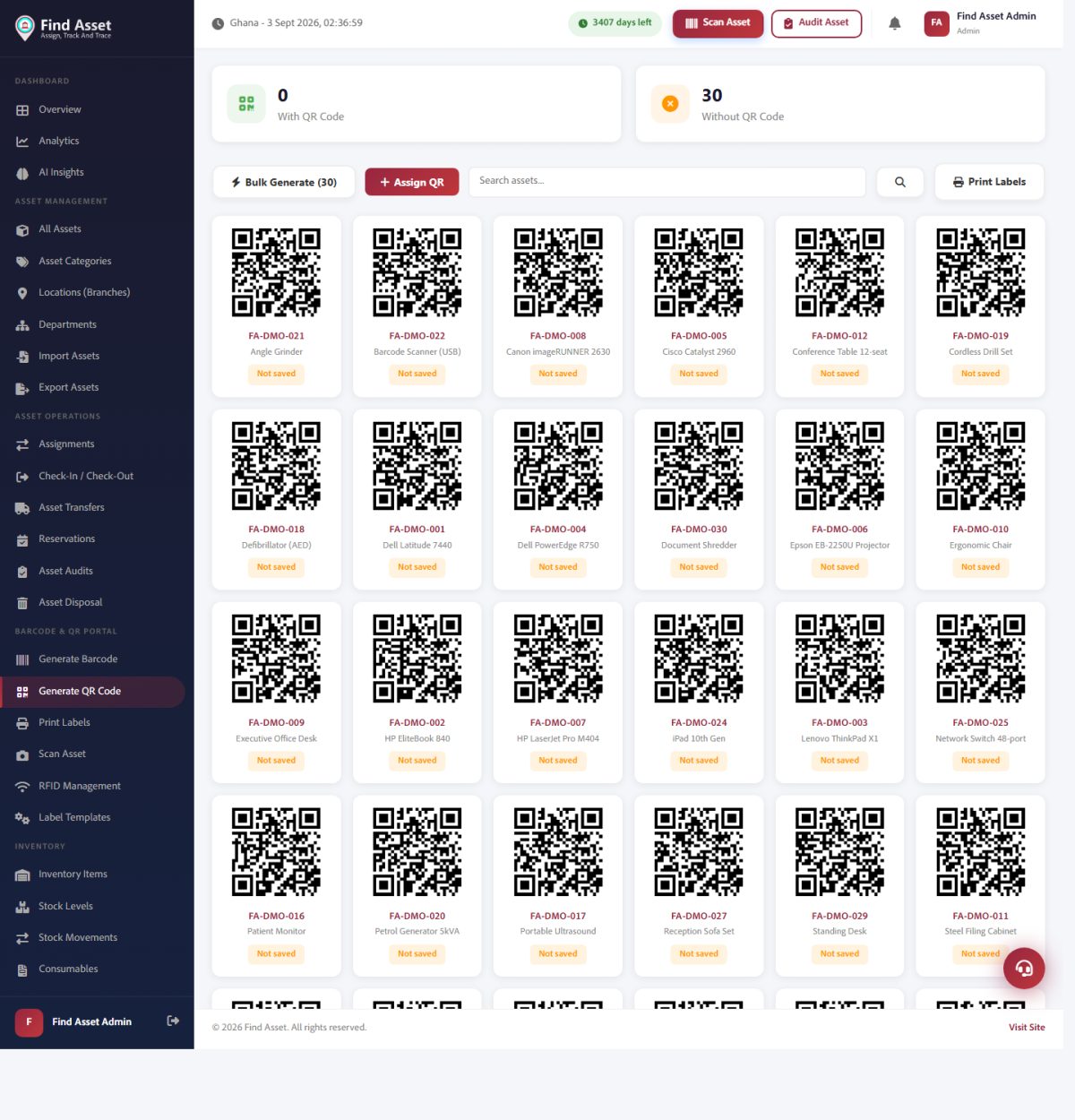
A numbering system earns its keep when it reaches the physical asset. Find Asset's QR generator (above) turns each asset's tag number into a scannable code you can print and stick on the item, linking the number on paper to the record in the system with one scan.
The hidden trap of smart codes
Smart codes carry one real danger. If you bake location or department into the tag, what happens when the asset moves? A laptop tagged HOF/FIN/LAP012 that transfers to Kumasi and the Operations team now wears a code that lies. The cleanest way out is a rule: the code is a permanent identity, not a live location. It records the asset's origin and never changes, while the system's location and department fields — which you can edit freely — carry the current truth. The tag stays stable; the database stays accurate.
Teams that miss this rule end up in one of two bad places, and both are expensive. Either they leave the stale code alone and slowly stop trusting what any tag says, or they start peeling and reprinting labels every time an asset moves, which turns a routine transfer into a re-tagging exercise and guarantees that some codes get duplicated in the churn. The discipline that saves you is to treat the printed code exactly like a person's national ID number: it was issued once, it describes where they started, and it does not change because they moved house. Once everyone internalises that the tag answers "which asset is this?" and never "where does it live today?", the whole trap simply disappears.
Rules for a numbering system that lasts
A few principles separate a scheme that ages well from one that fights you.
What unites these rules is that each one guards against a failure you cannot easily undo later. Reusing a retired number, changing a printed code, or letting look-alike characters creep in all create problems that surface months down the line, tangled up in old reports and audit trails, when fixing them is far harder than preventing them. It is worth walking through the list once with your own environment in mind — your smallest label, your rowdiest export, your least careful data-entry moment — because the rule that will bite you is usually the one that felt least important on the day you set the scheme up.
| Rule | Why it matters |
|---|---|
| Unique forever | Never reuse a disposed asset's number — it resurrects old confusion |
| Never change a printed code | Treat it as the asset's permanent name |
| Keep it short | It must fit your smallest label |
| Avoid look-alike characters | O/0 and I/1 cause mis-reads; spaces break exports |
How many digits? Plan for the organisation you will become
The most common rookie mistake is a running number with too few digits. A scheme that allows LAP01 to LAP99 feels generous until the hundredth laptop arrives. Look at your largest likely category, guess how many you might own in ten years, and add a digit for comfort. Three digits suit most single-site organisations; four give room for anyone growing quickly. Padding with leading zeros — 007 rather than 7 — also keeps your lists sorting correctly.
The trap is that you are not sizing the digits for the organisation you are today, but for the one you will have become before anyone revisits the scheme. A clinic with forty laptops feels comfortably clear of any ceiling, right up until a grant lands, three new sites open, and the fleet quadruples in a single procurement cycle. Adding a digit costs you one extra character on the label and nothing else; running out of numbers costs you a scramble mid-audit and a batch of improvised codes that never quite match the rest. When in doubt, err generous — the cost of an unused digit is trivial, and the cost of a hard limit reached at the worst possible moment is not.
The rules of a scheme that scales
- Choose meaningful codes if your people value readability at a glance.
- Make the code a permanent identity; let the database hold the live location.
- Unique forever — never reuse a retired number.
- Short, with no look-alike characters or spaces.
- Enough digits (with leading zeros) to cover a decade of growth.
Write the scheme down so it survives staff turnover
The person who designs a numbering system usually understands it perfectly — and is also, eventually, the person who leaves. Guard against this with a single page: what each part of the code means, which separator you use, how many digits the running number carries, and the rules for what never changes. It takes ten minutes and means the pattern you chose this year is still applied the same way a decade from now. A numbering system is only as durable as the shared understanding behind it — a principle at the heart of formal asset management practice.
Keep that page somewhere the next person will actually find it, not buried in the designer's personal email or a folder only they knew about. Pin it inside the asset system itself, in a shared drive beside the register, or printed in the store where tags are issued. Add a worked example or two — a real code broken into its parts with a plain-English translation beside each — because an example teaches the pattern faster than a paragraph of rules ever will. The goal is that someone hired three years from now, who never met you, can pick up a fresh asset, generate the next code correctly, and never wonder whether they are about to break something the rest of the register depends on.
Bringing it together
An asset numbering system is a small decision with a long shadow. Choose meaningful codes if your people value readability, make them permanent, keep them short and unique, leave room to grow, write the scheme down, and let the software do the counting. Do that and the tags you print this year will still make sense long after you have moved on. If you would rather define the pattern once and have every tag generated for you, you can start a free 14-day trial and set your scheme in a couple of minutes.
If you take only one idea from all of this, let it be the separation between identity and state. The code is the identity — fixed, unique, printed once and never argued with again — while location, custodian, department and condition are state that lives in the software and changes as freely as reality demands. Organisations that blur those two are the ones forever reprinting labels and distrusting their own register; the ones that keep them apart barely think about their numbering scheme at all, which is exactly how a good one should feel. Get that foundation right early, and every later decision about tags, scanners and audits rests on solid ground rather than sand.