

Pick up almost any product near you — a bottle of water, a phone charger, a box of medicine — and turn it around. There is a barcode on it, and above or below the bars there is a short number, usually twelve or thirteen digits, split into groups. That number is a GTIN, and it is one of the most quietly successful standards in commerce: the same scheme has identified retail products across the world for fifty years. Yet for something so universal, the GTIN is poorly understood outside the teams that print it — the prefixes, the check digit and the four different shapes all feel like secret knowledge.
They are not. A GTIN is a simple, well-defined structure, and once you can read one, a lot falls into place: why some products carry long numbers and others short ones, why the bars never match the digits one-for-one, and why a mistyped digit is caught before it ever reaches a till. This guide walks through what a GTIN is, the four sizes it comes in, where the numbers come from, and how to generate correct, scannable GTIN barcodes — whether for product artwork or for labels inside your own operation.
What a GTIN actually is
GTIN stands for Global Trade Item Number. It is not the barcode itself — it is the number the barcode encodes. The bars are simply a machine-readable shape of that number, drawn in a symbology such as EAN-13 or UPC-A. The number is the identity; the bars are the costume it wears. This separation matters more than it first appears, because it is the same principle that makes asset tag numbering systems work: fix the identity, let everything else describe it.
Every GTIN belongs to a company. A business joins GS1 — the not-for-profit organisation behind the standard — and is issued a company prefix, a unique block of digits that no other company on earth will ever hold. From that prefix the company mints as many product numbers as it needs, and because every number begins with the prefix, every GTIN worldwide traces back to exactly one issuer. That is the quiet genius of the scheme: uniqueness is not an honour system, it is built into the arithmetic of the number itself.
The four shapes of a GTIN
GTIN is a family name, not a single format. Depending on the product and the region, the same number appears in one of four lengths, and retail barcodes switch symbology to match.
| Name | Digits | Symbology | Typical use |
|---|---|---|---|
| GTIN-13 | 13 | EAN-13 | The standard retail code almost everywhere outside North America |
| GTIN-12 | 12 | UPC-A | The North American retail code |
| GTIN-8 | 8 | EAN-8 | Very small packs, where a full code will not fit |
| GTIN-12 short form | 6 | UPC-E | Compressed code for tiny packages; expands to a full GTIN-12 at the till |
The two you will meet most often are GTIN-13 and GTIN-12, and in practice they are the same idea drawn for different regions — a scanner in Accra and one in Chicago read both happily. The short forms exist for one reason only: physical space. A medicine carton or a lipstick simply has no face wide enough for a full-size code, so GS1 defined compressed variants that carry less information but occupy a fraction of the width.
The company prefix and the item reference
A GTIN-13 reads naturally in two parts. The first several digits are the company prefix; everything after them, up to the final digit, is the item reference — the number the company itself assigns to one product. A company with a short prefix gets a long item reference and can number millions of products; a company with a long prefix gets a shorter runway. The split is not fixed by position — it is fixed by whatever prefix length GS1 issued to that company, which is why two products from different makers can have their digits grouped at different-looking points.
This is also why you cannot legitimately invent a retail number. If the prefix is not yours, the product number collides with the company that actually holds it, and the mistake surfaces at the worst possible place — a distributor's system matching your product to someone else's records. Test designs freely with sample numbers, but before anything reaches a real shop, the prefix must be licensed to you through your local GS1 member organisation.
The check digit: small number, big job
That lonely final digit on every GTIN is a check digit, and it is pure arithmetic. Take the first twelve digits of a GTIN-13, multiply them alternately by three and one starting from the right, add the results, and the check digit is whatever it takes to push the total up to the next multiple of ten. For the sample number 400638133393, the weighted sum is 89, so the check digit is 1 and the complete GTIN is 4006381333931.
The point of the exercise is typing. At some point, someone will key a GTIN into a system by hand — a receiving clerk, a market researcher, a pharmacy assistant. Transpose two digits or fat-finger one, and the weighted sum no longer lands on a multiple of ten, and the system rejects the number instantly instead of silently matching the wrong product. The check digit catches every single-digit error and most transpositions, which is why a GTIN should always be verified, never trusted, whenever it passes through human hands. Any decent generator calculates it for you and flags numbers that arrive with a wrong one attached.
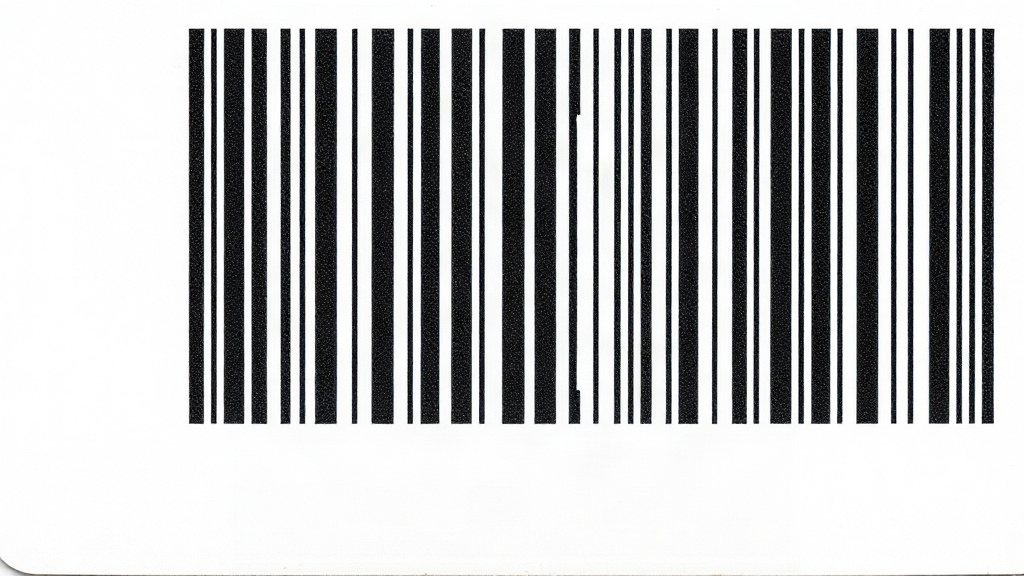
Notice, in any close-up of a retail code, that the three bars at the start, middle and end reach lower than the rest. Those are the guard bars, and they are one of the quickest ways to recognise an authentic retail barcode at a glance.
Why the guard bars drop below the rest
Retail symbologies are deliberately drawn with the start, centre and end guard bars running deeper than the data bars, and with the human-readable digits sitting in the gaps between them. The guards give the scanner a pulse to lock onto at both ends of every scan line — they anchor the decode — while the dropped centre guard splits the symbol into two halves that read left-to-right and right-to-left depending on which way the scanner meets them. A pack scanned upside down decodes identically.
This layout is also the quickest visual check of whether a retail barcode was built properly. A Code 128-style strip of uniform bars with a caption underneath might scan, but it is not a retail barcode: checkout systems and trading partners expect the guard structure, the descent and the embedded digits. When a number is going onto product artwork, it should be rendered by a generator that draws the genuine layout — the guard bars dropping below, the digits embedded between them — not by a generic barcode tool wearing a retail number.
Generating GTIN barcodes without the guesswork
The arithmetic of prefixes, references and check digits is exactly the kind of work software should absorb. Our free GTIN barcode generator does all of it: enter a company prefix and item reference and it calculates the check digit live, or paste a list of full numbers and it verifies each one. Every barcode renders in the authentic packshot layout — short data bars, descending guards, embedded digits — at GS1-standard magnifications from 80% to 200%, ready to download as PNG or print as a sheet.
It is free for up to ten barcodes per generation; generating in bulk needs any Find Asset plan or Label Studio plan. That pairing is deliberate. A tool makes codes; printing hundreds of labels from one design is a different job — and if the retail codes need to live on labels tied to live product records, a designer that merges your product list into the layout in one run is the piece that scales.
Common mistakes with retail numbers
Four failures account for nearly every GTIN problem in the wild, and each is avoidable at the design stage.
Getting GTINs right the first time
- License your prefix from GS1 before anything ships — never invent retail numbers.
- Let software calculate the check digit; verify any number typed by a human.
- Render with the authentic layout: descending guard bars, embedded digits.
- Keep magnification within the 80%–200% GS1 range and respect the quiet zones.
- Short packs get EAN-8 or UPC-E — never squeeze a full code until it will not scan.
The most expensive of these is the invented prefix, because it fails late and publicly: the artwork is printed, the cartons ship, and the number collides with another company's product in a distributor's system. The cheapest to avoid are the rendering mistakes — a code at the wrong magnification or without its quiet zones simply refuses to scan, and our barcode won't scan checklist walks through recovering exactly those. Fix the identity question first, then the drawing, and retail barcodes are genuinely unremarkable.
Bringing it together
A GTIN is a small piece of arithmetic with a global reach: a licensed company prefix, an item reference the company assigns, and a check digit that catches human error — drawn as bars whose guard structure makes the code scannable from any angle. Four sizes cover everything from a shipping carton to a lipstick, and the rules that make them work are short enough to fit on an index card.
If you are numbering retail products, start with a generator that respects the standard — calculate the check digit, draw the true packshot layout, and test at real magnifications. And if you are tagging company property rather than selling products, the same discipline of a permanent, verified identity applies with even more force; you can start a free 14-day trial and let the system generate every tag number for you.