

Ask ten organisations how often they audit their assets and you will get ten different answers, ranging from "every year at least" to a slightly embarrassed silence. The truth is that there is no single correct frequency, because a laptop in a locked office and a power tool that travels between sites live completely different lives. Auditing everything on the same rigid schedule wastes effort on stable assets and lets risky ones drift for far too long between checks. The smart approach is to match the schedule to the risk.
This article lays out a practical, tiered audit schedule you can actually keep. Instead of one exhausting annual count that everyone dreads, you spread the effort across the year and focus attention where losses are most likely. The result is fresher data, fewer nasty surprises, and an audit process that feels like routine maintenance rather than a fire drill. Whether you manage a hundred assets or ten thousand, the principle is the same: audit by risk, little and often.
Why the annual audit alone is not enough
The once-a-year audit is a comforting ritual, but on its own it leaves you blind for eleven months. If a valuable item goes missing in February, a December audit means the loss sits undetected for most of the year, by which point the trail is stone cold and recovery is hopeless. Worse, a single annual count of everything is so large that people rush it, tick boxes carelessly, and produce data that looks thorough but is riddled with quiet errors. Volume becomes the enemy of accuracy.
There is a human cost too. A giant annual audit pulls staff off their real jobs for days, breeds resentment, and gets postponed the moment something more urgent appears. Because it is so painful, it tends to be done badly or skipped entirely in busy years, which defeats the whole purpose. Spreading audits into smaller, regular checks removes that pain. Nobody minds counting a handful of high-value assets each month, and the cumulative result is far more reliable than one heroic annual push.
Match frequency to risk, not habit
The core idea is simple: the more likely an asset is to go missing or need attention, the more often you should check it. A server bolted into a locked room barely moves and can be verified once a year without worry. A cordless drill that travels between sites in different hands should be checked far more often, because it has a hundred chances to disappear. Sorting your assets into risk tiers lets you spend your limited audit energy exactly where it does the most good.
Risk is a blend of value, mobility and exposure. A cheap but highly portable item can be as worth watching as an expensive fixed one, because ease of loss matters as much as replacement cost. This tiered thinking is a natural part of good asset tracking best practices, where effort follows risk rather than treating every item identically. Once you sort your register into a few sensible tiers, the right audit frequency for each becomes obvious, and the whole schedule almost designs itself around where your real exposure lies.
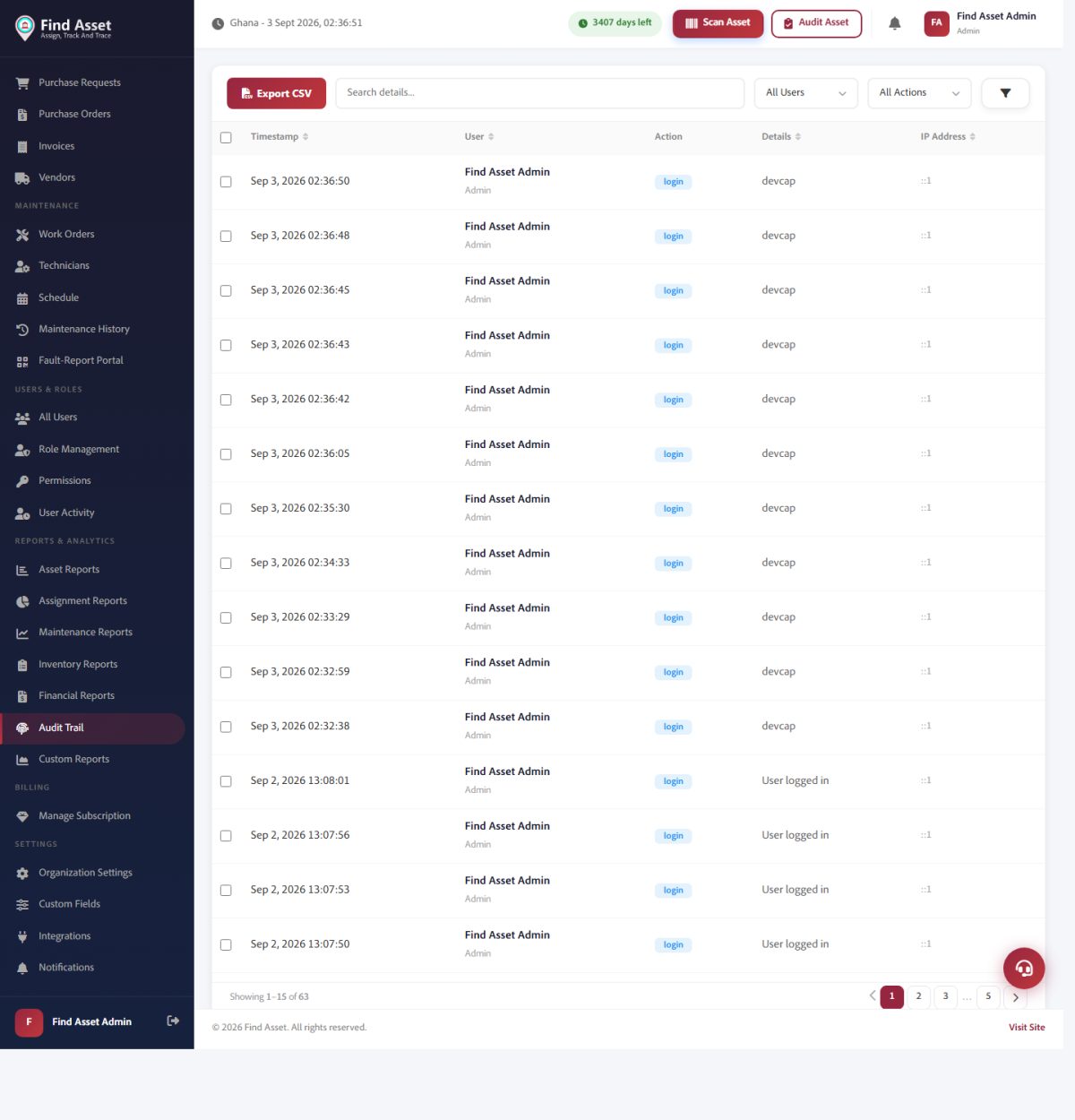
How often you should physically audit depends partly on how much changes in between. Find Asset's audit trail (above) captures every edit, assignment and status change chronologically, so even a site that counts once a year has a continuous record of what happened in the meantime.
A practical tiered schedule
Here is a schedule that works for most organisations without overwhelming them. High-risk, high-mobility assets get a monthly spot check; mid-tier assets are verified quarterly; and stable, fixed assets are confirmed once a year during a fuller review. Layered on top, a small random sample of assets across all tiers is checked each month, which keeps everyone honest and catches problems the fixed schedule might miss. This blend of targeted and random checking is what makes the system both efficient and hard to game.
The beauty of tiering is that the workload stays light and steady rather than spiking once a year. The table below shows a typical arrangement, but treat it as a starting point and adjust the tiers to your own reality. An organisation with lots of field equipment might check its top tier fortnightly, while a quiet office might relax the schedule. What matters is that riskier assets are seen more often, and that the schedule is realistic enough that your team will genuinely stick to it month after month.
| Asset tier | Suggested audit frequency |
|---|---|
| High value or highly mobile | Monthly spot check |
| Mid value, moderate movement | Quarterly verification |
| Fixed, low-risk assets | Annual full review |
| Random sample across all tiers | Monthly, keeps data honest |
A schedule you can keep
- Audit by risk tier, not one rigid frequency for everything
- Monthly spot checks for high-value, high-mobility assets
- Quarterly checks for the middle, annual for stable items
- Add a monthly random sample to catch what the schedule misses
Trigger-based audits between the scheduled ones
Beyond the calendar, certain events should trigger an audit regardless of when the last one happened. A staff member with custody of equipment leaving the organisation is a classic trigger; their assigned assets should be verified and reassigned before they walk out the door. A project closing, an office relocating, or a suspected theft are all moments that warrant an immediate targeted check rather than waiting for the next scheduled slot. These event-driven audits catch losses at exactly the point they are most likely to happen.
Trigger-based auditing also covers changes in the assets themselves. A batch of new equipment arriving, a bulk disposal, or a merger of two departments' inventories all disturb the register enough to justify a fresh count of the affected items. By pairing a steady tiered schedule with these situational triggers, you close the gaps that a purely calendar-based system leaves open. The scheduled audits keep your baseline honest, and the triggered ones handle the unpredictable moments where assets tend to slip through the cracks unnoticed.
Keep audits light with the right tools
An audit is only sustainable if it is quick, and quick means scanning rather than eyeballing paper lists. When a staff member can walk a room, scan each asset with a phone or handheld reader, and have the system instantly flag anything missing or out of place, a monthly spot check takes minutes instead of hours. The friction of manual checking is what kills good intentions; remove that friction and frequent auditing stops being a burden and becomes an easy, almost automatic habit your team barely notices.
Good tooling also produces a clean record of every audit, which compounds in value over time. You can see which assets are perennially hard to locate, which departments keep their records tight, and whether your loss rate is improving. This is auditing in the true sense of the word, a systematic, repeatable examination, and understanding the discipline behind a proper audit helps you treat asset checks as a source of insight rather than a mere chore to be endured and forgotten.
Turning audit results into action
An audit that ends with a list of discrepancies and nothing more is only half done. The point of checking is to act on what you find: update locations that have changed, reassign custody where staff have moved, investigate genuine losses, and retire items that no longer exist. Each discrepancy is a small lesson about where your control is weak, and feeding those lessons back into your process is what steadily drives your loss rate down year after year. Data without follow-through is just tidy record-keeping.
Track your audit results over time and patterns will emerge that no single count could reveal. Perhaps one branch consistently loses tools, or a particular category always drifts out of place. Those patterns tell you where to tighten policy, add labels, or change how assets are assigned. Over several cycles, a disciplined audit habit does not just keep your register accurate; it actively teaches you how to lose fewer assets in the first place, which is worth far more than any single tidy count.
Bringing it together
How often you should audit your assets comes down to risk, not ritual. Replace the dreaded annual marathon with a tiered rhythm, monthly for your riskiest items, quarterly for the middle, annually for the stable ones, plus a random sample and event-driven checks to cover the gaps. This spreads the effort, keeps your data fresh, and catches losses while they can still be reversed, all without pulling your team off their real work for days at a time.
The easiest way to sustain any audit schedule is to make each check fast and each result actionable, which is exactly where good tooling earns its place. If you want to try a tiered audit rhythm with scanning that turns a spot check into a five-minute task, you can start a free 14-day trial and run your first audit this week. Once you feel how light a well-scoped check can be, auditing your assets stops being a yearly ordeal and becomes a quiet, reliable habit.