

Most asset registers look healthy on the day they are created and start decaying the very next morning. A new laptop arrives, the finance team logs it, a tag goes on, and everyone feels organised. Six months later that same laptop has moved branch, been reassigned twice and lost its label, yet the register still shows it sitting at a desk that no longer exists. Multiply that by a few hundred items and you have the situation most operations managers quietly live with: a list they no longer trust.
The reason tracking fails is almost never a lack of software. It is that the habits around the data were built for a calm, fully-staffed office that does not exist during month-end, an audit rush, or the week three key people resign at once. Good asset tracking is not the system you buy; it is the small set of routines that keep working when nobody has time. This article covers the habits that actually survive real conditions, with the specifics that make them stick.
Give every asset one permanent identity
The single biggest cause of a broken register is that the same item exists under several names. The store calls it "HP laptop", finance calls it "Notebook 14in", and the branch calls it "Ama's computer". Each record is technically true and none of them can be reconciled. Before you worry about scanning or reports, decide that every physical asset gets exactly one identifier for its entire life, and that identifier never changes even when the custodian, location or condition does.
A number in a spreadsheet is only a promise; a scannable label bonded to the equipment is a fact. Print a durable tag, fix it somewhere it will not be rubbed off, and treat that code as the asset's true name. When the tag is the identity, a two-second scan replaces a guessing game, and a new employee who has never seen the item can still update it correctly on their first day. That resilience to turnover is the whole point.
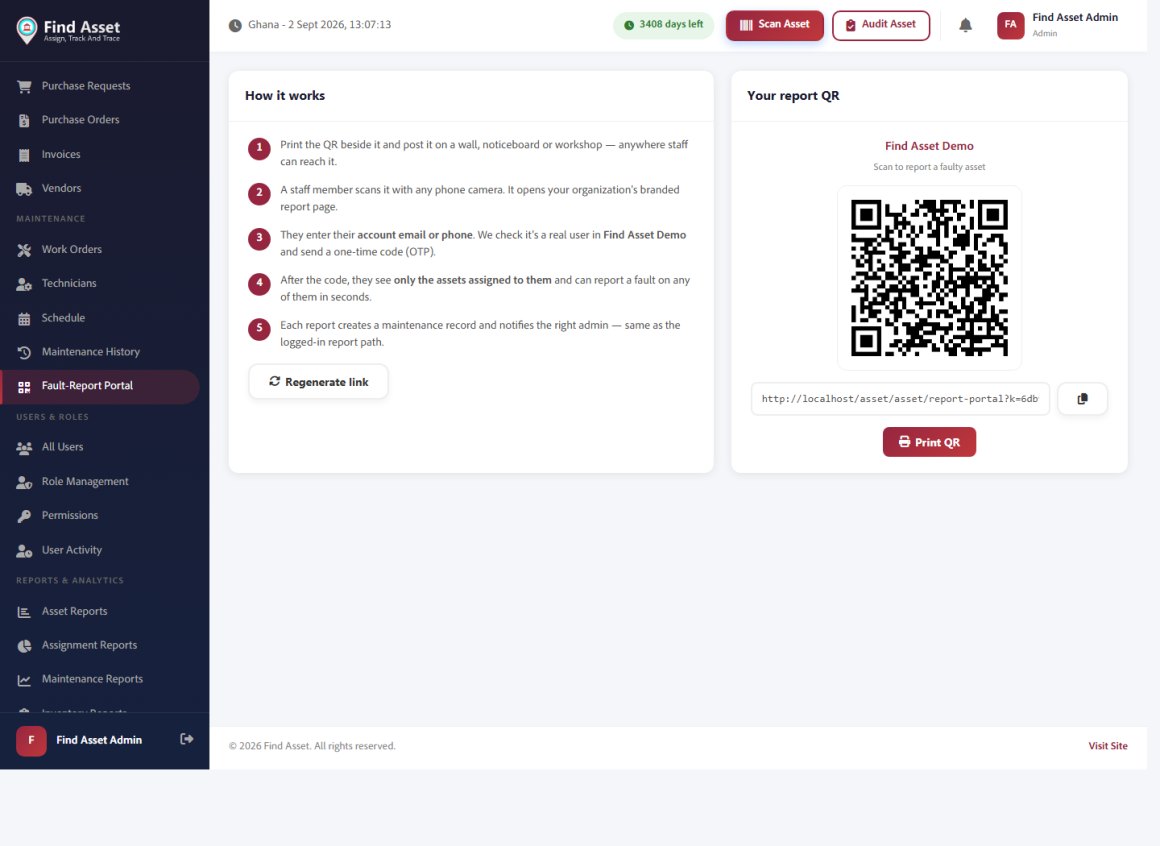
A good practice is only useful if it is easy to run, and Find Asset builds reporting in. The report portal below turns a scan into a report — staff scan a code, the portal opens on their phone, and each report is logged against the right asset with an OTP-verified account. Making the right action the easy action is what keeps a register accurate long after the initial rollout.
Update at the point of movement, not in batches
Registers rot because they are reconciled in bulk, weeks after the events they are supposed to record. Someone sits down on a Friday to "update the asset list" and has to reconstruct a month of transfers from memory and half-remembered WhatsApp messages. The data is stale before it is even entered. The fix is to make the update happen at the same moment as the physical action: when an item is handed over, it is scanned and reassigned there and then.
This is where a mobile-first system earns its keep, because the person moving the asset is rarely the person at the desktop. If updating means walking back to an office and logging in, it will not happen during a busy week — and busy weeks are exactly when assets move most. A phone scan that takes seconds survives pressure; a form that takes five minutes does not. If you are still deciding what to encode on your tags, our guide on choosing between QR codes and 1D barcodes will settle the choice for you.
Assign a named custodian to everything
An asset that belongs to "IT" or "the Accra branch" effectively belongs to no one, because responsibility that is shared is responsibility that is ignored. When an item goes missing, "the department" cannot be asked what happened to it. Every asset should have exactly one current custodian recorded by name, and every transfer should be logged so the record shows each pair of hands the item has passed through.
Named custodianship changes behaviour more than any policy document. People treat equipment differently when their own name is attached to it, and handovers become deliberate events rather than quiet disappearances. It also makes staff turnover survivable: when someone leaves, you can produce a clean list of everything in their name and formally reassign it, instead of discovering the gap a year later during an audit.
The habits of a well-owned register
- Every asset has one current custodian, recorded by name — never a department or a job title alone.
- Transfers are scanned and logged, so the history shows every hand the item has passed through.
- Staff exits trigger a reassignment check, so nothing leaves the building unaccounted for.
- Custodians can see their own list, which quietly encourages them to keep it honest.
Audit little and often
The annual stock-take is where organisations discover, all at once, everything that went wrong over twelve months. By then the trail is cold, the people involved have moved on, and the exercise becomes an expensive act of grief rather than control. Worse, it consumes a full team for days and still misses items because everyone is rushing to finish. A single large audit is the least reliable way to check a register.
Cycle counting spreads that same work across the year in small, low-stress passes. Instead of counting everything once, you count a slice each week — one department, one location, or one category — so the whole estate is verified over a rolling period and discrepancies surface while they are still traceable. It fits around normal work, needs no shutdown, and turns auditing from a dreaded event into a habit. Our walkthrough on how to run your first asset audit sets out the whole procedure in the order a team would actually run it.
Measure the numbers that predict loss
You cannot improve what you never look at, and most teams look at nothing until something goes missing. A handful of simple metrics, checked monthly, will tell you the register's health before a loss forces the issue. None of these require a data scientist or a new dashboard tool; they fall straight out of the tracking you are already doing, provided the scans and custodians are being recorded.
| Metric | The question it answers | Direction of health |
|---|---|---|
| Located rate | Share of listed assets physically found in the last count | Trending upward toward full |
| Unassigned assets | Assets with no accountable name | Drifting down to nil |
| Stale records | Assets not scanned or verified in 90 days | Falling steadily |
| Transfer lag | Average days between a move happening and being logged | Falling toward same-day |
| Ghost assets | Records still listed but never found across two counts | Fewer every quarter |
Watch the trend more than the absolute figure. A located rate of 92 per cent is fine if it climbed from 80 last quarter and alarming if it slipped from 99. The transfer-lag number is the early warning most teams miss: when it starts creeping up, it means the point-of-movement habit is slipping and losses are already being seeded, long before the annual count reveals them.
Design the routine for the worst week, not the best
Every process feels workable when it is demonstrated calmly to management. The real test is whether a stand-in can run it during the fortnight after two colleagues resign and a delivery of new equipment lands unannounced. If the routine depends on one person's memory, a shared login, or an undocumented naming convention, it will not survive that week — and that week is when it matters most.
Build for handover from the start. Write down the tagging scheme, keep custodian records self-service so people maintain their own lists, and make the mobile flow simple enough that a temporary staff member can be productive in ten minutes. In many Ghanaian organisations the person physically holding an asset is at a branch far from head office, so a routine that assumes everyone is in one building is quietly broken before it begins. The strongest systems are the ones a newcomer can operate without a training session.
It also helps to separate the durable rules from the daily actions. The rules — one identity per asset, one named custodian, updates at the point of movement — rarely change. The actions built on them can be handed to anyone. This is the same principle behind formal standards such as ISO 55000 asset management, which treats good stewardship as a repeatable discipline rather than a personality trait of one diligent employee.
Bringing it together
Look back down that list and technology is nowhere near the top of it. Permanent identities, point-of-movement updates, named custodians, frequent small audits and a few honest metrics are all just ways of making the truth easy to record and hard to lose. The software matters only because it removes the friction that causes people to skip these steps when they are busy — and busy is the normal state, not the exception.
A final word on sequencing, because teams often try to adopt all five habits at once and stall. Start with identity, since nothing else works until each asset has one permanent name and a tag to match. Layer point-of-movement updates on top, then named custodians, and only then worry about counts and metrics, which simply read back the quality of the first three. Adopted in that order, each habit makes the next one easier, and within a couple of months the register stops being a source of anxiety and becomes something you can actually quote with confidence.
Durable scannable tags, a mobile flow fast enough to use at the point of movement, custodian history that survives staff changes, cycle-count tools that turn auditing into a routine instead of an ordeal: Find Asset ships all four. If you want to see how these habits feel with the friction removed, start a free 14-day trial and put a single, honest register in place before the next busy period arrives.