

The first time an organisation attempts a proper physical asset audit, the mood in the room is usually optimistic. Someone prints the fixed asset register, hands out clipboards, and everyone fans out across the building expecting a quiet afternoon of ticking boxes. By mid-morning the mood has changed. Serial numbers do not match, three laptops on the register cannot be found, and a generator that was written off two years ago is humming happily behind the store. The audit that was meant to confirm order instead exposes just how little anyone really knew.
This is normal, and it is not a reason to panic. A first audit is not a test you pass or fail; it is the moment your records stop being a guess and start being a measurement. The gap you discover between the register and reality is the whole point. What separates a smooth first audit from a demoralising one is not luck or expensive equipment. It is preparation, a sensible scope, and a clear method for turning what you find on the floor into decisions. This guide walks through that method end to end, in the order you will actually need it.
Decide what you are auditing before you count anything
The single most common mistake is trying to audit everything at once. An organisation with three branches, a warehouse and a fleet of vehicles decides its first audit will cover the lot, then collapses under the weight of it by day two. Scope narrowly. For a first pass, pick one site, or even one category, such as IT equipment or laboratory instruments, and finish it properly. A completed audit of 400 assets teaches you more than an abandoned audit of 4,000, because a finished count produces numbers you can act on rather than a mess of half-checked lists.
Write down, in one sentence, what is in scope and what is out. State the cut-off date, the physical boundaries, and the asset classes included. This sounds bureaucratic, but it is what stops arguments later when someone asks why the office in Kumasi was not counted or why the vehicles were left out. A scope written on paper is also a scope you can defend to auditors and management afterwards. If your register is still scattered across spreadsheets, resolve that first; our guide on how to build a proper fixed asset register covers the groundwork.
Prepare the register and the tags in advance
An audit is only as good as the list you check against. Before anyone walks the floor, clean the register. Remove obvious duplicates, standardise how each asset is described, and make sure every line has a unique identifier. If the same projector appears as "Projector", "Epson Proj." and "Meeting Room Beamer", your auditors will count it three times and reconcile none of them, and you will spend the evening arguing about a discrepancy that was never real in the first place. An hour spent tidying the list beforehand pays for itself many times over on the day.
This is also the moment to fix tagging. A number written on a page is a promise; a scannable label bonded to the equipment is a fact. If assets are untagged, budget time to apply labels as part of the audit itself, and choose a durable format suited to the environment. A sticker that survives an air-conditioned office will peel off a workshop tool in weeks, and a faded tag is as useless as no tag at all. Our note on how to choose asset tags is worth reading before you order a single roll.
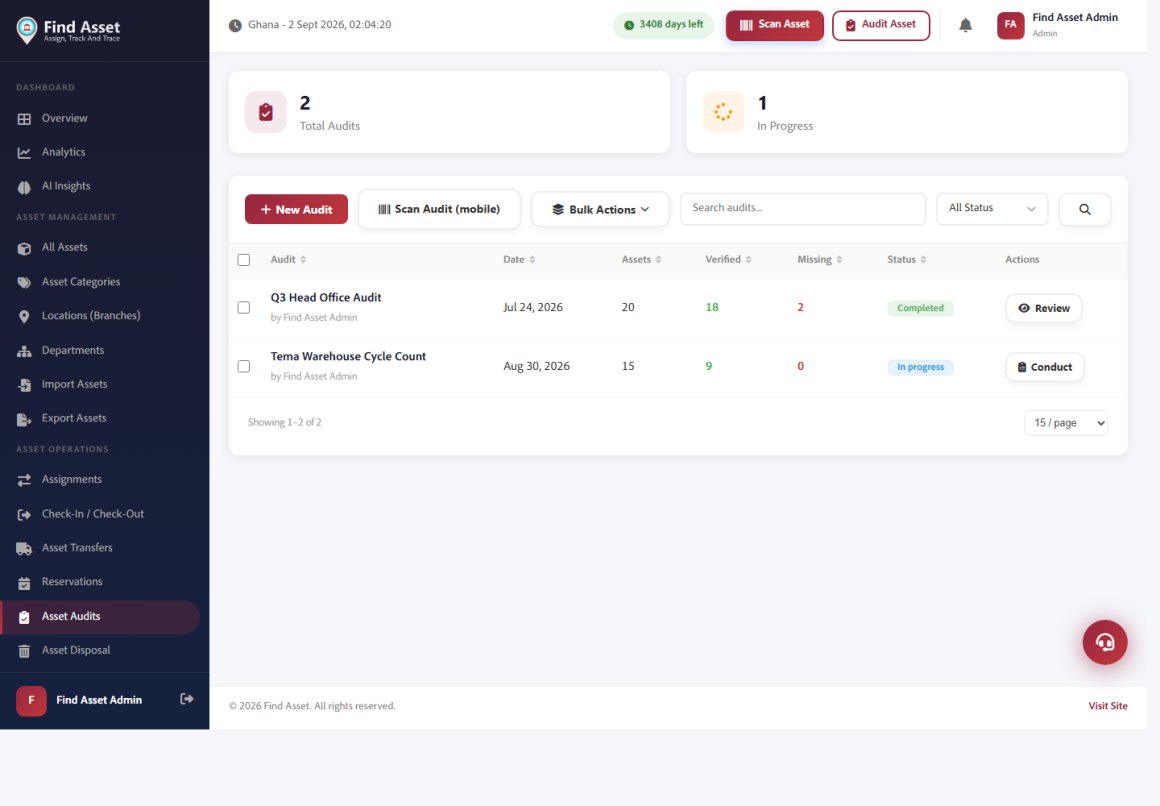
Find Asset runs audits as tracked sessions rather than a one-off spreadsheet. The screen below shows two on the go: a completed Head Office audit (20 assets, 18 verified, 2 flagged missing) and a warehouse cycle count in progress. You start an audit, walk the space scanning tags — each scan marks that asset verified — and anything unscanned is surfaced as missing when you close the session.
Choose a counting method that matches your team
There are two honest ways to run the count. A blind count hides the register from the auditor, who records what they physically find; you then compare their list to the register afterwards. This catches lazy ticking, because nobody can simply confirm what the sheet already says without looking at the item. The alternative, a directed count, hands the auditor the expected list to verify item by item. It is faster but more forgiving of error, since a tired counter can drift into agreeing with the list rather than checking against it.
For a first audit with a small, trusted team, a directed count is usually the pragmatic choice, provided you scan rather than eyeball. Scanning a barcode or QR code removes the temptation to assume, because the device either finds the record or it does not. If you have the discipline for it, run a blind count on your highest-value category, where a missing item costs the most, and directed counts elsewhere. Whichever you pick, decide it before the day, not during it, so nobody improvises a method halfway through the warehouse.
Run the count in the field
On the day itself, movement is the enemy of accuracy. Assets walk between rooms while you count, so freeze transfers for the duration if you can, or count each zone in a single unbroken sweep before moving on. Assign clear zones to named people so no cupboard is counted twice and none is skipped. A mobile-first tool matters here because the record updates the instant an item is scanned, rather than waiting for someone to key in a clipboard that evening, by which time the handwriting is a mystery and half the notes are ambiguous.
Capture more than a tick. Note the asset's condition, its location, and the name of whoever currently holds it. An audit that only confirms existence wastes the visit; you are already standing in front of the item, so record everything that will save you a second trip across town later. Photograph anything damaged so the state is documented rather than remembered. These details are what turn an audit from a headcount into an inventory of real, usable knowledge that feeds maintenance, insurance and replacement planning for the rest of the year.
What a clean field count captures
- A scan of the physical tag, not a typed guess at the serial number.
- Current location, recorded against the zone you are actually standing in.
- The named custodian responsible for the item right now.
- Condition and, where relevant, a photo of any damage or wear.
Reconcile the differences honestly
Once the count is done, the real work begins: comparing what you found to what you expected. Every asset falls into one of three buckets. It was on the register and found, which is the happy path. It was on the register and not found, which is a potential loss or a misplacement to chase. Or it was found but not on the register, which means your record was incomplete all along. That third category surprises people the most, and it is often the most valuable finding of the entire exercise.
Resist the urge to "fix" the numbers by quietly deleting the assets you could not find. An unlocated item is information, not an embarrassment to bury. Give each discrepancy a status and an owner, and set a deadline to investigate. Some will turn up in a colleague's drawer; some are genuinely gone and belong in a loss report that feeds your insurance and security conversations. The table below shows the categories worth tracking from your very first audit, because they become the baseline every future count is measured against.
| What to measure | Why it matters | A good number |
|---|---|---|
| Located rate | Share of registered assets physically found | Should approach full coverage |
| Ghost assets | Items on the register that no longer exist | Should approach zero |
| Unregistered finds | Real assets missing from the register | Falling as records mature |
| Unassigned assets | Assets without an accountable name | On a path to zero |
| Reconciliation time | Days from count to a signed-off result | Shortening each cycle |
None of these require a data scientist. A located rate of 82 per cent on a first audit is not a disaster; it is a baseline, and an honest one is worth far more than a flattering guess. The number that matters is whether it climbs on the next count. Ghost assets, meanwhile, quietly inflate depreciation and insurance premiums across many Ghanaian institutions, so removing them has a direct financial return that finance teams notice immediately, often paying back the cost of the whole exercise in a single reconciled ledger.
Turn the one-off audit into a rhythm
The annual stock-take is where organisations discover a year's worth of accumulated error in a single painful week. The fix is to audit little and often. Cycle counting spreads the workload across the year: you audit a slice of assets every month, so that by year end everything has been checked at least once, without ever shutting down operations for a marathon count. Because each slice is small, people actually finish it, and the register never drifts far enough from reality to become frightening or untrustworthy again.
Pick the slices by risk. High-value or highly mobile items, such as laptops and test instruments, deserve a count every quarter; heavy fixed plant that never moves can wait a year without much danger. This risk-weighted approach keeps effort proportionate and means each audit is small enough that people actually complete it rather than abandon it. Once you have run one full audit, the process becomes repeatable, and our step-by-step notes on asset-tracking best practices help you keep records honest between counts.
Bringing it together
Notice that none of this is really about technology for its own sake. A first asset audit succeeds or fails on preparation, sensible scope, honest reconciliation and the discipline to repeat it. The scanner and the software simply make each of those things faster and harder to fudge, which is no small thing when the alternative is a clipboard and a hopeful memory. The organisations that get value from auditing are the ones that treat the first count as a starting line rather than a finish line to be crossed once and forgotten.
A clean register, durable scannable tags, mobile counting that updates the record the moment you scan, and reconciliation reports that surface located rates and ghost assets: that loop is the product's daily work. If you are planning your first audit, you can start a free 14-day trial and walk your first zone with it. For the wider context, the background on physical inventory and the ISO 55000 asset-management standards are both worth a read.