

Somewhere in every organisation there is a piece of equipment being repaired at full price while a warranty that would have covered it sits, forgotten, in a drawer or an inbox. Nobody set out to waste the money. The purchase happened months or years ago, the paperwork was filed with good intentions, and by the time the fault appeared the person who bought the asset had moved on, taking the knowledge of its cover with them. The repair invoice was approved because it looked routine. The warranty was never checked because nobody knew it was there.
Warranties and service contracts are among the quietest sources of value in an asset register, and among the easiest to lose. They are promises made at the moment of purchase and redeemed, if at all, long afterwards. The gap between those two moments is where the value leaks away. Managing them well is not really a matter of legal expertise or careful reading of small print. It is a matter of memory: of capturing what was agreed, attaching it to the thing it protects, and making sure the dates surface before they pass rather than after.
The promise made at purchase, and where it goes
When an asset arrives, it usually arrives with cover. A manufacturer's warranty is bundled into the price, an extended warranty may have been bought alongside it, and for larger equipment there is often a service or maintenance contract negotiated separately. In the excitement of commissioning something new, this cover is treated as background noise. The asset is put to work, and the terms that govern its repair and replacement are set aside as a problem for a future that feels comfortably distant.
The trouble is that the future arrives without announcing itself. A pump fails, a laptop screen cracks, a generator refuses to start on the morning it is needed most. In that moment the question is not whether the asset is important but whether it is covered, and the answer has to be found quickly. If the warranty term, the expiry date and the proof of purchase were never recorded against the asset, the search becomes an archaeology of old emails and supplier portals. More often than not the easier path wins: the repair is simply paid for, and the cover that existed all along goes unclaimed. An unclaimed warranty is not a neutral oversight; it is money spent twice, once on the cover and again on the repair the cover would have met.
Knowing what you actually hold
Before you can manage cover you have to be honest about what kind of cover you have, because the word "warranty" is doing a lot of work for several different things. A manufacturer's warranty is the baseline promise that comes with the product, guaranteeing it against defects for a defined period at no extra cost. An extended warranty is a paid continuation of that promise, bought to push the expiry further out. A service or maintenance contract is a different animal altogether: it is an ongoing relationship in which a provider agrees to inspect, maintain or repair the asset, often with a service-level agreement defining how quickly they will respond and to what standard.
These distinctions matter because they change what you can expect and when. A manufacturer's warranty may cover parts but not labour, or exclude wear items entirely. An extended warranty may carry conditions that void it if servicing lapses. A maintenance contract may guarantee a four-hour response for a critical machine and next-day for a peripheral one, and that difference is precisely what you are paying for. Recording the type of cover, not merely its existence, is what lets you answer the only question that ever matters in a crisis: what, exactly, am I entitled to here, and by when. A field that simply says "under warranty" is almost worthless if it cannot tell you which promise, on what terms, until which date.
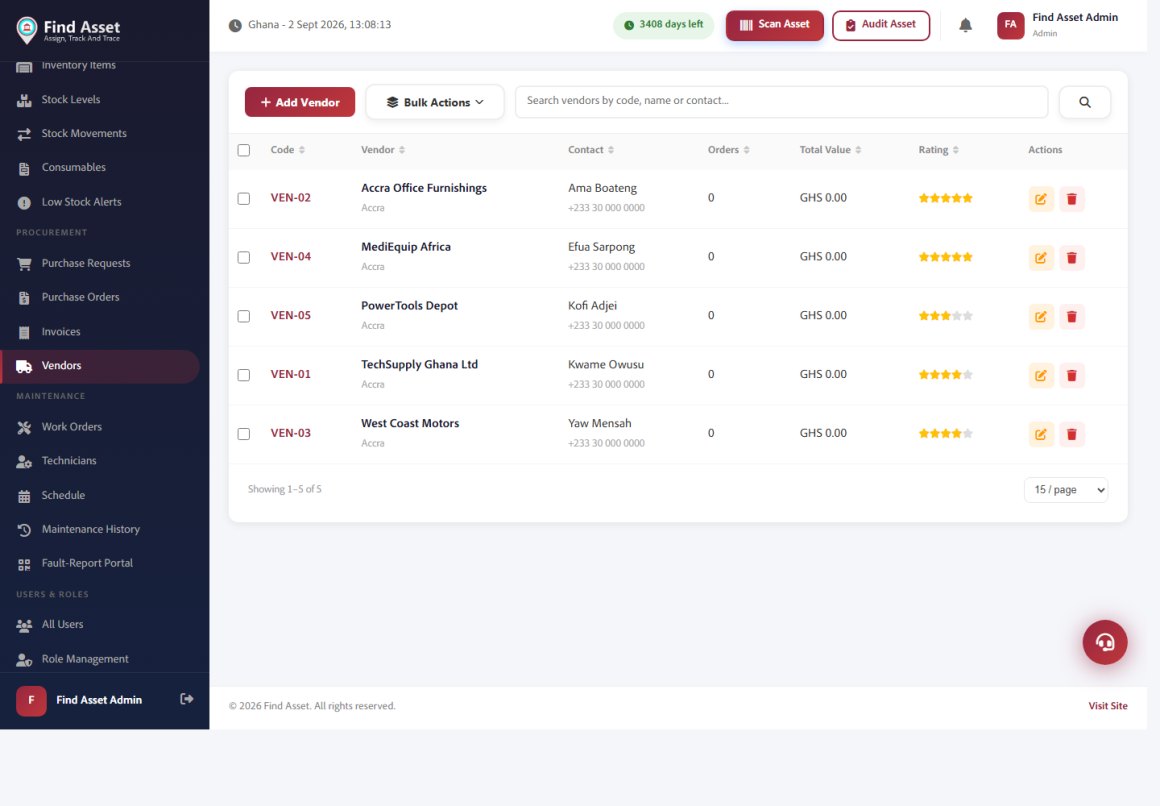
Warranties and contracts live with the supplier behind them, and Find Asset keeps that supplier directory too. The vendors screen below records each supplier, their contact, category and rating, so a warranty claim or a service contract is one click from the person you actually call — not a spreadsheet lookup. Assets link to their vendor, closing the loop between an item, its warranty and who honours it.
Attaching cover to the asset, not to a person
The single most useful thing you can do with warranty and contract data is to bind it to the asset record itself. Every asset in your register should carry its purchase date, its warranty term, the resulting expiry date, the type of cover, the provider, and a copy of the proof of purchase and the contract document. When those details live on the record rather than in someone's memory, they survive the departure of the person who bought the asset and the passage of years between purchase and failure.
This is where a proper fixed asset register earns its keep. An asset record that already tracks location, custodian and value has a natural home for warranty and contract fields, and the discipline of filling them in at the point of acquisition is small compared with the cost of reconstructing them later. The goal is that anyone who opens the record for a failing asset can see its cover status immediately, without a single email to the supplier. The knowledge stops being personal and becomes institutional, which is the only form of knowledge an organisation can rely on when the person who once held it in their head is no longer in the building.
Making expiries surface before they lapse
Recording an expiry date is only half the task. A date sitting quietly in a field protects nobody unless something makes it visible as it approaches. The whole point of capturing warranty terms is to be warned in advance, so that a decision about renewal is made deliberately rather than discovered by accident when a claim is refused. Cover that lapses unnoticed is the worst of both worlds: you paid for protection and then let it expire without ever using the chance to extend it.
This is why warranty and contract dates should feed the same alerting that governs the rest of your asset lifecycle. An expiry ninety or sixty days out is a prompt to decide, not a deadline to miss. The table below shows the kind of window each type of cover deserves, because the decision behind each is different in both weight and urgency, and a compliance certificate that lapses carries a very different consequence from a service contract you simply choose not to renew.
| Type of cover | What it protects | Typical lead time to review | Decision it triggers |
|---|---|---|---|
| Manufacturer's warranty | Defects in parts or workmanship | 60 days before expiry | Extend, or accept the asset moves off cover |
| Extended warranty | Continued defect cover beyond the base term | 90 days before expiry | Renew, let lapse, or self-insure |
| Service contract | Scheduled maintenance and repairs | 90 days before renewal | Renew, renegotiate, or bring in-house |
| Service-level agreement | Response time and repair standards | 60 days before renewal | Confirm terms still match criticality |
| Calibration or inspection cover | Compliance and safety certification | 45 days before expiry | Rebook before the certificate lapses |
The renewal decision: renew, lapse, or self-insure
When an expiry approaches, the reflexive answer is to renew, and for critical or expensive assets that reflex is usually right. But renewal is a financial decision, not an administrative one, and it deserves to be weighed against the asset it protects. An extended warranty on a machine that is nearing the end of its useful life may cost more over its remaining years than the machine is worth. A service contract renewed out of habit may be paying for response times the asset no longer needs, because its role has quietly diminished since the contract was first signed.
The honest alternative to renewal is often self-insurance: choosing to carry the risk yourself, setting aside the money you would have spent on cover, and paying for repairs from that reserve if and when they come. This makes sense for lower-value assets held in numbers, where the occasional failure is cheaper to absorb than to insure against across the whole fleet. Framing the choice this way turns renewal season from a rubber-stamp exercise into a genuine review, one that looks at each asset's value, age and importance and asks whether the cover still pays for itself. Understanding the true cost of ownership is what lets you make that call with confidence rather than guesswork.
What good warranty management looks like
- Capture purchase date, cover type, term and expiry against every asset at the point of acquisition.
- Attach the proof of purchase and the contract document to the asset record itself.
- Distinguish manufacturer warranties, extended warranties and service contracts, and record the SLA where one exists.
- Let expiry dates surface as alerts weeks in advance, never as surprises after a claim is refused.
- Treat each renewal as a decision weighed against the asset's value, age and remaining life.
Keeping the paperwork where the asset can find it
A warranty is only as good as your ability to prove it. When a claim is made, the provider will want the proof of purchase, the serial number, and often the original terms, and if any of these cannot be produced quickly the claim stalls or fails. Storing these documents in a general shared drive, sorted by supplier or by date, means that finding them at the moment of need depends on remembering how they were filed. That memory rarely survives contact with an emergency.
The remedy is to attach the documents to the asset they belong to, so that opening the asset record brings up its receipt, its warranty certificate and its contract together. This turns a claim from a hunt into a formality. It also protects you in the quieter moments that matter just as much: an audit, an insurance review, a dispute over what was actually agreed. The paperwork stops being a liability waiting to go missing and becomes part of the asset's own history, as much a property of the thing as its serial number or its location.
How cover shapes repair, replace and retire
Warranty status is not just a claim to be made; it is information that should shape every decision about an asset's future. When something fails, the first question is whether it is still covered, because a covered repair costs little and an uncovered one may cost more than the asset's remaining value. Knowing the cover status turns the repair-versus-replace question from a hunch into an arithmetic. An asset under warranty is almost always worth repairing; an asset just out of warranty, ageing and expensive to fix, may be telling you it is time to let go.
This is where warranty data connects to the end of the lifecycle. The same expiry that prompts a renewal decision also feeds the eventual choice to retire and dispose of an asset that has passed beyond economic repair. An asset that is out of cover, out of support and approaching the end of its useful life is a candidate for replacement, and recognising that early lets you plan the replacement rather than scramble for it after a failure. Cover, in this sense, is a lifecycle signal as much as a financial safeguard, quietly marking the moment when an asset stops being worth maintaining and starts being worth succeeding.
Bringing it together
None of this requires heroics. It requires that the promise made at purchase be written down against the asset it protects, that the dates be watched, and that each renewal be treated as a real decision rather than a reflex. Do that consistently and the warranties you paid for become warranties you actually use, the contracts you hold match the assets you still care about, and the repair bills you approve are the ones you genuinely owe. If you would like a single place to hold that record, you can start a free 14-day trial and put your cover where your assets can find it.
In the end, managing warranties and service contracts is an act of remembering on the organisation's behalf. The value was created the day the asset was bought and the cover agreed; the work of the years that follow is simply not to lose it. An asset register that carries each promise faithfully, surfaces each expiry in good time and links each decision to the asset's own worth turns forgotten cover into money kept, and turns the quiet leak of unclaimed warranties into a leak that has finally been closed.