

Every maintenance team has a story about the machine that failed at the worst possible moment. The packaging line that seized on the morning of a big shipment. The standby generator that would not start during a grid outage. The cold room that quietly drifted out of range overnight and spoiled a week of stock. In almost every one of these stories, the failure was not a bolt from the blue. It was a small, cheap problem that had been quietly growing for months while everyone was too busy fighting the last fire to notice.
That is the trap of running everything to failure: it feels efficient because you only touch equipment when it breaks, but you pay for that saving many times over in emergency call-outs, rushed parts, overtime and lost production. Preventive maintenance flips the economics. By servicing assets on a planned schedule, before they fail, you trade a large unpredictable cost for a small predictable one. The habit is not glamorous, but done properly it is one of the highest-return disciplines an operations team can build. This guide walks through how to design a schedule that actually holds.
Start by ranking assets on consequence, not age
The instinct when building a maintenance programme is to list every asset and give each one the same treatment. That is how teams end up drowning in checklists nobody completes. A better starting point is criticality: for each asset, ask what happens to safety, output and cost if it stops. A single compressor feeding the whole plant is critical; one of forty identical desk fans is not. Rank your assets into three or four tiers and spend your best effort where a failure hurts most.
This ranking is what stops a preventive programme from collapsing under its own weight. It is far better to maintain your twenty most critical assets flawlessly than to maintain two hundred assets half-heartedly. Criticality also tells you where to invest in condition monitoring versus a simple time-based check, which matters when budgets are tight and every cedi has to earn its place.
Choose the right trigger for each schedule
Preventive maintenance is not one method but several, and the mistake is applying the same trigger to everything. Time-based maintenance runs on the calendar: grease this bearing every month, service this vehicle every quarter. Usage-based maintenance runs on a meter: change the oil every 250 running hours or every 10,000 kilometres, whichever comes first. Condition-based maintenance acts on a measurement, such as vibration, temperature or oil analysis, and only intervenes when a reading drifts out of range.
For most organisations the honest answer is a blend. Time-based schedules are simple and suit assets that degrade steadily. Usage-based schedules suit anything whose wear tracks how hard it is worked, which is why they dominate fleet and generator maintenance. Condition-based monitoring is powerful but only worth the sensors and skill on your most critical, most expensive assets. Match the trigger to the failure pattern rather than picking one method and forcing every asset into it.
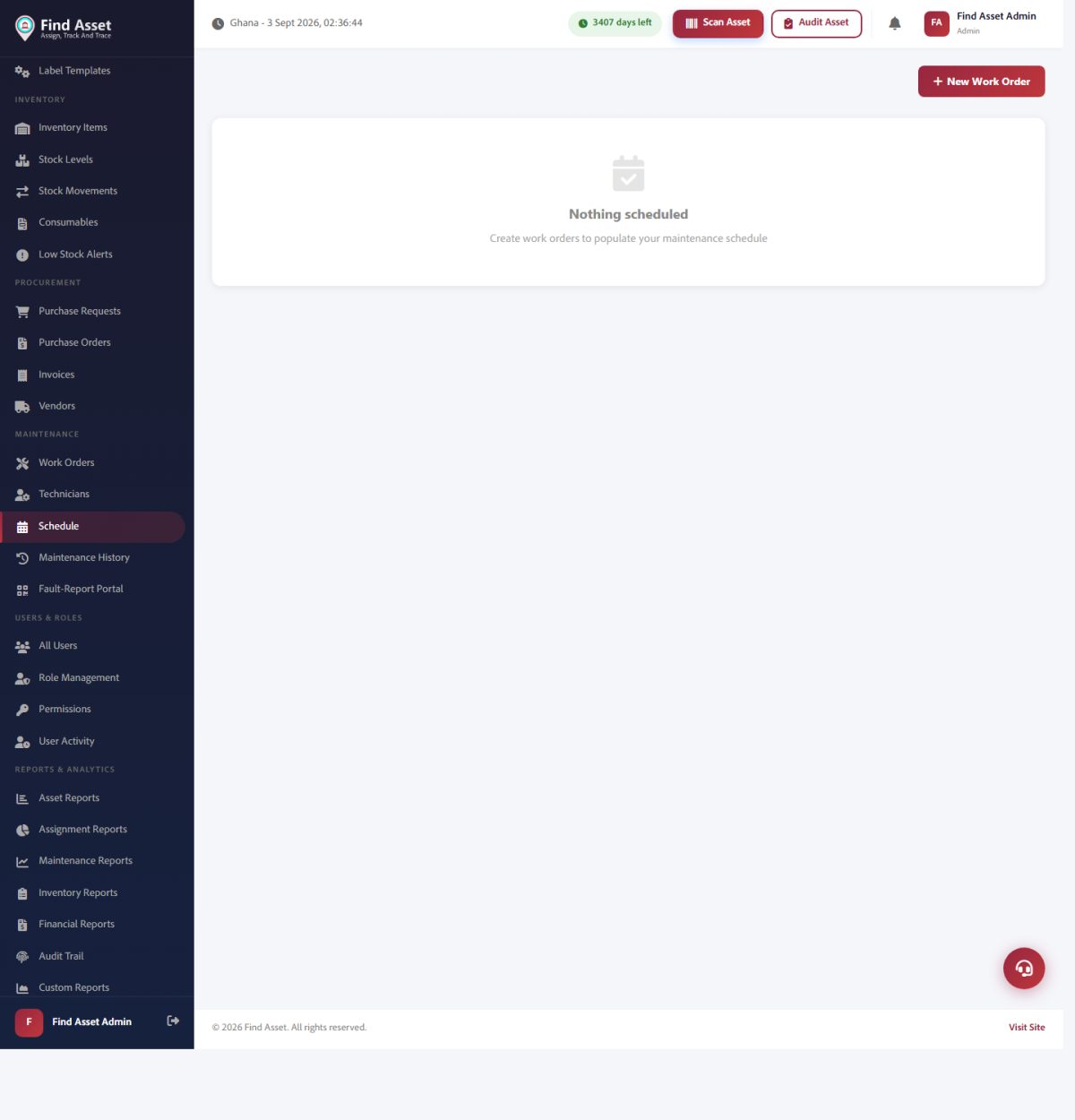
Preventive maintenance only works when it is scheduled rather than remembered. Find Asset's maintenance schedule (above) lets you attach recurring service intervals to individual assets, so the system reminds you before a machine is due, and every completed service is logged against that asset's history.
Set frequencies you can actually sustain
A schedule is only useful if it gets done, and the fastest way to kill a programme is to set frequencies your team has no hope of meeting. Look at the manufacturer's recommendations as a starting point, then adjust for how the asset is really used and the environment it sits in. Equipment running in the dust and heat common across much of West Africa will need filters and cooling checks far more often than the manual, written for a temperate climate, assumes.
Balance the interval against the cost of doing the task versus the cost of the failure it prevents. Over-maintaining wastes labour and can even introduce faults through unnecessary handling; under-maintaining defeats the whole purpose. The table below shows how frequency and trigger tend to line up across common asset types, as a sanity check rather than a rulebook.
| Asset type | Typical trigger | Frequency starting point | Key tasks |
|---|---|---|---|
| Standby generator | Time and running hours | Monthly test, service every 250 hrs | Oil, filters, coolant, load test |
| Fleet vehicle | Distance and time | Every 10,000 km or 6 months | Oil, brakes, tyres, fluids |
| HVAC / cold room | Time and condition | Quarterly service | Filters, gas pressure, temperature log |
| Production motor | Condition and hours | Monthly inspection | Vibration, lubrication, alignment |
| Office IT hardware | Time | Annual clean and check | Dust removal, backups, updates |
Write task lists a stand-in can follow
A calendar reminder that simply says "service the pump" is not a maintenance schedule; it is a hope. The value lives in the checklist attached to each job. A good task list spells out exactly what to inspect, the measurements to record, the tolerances that count as pass or fail, the parts and consumables needed, and the safety steps to take first. Written this way, the job no longer depends on one experienced person remembering everything in their head.
This matters most when that experienced person is on leave or has moved on. Documented procedures turn maintenance from tribal knowledge into an institutional asset, and they make it possible to hand a job to a junior technician or contractor without quality falling off a cliff. They also feed your records: when every check writes down a reading, you build the history that later tells you whether an asset is getting better or quietly heading for the scrap heap.
What a maintenance task list should always capture
- The specific steps to perform, in order, with safety and isolation first.
- The exact readings to record and the pass or fail tolerance for each.
- The parts, consumables and tools required to finish the job in one visit.
- Who performed it, when, and any faults found for follow-up.
Tie schedules to a single asset register
Preventive maintenance falls apart when the schedule lives in one person's calendar and the asset list lives somewhere else. Every planned job should hang off a real record in your asset register, so that history, custodian, location and service dates all sit in one place. When maintenance is bolted onto proper asset records, you can answer questions that matter: which assets cost the most to keep running, which are overdue, and which have failed so often they are cheaper to replace.
If your asset list is still scattered across spreadsheets and WhatsApp messages, fix that foundation first. A maintenance programme built on a shaky register will inherit every gap in the underlying data.
Make the work visible on the shop floor
Schedules that live only in an office system get ignored the moment the day gets busy. The teams that sustain preventive maintenance make the next job visible where the work happens. A technician should be able to scan a tag on the equipment and immediately see its service history, the open jobs against it, and the checklist for today's task. That single scan removes the excuse of not knowing what was due or what was done last time.
This is where labelling and mobile access earn their keep. When each asset carries a durable, scannable tag, updating the record becomes a ten-second action at the machine rather than a chore saved for later and forgotten. If you are weighing up how to tag your equipment, our guide on how to choose asset tags covers what survives heat, oil and daily handling.
Measure the numbers that predict downtime
You cannot manage a maintenance programme on gut feel. A handful of metrics tell you whether it is working long before the next breakdown does. Planned maintenance percentage, the share of maintenance hours that were scheduled rather than reactive, is the headline: mature programmes push this above eighty per cent. Mean time between failures should climb as your schedule bites, and schedule compliance, the proportion of planned jobs actually completed on time, tells you whether the plan is realistic or just aspirational.
Watch overdue jobs and repeat failures too. A rising backlog is an early warning that you have scheduled more than your team can deliver, and a cluster of repeat failures on one asset usually means the root cause was never fixed, only patched. None of this needs a data scientist; it needs a system that records every job so the numbers assemble themselves rather than depending on a monthly scramble through paper sheets.
Roll it out without stalling the plant
The final trap is trying to schedule everything at once. Start with your critical tier, get those schedules running cleanly for a month or two, then expand. Review each schedule quarterly against what actually happened: if an asset never fails between services, you may be over-maintaining and can stretch the interval; if it fails anyway, tighten it or move to condition monitoring. A maintenance programme is a living thing, not a document you write once and file away. Running a periodic physical check keeps the register honest, and our walkthrough on how to run your first asset audit shows how to fold that into the same routine.
The human side of the rollout matters as much as the schedule itself, and it is the part most plans forget. Technicians who have spent years firefighting can read a new preventive programme as a criticism of how they worked before, or as extra paperwork piled on top of an already full day. Bring them into designing the checklists, since they know the real failure points far better than any manual, and let the early wins speak for themselves — the first month a chronic breakdown simply stops happening does more to convert a sceptical team than any memo. Start small enough that the plant never feels the disruption, and each proven success buys you the credibility to widen the programme to the next tier.
Bringing it together
The machines barely feature in that list. What the habits are really about is turning maintenance from a series of emergencies into a predictable rhythm: rank by consequence, pick the right trigger, set frequencies you can sustain, write down the work, and watch a few honest numbers. Do that and unplanned downtime stops being a fact of life and becomes a metric you can drive towards zero. For the wider theory behind why planned intervention beats running to failure, the background on preventive maintenance is a useful read.
A programme shaped like that is what Find Asset is designed for. It keeps your asset register, service history, custodians and scannable tags in one place, so every scheduled job hangs off a real record and every technician can see what is due with a single scan. If you are ready to move maintenance out of spreadsheets and calendar reminders, start a free 14-day trial and schedule your most critical assets first.