
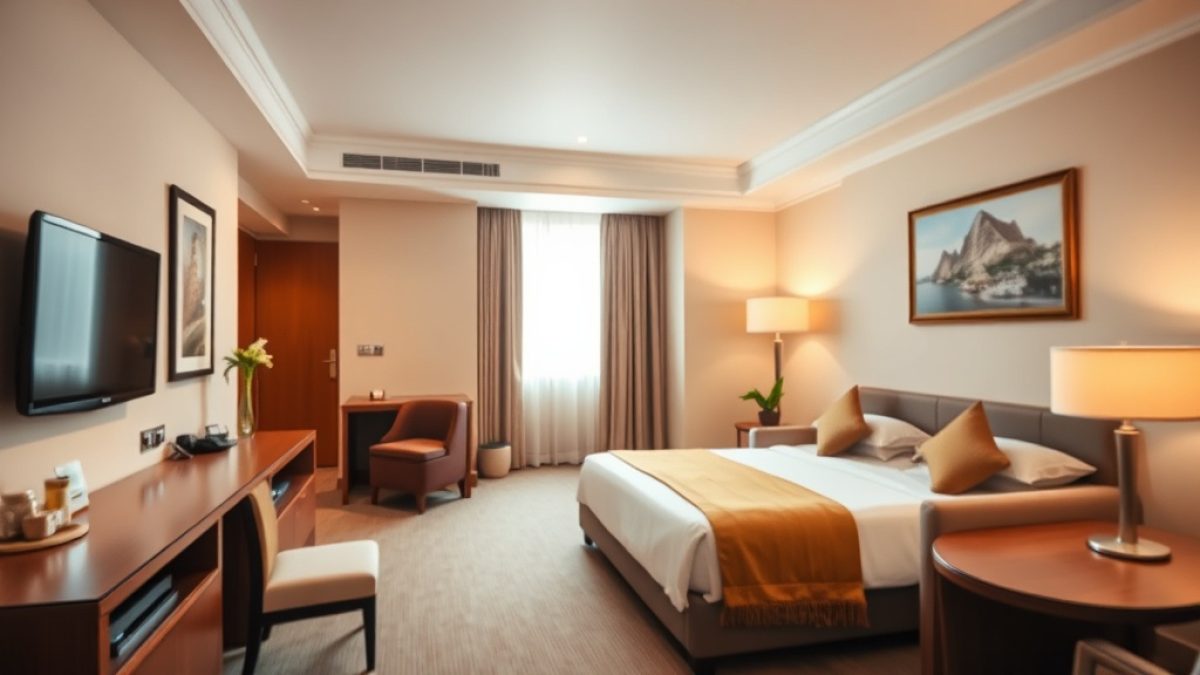
A hotel is one of the most asset-dense businesses there is. Every guest room is a small warehouse of trackable things: a television, an air-conditioner, a mini-fridge, a kettle, a hairdryer, linens, lamps, a safe, furniture and fittings. Multiply that by a hundred rooms, add the restaurant, the kitchen, the laundry, the gym and the grounds, and a mid-size hotel can easily own tens of thousands of individual items.
Those items move, break, walk out in suitcases and wear out under constant use. For a hospitality business, asset management is not a back-office nicety — it is directly tied to whether a room can be sold tonight. A single failed compressor or a fire-safety lapse can pull a floor out of service and dent the ratings that fill your rooms, so the register you keep is really a map of your revenue. Get it honest and current, and the whole operation runs quieter; let it drift, and you pay for the same items twice while guests notice the cracks.
Why hospitality assets are uniquely hard to track
Most organisations track assets that sit still and are handled only by staff. A hotel's assets are handled by strangers, all day, every day. Guests use the equipment, sometimes damage it, occasionally take it. Housekeeping moves items between rooms. Maintenance swaps a faulty air-conditioner from one room to another to keep a booking alive. The result is a register that drifts out of date faster than almost any other industry's, which is exactly why a casual spreadsheet fails in a hotel: by the time you have finished typing it, it is already wrong.
The churn is relentless in a way that catches new owners off guard. A hotel never closes, so there is no quiet Sunday when everything sits in its place long enough to be counted properly. Peak season doubles the traffic through every room, contractors come and go during a refurbishment, and seasonal staff turn over before they ever learn where things belong. Tracking here is not a once-a-year project you can schedule around a slow week; it has to be a habit woven into the daily rhythm of turnover, or the record and the reality will part ways within a fortnight.
Room-level and back-of-house assets are different problems
It helps to split the hotel's assets into two worlds. Room assets are numerous, repetitive and identical across many rooms — the same television model in every standard room. The value is in knowing which specific unit is in which room, so a fault can be traced and a replacement dispatched without disturbing a guest. Back-of-house assets — kitchen equipment, laundry machines, generators, pumps — are fewer, more valuable, and their failure has outsized consequences. A dead walk-in freezer or a failed generator can close a wing.
Because the two worlds fail differently, they deserve different tracking effort. Room assets reward breadth: a simple, consistent tag on every unit tied to a room number, so a housekeeper's report of a dead kettle in 214 becomes an instant work order rather than a hunt. Back-of-house assets reward depth: fewer items, but each one carrying its full service history, warranty status and supplier contact, because when a generator quits at nine on a Friday night you need the maintenance record and the engineer's number in seconds, not the following Monday. Treating both the same way over-burdens the rooms and under-protects the plant room.
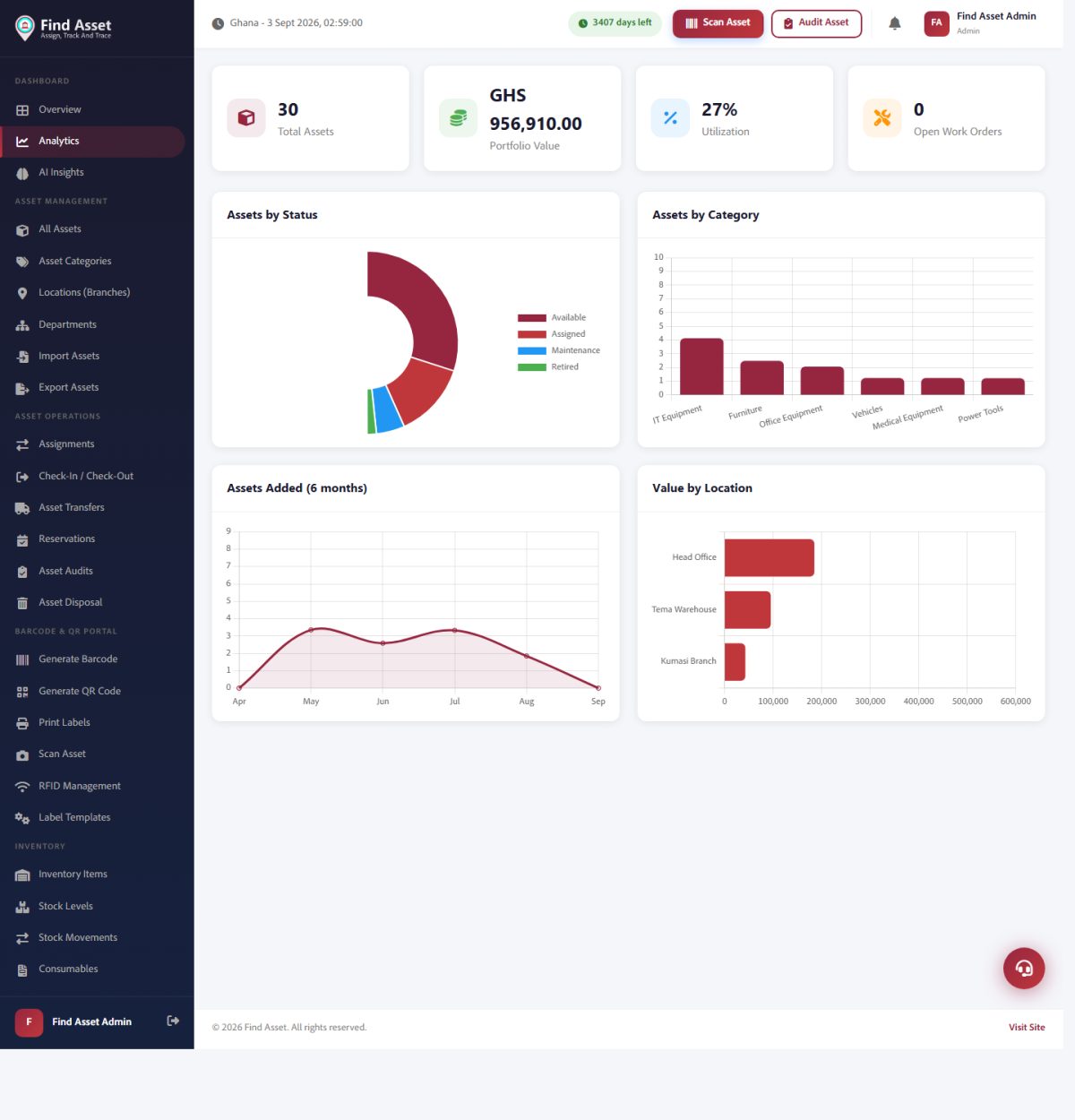
A hotel's assets are spread across hundreds of rooms and back-of-house areas. Find Asset's analytics (above) roll that sprawl up into a single view, which is the kind of overview a property manager needs day to day.
The shrinkage and guest-damage problem
Every hotelier knows the quiet drain of missing towels, vanished hairdryers and the remote control that left in a guest's bag. Individually trivial, in aggregate this shrinkage funds a small competitor. Tagging and periodic room checks will not stop a determined thief, but they turn invisible drift into a measured number, and a measured number can be managed. When housekeeping records what is in a room and a quick check at turnover flags what is missing, losses surface within a day instead of at the annual stock-take.
Guest damage is the twin of shrinkage, and it is where a good record quietly pays for itself. A scald mark on a laminate top, a cracked bathroom mirror, a television screen someone leaned a suitcase against — without a dated log of what each room held and in what condition, the front desk cannot fairly charge the damage or defend the charge when a guest disputes it. A register that captures condition at check-in and flags the change at turnover gives the manager the evidence to recover the cost, and just as importantly, the confidence to waive it graciously when the wear is genuinely fair. Fairness, backed by a record, protects both the margin and the review score.
Preventive maintenance keeps rooms sellable
In hospitality, a broken asset is not just a repair cost; it is a room you cannot sell and a review you would rather not read. An air-conditioner that fails on a hot night, a shower that runs cold, a lift out of service — each one converts directly into refunds and lost bookings. This is why the most valuable thing a hotel can attach to its assets is a maintenance schedule, the discipline covered in preventive maintenance 101. Servicing air-conditioners before the hot season and testing the generator monthly cost a fraction of the emergency repair and the lost night's revenue.
The economics are stark once you put a night's rate against the alternative. A planned air-conditioner service might cost a modest call-out fee and half an hour of a technician's time; the same unit failing at midnight in a full house means a refunded room, a scrambled upgrade, a one-star review that lingers online for years, and an emergency repair at weekend rates. Preventive maintenance simply moves that spending forward into a cheaper, calmer window. Tie the schedule to the asset record so the next-due date travels with the machine, and the work stops depending on any one person's memory — the system reminds you before the guest does.
What to tag and what to treat as consumables
Not everything in a hotel is an asset worth tracking individually. Draw a sensible line. The test is simple: an item earns an individual tag when knowing which specific unit is where actually changes a decision — a fault to trace, a warranty to claim, a theft to notice. Anything you buy by the box, use up, and never miss as a single unit belongs in stock, counted as a pooled quantity rather than chased one by one. Getting this boundary right is the difference between a register that stays useful and one that collapses under its own detail.
| Handle as an asset | Handle as stock / consumable |
|---|---|
| Televisions, fridges, air-conditioners | Toiletries, stationery |
| Furniture, safes, kitchen equipment | Most linens (track as pooled quantities) |
| Generators, pumps, gym equipment | Cleaning supplies, guest amenities |
Tagging a bar of soap costs more than the soap; getting this line right keeps the register focused on what matters. The failure mode is over-tracking, not under-tracking — enthusiastic teams that try to barcode every pillowcase quickly abandon the whole system when the admin overwhelms them. Keep the asset register lean and let a separate, simpler stock count handle the high-volume consumables. A register that holds a few thousand things that genuinely matter will be maintained; one that holds fifty thousand trivial ones will be quietly ignored within a month.
A starting playbook for a mid-size hotel
- Tag the expensive back-of-house equipment first — one failure hurts most.
- Tag standard room assets one room type at a time, using the room number as the location.
- Build a turnover check into housekeeping so missing items surface daily.
- Attach maintenance dates to anything a guest depends on.
Tie assets to shifts, not just to rooms
In a hotel, responsibility changes hands several times a day as shifts rotate, and assets have a way of going missing precisely in the gaps between them. The organisations that control shrinkage best build a light handover habit: at the change of a shift, the incoming staff confirm that the flagged assets on their section are present, so any loss is pinned to a window of a few hours and a named team rather than discovered weeks later. This is not about blame; it is about closing the anonymity that lets losses hide.
The handover works best when it is fast enough to survive a busy night. A housekeeper scanning the flagged items on her floor as she clocks off, a night porter confirming the crash-cart of tools he inherits, a duty manager signing off the safe and the till floats — each check takes seconds when it rides on a phone rather than a clipboard. Over time the pattern does something subtler than catching thieves: it makes every member of staff feel that the equipment on their watch is genuinely theirs to mind. Ownership, once it has a name and a shift attached, quietly tightens everything.
Bringing it together
Hospitality lives or dies on the guest experience, and the guest experience quietly depends on thousands of assets working, present and in good order. Split room from back-of-house, measure your shrinkage, schedule maintenance around the guest, and tie assets to shifts. Track them well and the machinery of the hotel fades into the background where it belongs. If you would like every room's inventory in one place, you can start a free 14-day trial and tag your first room type this afternoon.
Start small and let the wins build their own momentum. Tag the plant room and the kitchen first, because that is where a single failure does the most damage, then work through one room type at a time until the whole property is covered. Fold the turnover check into housekeeping so the register updates itself through the ordinary rhythm of the day, and review the short list of losses and overdue services once a week over coffee. None of this demands a new department or a consultant. It demands a decision that knowing what you own, and where it is tonight, is worth ten disciplined minutes a shift — and in a business where an empty room can never be sold again, it plainly is.