

Most organisations do not fail at asset management because they lack software or spreadsheets. They fail because nobody is quite sure who is allowed to do what, when a record should be updated, or what happens when a laptop walks out the door. A policy is supposed to answer those questions once and for all, yet the average asset policy sits in a shared drive gathering dust, written in language so stiff that the people it governs never read past the first page.
This guide takes a different view. A good asset management policy is not a legal shield or a box-ticking exercise; it is a short, plain agreement about how your team treats the things it owns. When it is written for real humans doing real jobs, people follow it because it makes their day easier, not harder. Below is how to draft one that survives contact with a busy office in Accra, Lagos, Nairobi or anywhere else work actually happens.
Why most asset policies get ignored
Walk into almost any finance or IT department and you will find a policy document that reads like it was translated from a regulatory manual. It is long, it references clauses nobody remembers, and it assumes everyone has time to memorise procedures. The result is predictable: staff sign it during onboarding, forget it by lunchtime, and carry on doing whatever felt natural. A policy that is never referenced is not a policy at all; it is decorative paperwork with a signature block.
The second reason policies get ignored is that they describe an ideal world rather than the messy one your team lives in. If your policy says every asset transfer must be approved in triplicate but the warehouse is short-staffed on a Friday afternoon, people will improvise. Every time reality forces a shortcut, the policy loses a little more authority. Writing rules people can genuinely keep, even on a bad day, is the single biggest predictor of whether they will be followed at all.
Start with the questions people actually ask
Before you write a single rule, spend an afternoon listening. What do staff actually ask when an asset issue comes up? Usually it is small and practical: who do I tell if my phone breaks, can I take this monitor home, who signs off when I move a printer between branches, what happens if something gets stolen off-site. These questions are the real skeleton of your policy. If your document answers them clearly, it will earn its keep; if it answers questions nobody is asking, it will be ignored.
Group those questions into themes and you will find your policy almost writes itself. Ownership and responsibility, acquisition and disposal, movement and transfers, loss and damage, and record-keeping cover the vast majority of daily situations. Resist the urge to invent scenarios that have never happened in your organisation. A policy built from genuine questions feels relevant, and relevance is what keeps a document alive on people's desks instead of buried in a folder they open once a year.
Define ownership before anything else
Nothing derails asset management faster than fuzzy ownership. When everyone is responsible, no one is. Your policy should name, by role rather than by person, who owns each stage of an asset's life. A department head might own assets assigned to their unit, a custodian might own physical safekeeping, and finance might own the valuation and the books. Spell out these roles in one clear table so that when something goes wrong, the first question, "whose job was this," has an instant answer.
Ownership also means accountability for the record itself, not just the physical item. Someone must be responsible for keeping the register accurate, which is why a policy without a well-maintained fixed asset register is toothless. If nobody is charged with updating entries when assets move, get repaired, or are retired, the data drifts within months. Tie a named role to the register in your policy, and review that ownership annually so it survives staff changes and reorganisations without quietly lapsing.
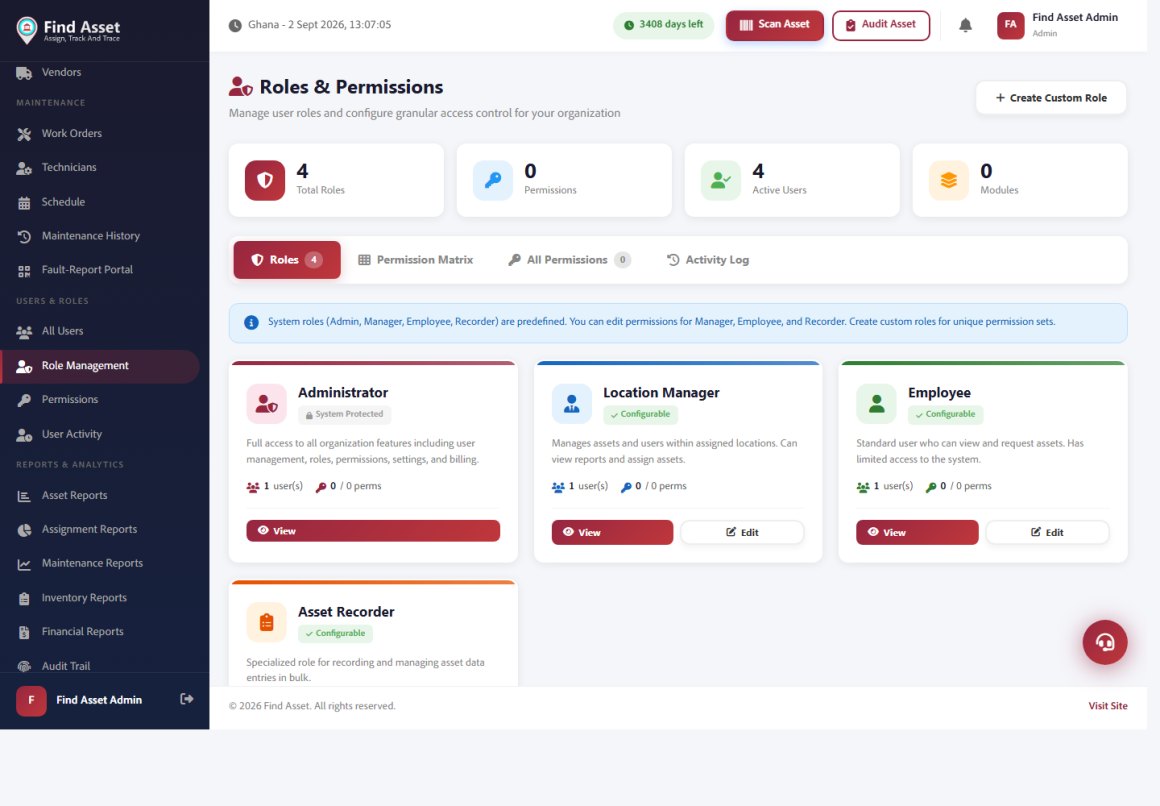
A policy is only as strong as the access controls behind it. Find Asset ships with role-based permissions — as the screen below shows, roles like Administrator, Location Manager, Employee and Asset Recorder each carry a defined scope, and you can create custom roles with granular permissions. Your written policy then maps straight onto who can register, assign, edit, audit or dispose of an asset.
Keep the rules short, specific and testable
A rule that cannot be tested is a wish. "Assets should be handled with care" sounds fine but means nothing in practice. Compare it with "any asset leaving the building overnight must be logged in the movement register before it goes." One is a vibe; the other is something you can check. Every clause in your policy should pass a simple test: could an outsider tell, just by looking at your records, whether the rule was followed? If not, rewrite it until they could.
Specificity also protects your staff. When rules are vague, people get blamed after the fact for decisions that seemed reasonable at the time. Clear, testable rules remove that anxiety because everyone knows exactly where the line sits. This is the same discipline that underpins good asset tracking best practices, where consistent, checkable data beats good intentions every time. A short policy full of testable rules will always outperform a long one full of aspirations nobody can measure.
What a followable policy needs
- Answers the questions staff actually ask, in plain language
- Names an owner for every asset stage and for the register itself
- Uses testable rules, not vague aspirations like "handle with care"
- Fits on a few pages so people genuinely read it
Match consequences to reality
Policies love to threaten consequences, but empty threats corrode trust faster than having no rules at all. If your document says losing an asset means disciplinary action, that consequence must actually be applied consistently, or staff quickly learn the whole thing is theatre. It is often wiser to write graduated, proportionate responses: an honest report of a broken laptop is handled very differently from a pattern of unexplained disappearances. People respect rules they see enforced fairly.
Consider also the incentives you are creating. If reporting a lost item triggers punishment, staff will hide losses rather than report them, and your data becomes fiction. A smarter policy rewards honesty by making reporting easy and blame-free for genuine accidents, while reserving firm consequences for negligence or repeated carelessness. The table below shows how the same situation can be framed either to encourage transparency or to drive it underground, and the difference is entirely in the policy's tone.
| Situation | Policy that people follow |
|---|---|
| Laptop screen cracked accidentally | Report within 24 hours, no blame, repair logged against the asset |
| Asset moved between branches | Custodian updates the movement register the same day, one approval |
| Item genuinely lost off-site | Honest report accepted, investigation focuses on prevention not punishment |
| Repeated unexplained losses | Escalation to management with a documented history from the register |
Make the policy easy to live with day to day
The best policy in the world fails if following it requires ten extra minutes per task. Wherever a rule creates friction, look for a way to make compliance the path of least resistance. If logging a transfer takes thirty seconds on a phone, people will do it; if it means finding a paper form, a pen and a manager's signature, they will skip it. Design your procedures so that the correct action is also the quickest, and adherence will climb without any nagging.
This is where good tooling and a good policy reinforce each other. A system that lets a custodian scan an asset and update its location in seconds turns a policy rule into a natural habit. The broader discipline of asset management has always recognised that process and technology must fit the people using them. When your policy and your tools pull in the same direction, following the rules stops feeling like a chore and starts feeling like the obvious way to work.
Review, refresh and keep it honest
A policy is a living document, not a monument. Set a fixed date each year to read it against what your organisation actually does, and be ruthless about cutting rules that no longer match reality. If a clause has been quietly ignored for twelve months without any harm, that is strong evidence it was never necessary. Trimming dead rules is not weakness; it is what keeps the remaining rules credible and worth following.
Involve the people who live under the policy in each review. The custodians, department heads and finance staff who handle assets daily know exactly where the document rubs against reality, and they will tell you if you ask honestly. A policy shaped by their feedback belongs to them, and people follow rules they helped write far more willingly than rules imposed from above. Small, regular refreshes keep the whole thing trustworthy year after year.
Bringing it together
An asset management policy that people actually follow is short, specific, and built from the real questions your team asks. It names owners, ties itself to an accurate register, uses testable rules instead of vague hopes, and matches its consequences to reality so honesty is never punished. Above all, it makes the correct action the easy action, so compliance becomes a habit rather than a burden that staff resent and eventually abandon.
If you are ready to pair a clear policy with tooling that makes those rules effortless to keep, the simplest first step is to put your assets somewhere structured and see how the workflow feels. You can start a free 14-day trial and build your register, assign custodians, and test your draft policy against real movements before you roll it out organisation-wide. A policy tested against live data is one your team will trust, and trusted rules are the only rules worth writing.