

A church can run for years on volunteer goodwill and still lose track of what it owns. The sound desk is serviced by whoever remembers which company installed it. The plastic chairs and canopies return from funerals in numbers nobody counts. A keyboard bought by the choir lives at the music director's house, and the generator's service book sits in the sacristy drawer. None of this is carelessness; churches simply grow asset by asset, donation by donation, and the paperwork never catches up. A church asset register fixes that: one list, one place, kept current by the people already using the equipment.
Start with a sweep, not a spreadsheet
The register begins with a physical walk-through. Take a phone and a notebook through every space the church controls: the sanctuary, the hall, the offices, the store, the kitchen, the compound. Write down what is there, roughly how old it is, and its condition. Expect the sweep to find things nobody remembered: a second projector from a renovation, instruments stored at members' homes, canopy frames missing their tops. The sweep is also the moment the church discovers its fleet is larger than any list claimed, which is normal, and better discovered now than during an audit.
Two capture rules keep the register honest from day one. Record items even when details are missing, because an entry with "value unknown" beats no entry at all and can be enriched later. And record the donated items too, the keyboard from a member, the second-hand PA system, because donated equipment is the first to be forgotten and the first to walk away.
The categories a church register should hold
Churches organise equipment differently from businesses, so the register's categories should match how the church actually thinks.
Worship and sound: the PA system, speakers, mixers, microphones, cables, and the instruments the choir and band use, from keyboards and drums to the steel racks that store them. Media: projectors, screens, cameras, the streaming laptop, and the lighting rig. Furniture: pews and chairs, including the stackable plastic chairs that swell every convention, plus canopies and tents that do double duty at outdoor events. Hall and kitchen: coolers, warming appliances, water dispensers, tables. Office and IT: computers, printers, and the UPS units that protect them from power cuts. Vehicles and compound: the church bus, the generator, and any equipment used to maintain the grounds.
Whatever the categories, the test is the same: when the media team says "the camera", the register should say which camera, where it lives, and who holds it.
The details worth recording per item
A register earns its keep through the details captured once, at entry. For each asset: a name and a tag number, the room or store where it lives, its condition, an estimated value, and the serial number where one exists. Purchase date and cost where receipts survive, donor and date where items were given, and warranty end dates for anything bought new. For equipment that gets repaired, the sound desk and the generator above all, record each service with its date and cost, because that history is what turns a breakdown into a known cost rather than a crisis. The fixed asset register guide covers the structure in full; the church additions are donor information and loan tracking.
Assign each ministry its custodians
Churches already run on ministry ownership, so the register should follow that shape. The media team holds the cameras and projectors. The choir holds the instruments. The youth ministry holds whatever it was given. Recording a custodian against each asset, a person or a ministry, ends the church's most common argument: who had it last. When the keyboard that belongs to the choir is at the music director's house, the register should say so, plainly and without judgement, because an honest record of where things are beats a tidy record of where they should be.
Tag what people handle, scan what they carry
Tags turn the register from a document into a system. A laminated QR label on the sound desk, each camera case, and the store shelving lets any member scan with a phone and see the item's record in seconds: what it is, who holds it, its service history. Tags survive Sunday handling when they are placed away from grips and hot surfaces, and the scanning habit is the whole system: items scanned out for events and scanned back in on return. Our guides to durable asset label materials and scanning asset tags with a phone cover the choices in practical detail.
Track loans, events, and rentals
Church equipment lives a public life. Chairs and canopies go to members' weddings and funerals. The PA system serves the convention and the crusade. In many churches, renting out chairs, canopies, and tables is also a small income line, and nobody reconciles the returns against the bookings. A register with loan recording turns all of this into simple entries: what left, with whom, when due, what returned. Damaged or missing items surface within days instead of surfacing at the next event when the count comes up short.
Keep the register ready for handovers and audits
Church leadership changes, and with it the trustees, the stewards, and the committee members who signed for equipment years earlier. A current register is what makes those transitions peaceful: the outgoing leadership hands over a list, the incoming leadership verifies it by scanning, and the church's property passes with a record instead of a dispute. The same register answers the church's other obligations, insurance schedules when the policy renews, valuations when the bank asks, and the annual report to the congregation that funded everything. When the denomination's audit committee visits, the answers come from the screen.
How Find Asset fits a church's routine
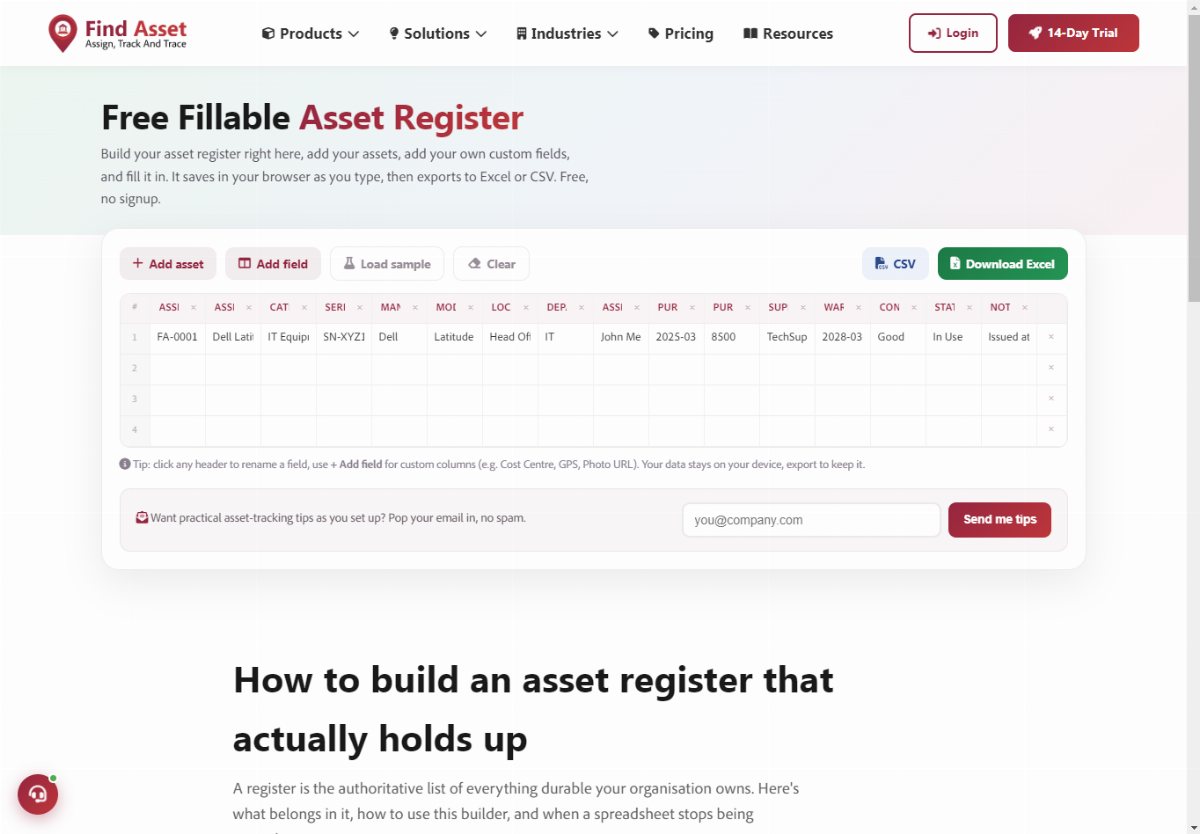
Find Asset runs the whole workflow on one platform: the register, QR label printing, phone scanning, custodian and ministry assignment, loan and event tracking, and the reports that handovers and audits require. It works across multiple branches from one account, which suits churches running a sanctuary, a hall, and a school on the same compound. Churches can start with a free trial and load the register one ministry at a time, and our guide to asset management for churches covers the broader practice, from service scheduling to budgeting. For a head start on structure, the free fillable asset register template produces the same columns this guide describes.
What the register really protects
The value of a church asset register is not the list itself. It is the peace of the next handover, the fairness of the next audit, the generator serviced before the convention instead of during it, and the chairs that come home from every funeral. Churches steward what their members gave, and a register is how that stewardship stays visible, year after year, leadership after leadership.