
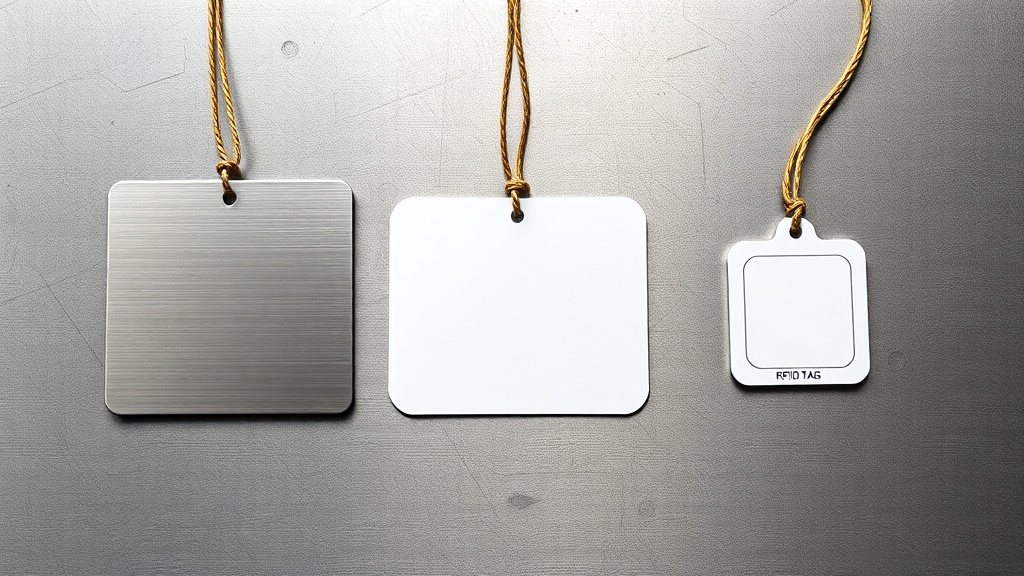
Buy a stack of the cheapest labels you can find, print your asset numbers on them and stick them on everything. It feels like a sensible way to start, and for the first few weeks it works perfectly. Then the harmattan dust arrives, a generator housing heats up, a delivery van bakes in the sun, and six months later half your tags are curled at the corners, faded to grey or gone entirely. The register still lists the assets; the physical link between the record and the equipment has quietly failed.
An asset tag is only doing its job if it survives as long as the asset it identifies. That sounds obvious, yet it is the single decision most organisations rush. The right material depends on where the tag will live, what it will be stuck to, how often it is scanned and how long the item is expected to serve. This guide walks through the three families you will actually choose between, the surfaces and environments that push you towards each, and how to avoid paying for durability you do not need.
Start with the enemy, not the label
Before comparing materials, describe what the tag has to survive. A label on an office monitor faces almost nothing: a wipe with a cloth, the occasional knock. A tag on a water pump at a treatment plant faces heat, moisture, cleaning chemicals and vibration. A plate on a road-construction excavator faces sun, rain, mud and the abrasion of grit blowing across it every working day. Those are three completely different problems, and no single material solves all of them well.
Write down four things for each class of asset: the surface material, the temperature range, whether it gets wet or chemically cleaned, and the expected service life. Those four answers narrow the field faster than any product catalogue. A tag that will outlive a five-year laptop is over-engineered; a tag that fails before a fifteen-year transformer is a false economy you will pay for twice.
Polyester and vinyl: the everyday workhorse
For the majority of indoor and light-industrial assets, a printed polyester or vinyl label is the correct answer, and it is not close. These synthetic labels resist moisture, mild solvents and UV far better than paper, hold a crisp barcode, and cost a fraction of engraved metal. A good polyester label with a permanent acrylic adhesive will happily last the life of a laptop, a desk, a projector, a hospital bed frame or a classroom cabinet.
The important upgrade over cheap paper stock is the print method. Thermal-transfer printing, where a resin ribbon bonds the image to the label, produces a mark that shrugs off abrasion and sunlight. Direct-thermal labels, which have no ribbon and darken under heat, are fine for temporary tickets but fade badly and should never be used for a permanent asset tag. If you are designing your own, our walkthrough on designing a clean Zebra label covers the print settings that matter.
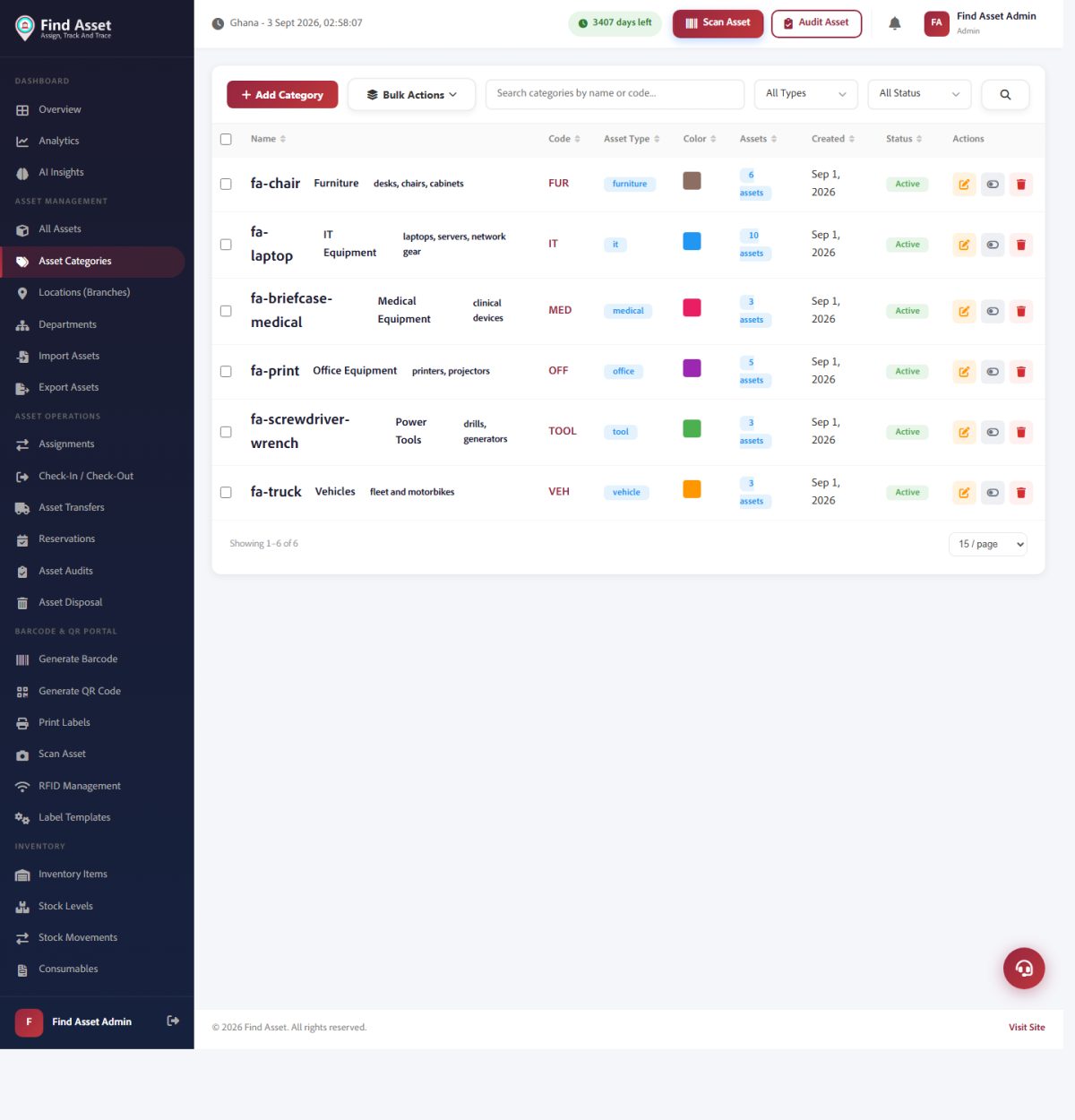
Different assets want different tags. Find Asset's categories (above) let you group items by type, which is a sensible first step before choosing tags — laptops, furniture and vehicles rarely need the same label.
Polyester also flexes, which lets it wrap around curved surfaces such as cable drums, cylindrical tools and pipe fittings where a rigid plate simply will not sit flat. For most schools, offices, clinics and NGOs across Ghana, a well-specified polyester label covers eighty per cent or more of the estate at a price that keeps the whole project affordable.
Metal tags: when the asset outlives everything
There is a point where a stick-on label stops making sense: heavy plant, outdoor infrastructure, machinery washed with harsh chemicals, or anything expected to serve for a decade or more. Here you want anodised aluminium or stainless steel tags, where the barcode is etched or sub-surface printed rather than sitting on top. The image lives beneath a protective layer, so grit and cleaning cannot scrub it away.
Metal tags are fixed with industrial adhesive, rivets or screws. On a generator, a pump, a transformer or a fleet vehicle chassis, a riveted metal plate will still scan cleanly long after a paper label would have turned to confetti. The trade-off is cost and effort: metal tags cost several times more per unit and take longer to fit. Reserve them for the assets that genuinely earn the investment rather than defaulting to them across the board.
When a metal tag is worth the premium
- The asset is expected to last ten years or more.
- It lives outdoors or in direct sun, rain or dust.
- It is regularly washed down with water or cleaning chemicals.
- It faces heat, vibration or abrasion that would destroy an adhesive label.
- Losing the identity would be expensive or safety-critical to re-establish.
RFID: when you cannot scan one tag at a time
Barcodes, whether on polyester or metal, share one limitation: someone has to see each tag and point a scanner at it. RFID removes the line-of-sight requirement. A reader can capture dozens of tags in seconds, through boxes and without perfect aim, which transforms the economics of counting a store room or checking a lab full of equipment. If a full audit of a large site currently eats two days, RFID can turn it into an afternoon.
The catch is cost and physics. RFID tags cost more than a printed label, readers are a real investment, and standard UHF tags misbehave near metal and water unless you buy on-metal variants designed for it. RFID is not a replacement for barcodes so much as a step up for high-volume, high-value or fast-moving estates. Many organisations run both: barcodes as the universal backbone and RFID on the specific pools where bulk reading pays for itself. Our comparison of RFID versus barcode digs into where the line sits.
Matching material to the job
The table below summarises the trade-offs in the terms that actually decide a purchase. Treat it as a starting point, then confirm against your own four answers about surface, temperature, exposure and lifespan.
| Tag type | Best for | Weak against | Relative cost |
|---|---|---|---|
| Direct-thermal paper | Temporary tickets, short-term loans | Heat, sunlight, moisture, abrasion | Lowest |
| Thermal-transfer polyester | Offices, schools, clinics, indoor kit | Very harsh chemicals, extreme heat | Low |
| Anodised aluminium | Outdoor plant, machinery, vehicles | Higher unit cost, slower to fit | Medium-high |
| Stainless steel (etched) | Chemical, marine, high-temperature use | Cost, weight, fitting effort | High |
| UHF RFID (on-metal) | Bulk counting, high-value pools | Reader cost, metal/water interference | Highest |
Notice that the cheapest option, direct-thermal paper, is also the one you should almost never use for a permanent tag. The genuine saving comes not from buying the cheapest label but from buying the right one once, rather than re-tagging the same assets every year.
Surface and placement decide whether any tag survives
Even the best material fails if it is applied badly. Adhesive needs a clean, dry, room-temperature surface; wipe off dust and grease with alcohol before fitting, because a tag stuck to grime is a tag that will peel. Textured plastics and powder-coated metal hold adhesive far better than glossy or oily surfaces. On very rough or hot surfaces, mechanical fixing with rivets or screws beats any glue.
Placement matters just as much as the tag itself. Put the label where a person can reach and scan it without moving the asset, away from edges that catch and peel, and away from hinges, heat vents or wear points. A tag on the underside of a monitor foot or the back of a cabinet looks tidy and never gets scanned. Our note on common label placement mistakes covers the traps in detail.
Size, contrast and the boring details that stop scans
A tag can be perfectly durable and still refuse to scan. Barcodes need a minimum quiet zone of clear space around them, adequate contrast between the bars and background, and enough physical size for the reader you use. Shrinking a barcode to fit a small tool is a false economy if a phone camera can no longer resolve it. When you standardise on a material, standardise on a minimum tag size and a tested layout at the same time, and print a handful to scan in real conditions before committing to a full run. The international standard behind these symbols, ISO/IEC 15417, exists precisely so that a correctly printed barcode reads reliably on any conforming scanner.
The reason these details feel boring is that they only announce themselves when they fail, usually weeks after the labels have gone out and always at the least convenient moment. A tag squeezed onto a tool so small that the bars sit below your scanner's minimum resolution will pass a casual glance and then defeat every attempt to read it in the field. So will a code laid over a busy printed logo, or one crammed so tight to the label edge that its quiet zone is gone. The habit that saves you is treating size, contrast and margin as fixed constraints you design the tag around, not as things you trim to fit — and proving it with a real scan, in the real light, on the real surface, before you order a thousand of them.
Bringing it together
Choosing an asset tag is not about finding the single toughest label on the market; it is about matching material to job. Polyester for the everyday indoor majority, metal for the assets that outlive everything, and RFID for the pools where bulk reading changes the maths. Get that fit right and the physical link between your register and your equipment holds for years, which is the whole point of tagging in the first place.
That match is exactly what Find Asset is built to support, from generating consistent tag numbers to printing durable labels in the field and scanning them straight into a live register. If you are ready to move from a shelf of misprinted stickers to a tagging scheme that lasts, start a free 14-day trial and print your first batch today.