

Ask a facilities officer in Accra how many generators, laptops or hospital beds their organisation owns and you will usually get a crisp figure from a spreadsheet. Ask them to walk you round the building and physically produce each one, tag in hand, and the crisp figure starts to soften. A projector was "borrowed" for a training two branches away. A pump is either in the store or on a truck, nobody is quite sure. Three laptops on the list were written off eighteen months ago but never removed. The register and the reality have quietly drifted apart, and every month that gap widens.
The good news is that closing that gap almost never depends on buying expensive hardware. Efficient asset tracking is far more about discipline than about technology. A handful of consistent habits, applied by ordinary staff during ordinary work, will do more for your accuracy than any single gadget. What follows are five of those habits, in the rough order you should adopt them, with the reasoning that makes each one stick.
1. Give every asset a single, permanent identity
The most common reason tracking fails is that the same item is recorded three different ways. The finance team calls it "Dell Laptop (Kwame)", the IT log calls it "LT-0442", and the insurance schedule calls it "notebook computer, silver". When those three records can never be matched, reconciliation becomes guesswork and nobody trusts the numbers.
Fix this by giving each asset one identifier that never changes for its whole life, from purchase to disposal. That identifier should be short, sequential and meaningless in itself, so it does not break when the item moves department or changes custodian. Attach it to a small set of stable fields such as category, acquisition date and cost, and treat everything else as changeable detail.
Physical tags matter here more than people expect. A number typed into a spreadsheet is a promise; a scannable label bonded to the equipment is a fact. When the tag lives on the asset, anyone with a phone can confirm identity in a second, and the temptation to invent a new record for an item that "looks untagged" disappears. If you are choosing between formats, our note on how to choose the right asset tags covers the trade-offs for dusty, hot and outdoor environments common across the region.
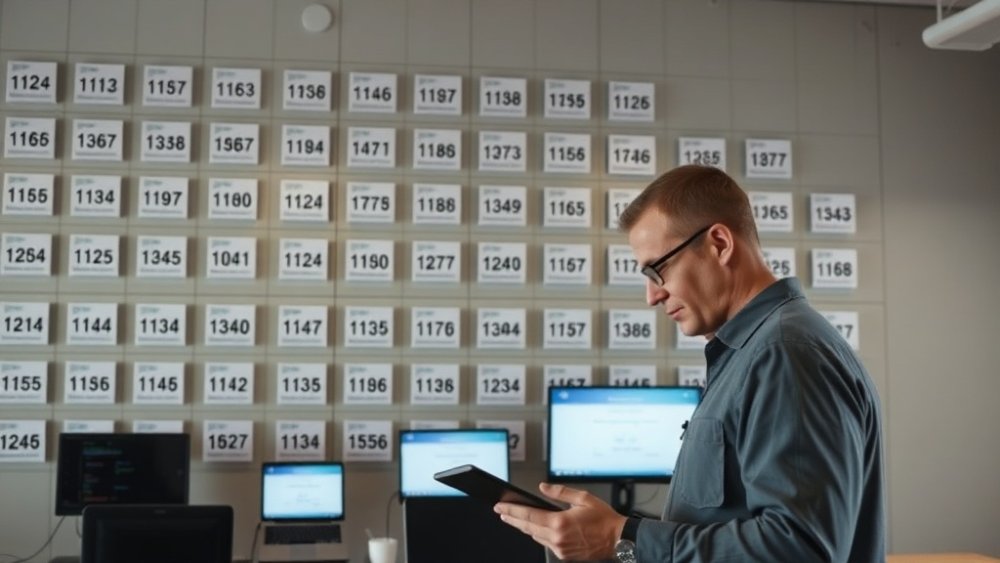
2. Update records at the point of movement, not at month-end
Registers rot because they are updated in batches. An item moves on the 3rd, someone remembers to write it down on the 28th, and by then two more moves have happened that no one recorded at all. Batch updates guarantee that your data is always weeks behind the truth, and weeks is more than enough time to lose something.
The remedy is to make the update happen at the exact moment the asset changes hands or location. Scan on issue, scan on return, scan on transfer. This is where a mobile-first system earns its keep: if a storekeeper can update a record in five seconds from a phone, they will; if it means walking to a desktop and logging into a portal, they will not. The friction of the tool decides whether the habit survives contact with a busy day. If you are still deciding what to encode on the tag itself, our guide on choosing between QR codes and 1D barcodes is a useful next read.
3. Assign a named custodian to everything
An asset that belongs to "IT" or "the clinic" belongs to no one. Shared ownership is the fastest route to quiet disappearance, because when everyone is responsible, no single person feels the loss. The cure is boringly simple: every asset has exactly one current custodian, recorded by name, and that name changes only through a logged transfer.
This does two things at once. It creates accountability, because a person can be asked directly where an item is. And it creates history, because the chain of custody shows every hand the asset has passed through, which is invaluable when something goes missing or a warranty claim needs a paper trail.
What good custodianship looks like
- Every asset has one current custodian, recorded by name rather than by department.
- Transfers are logged with a date, so the record shows every hand the item has passed through.
- Custodians can see the list of assets in their care and are asked to confirm it periodically.
- When staff leave, their assets are formally handed back before the final clearance is signed.
4. Audit little and often instead of once a year
The annual stock-take is where organisations discover, all at once, everything that went wrong over twelve months. It is exhausting, it halts normal work, and it delivers its bad news far too late to do anything about it. By the time you find the pump is gone, the trail is a year cold.
Cycle counting spreads the same work across the year. Instead of counting everything once, you count a slice every week: high-value items monthly, everything else on a rolling schedule. The counts are small enough to fit into a normal shift, discrepancies surface while they are still fresh, and your located rate stays high all year rather than collapsing and recovering in an annual sawtooth. Our walkthrough on how to run your first asset audit lays out a process you can shrink into a weekly rhythm.
5. Measure the numbers that predict loss
You cannot improve what you do not watch. Most organisations only measure assets in money terms, through the depreciation schedule, which tells you nothing about whether the items still physically exist. A few operational metrics, reviewed monthly, will warn you long before the annual write-off does.
| Metric | What it tells you | Healthy direction |
|---|---|---|
| Located rate | Share of listed assets physically found and scanned | Rising toward 100% |
| Unassigned assets | Items with no named custodian | Falling toward zero |
| Stale records | Assets not scanned or confirmed in 90 days | Falling |
| Overdue transfers | Moves logged as started but never completed | Falling toward zero |
| Ghost assets | Records on the book with no physical match found | Falling as the list is cleaned |
None of these require a data scientist or a bespoke dashboard. They are counts you can pull in a minute, and their direction of travel matters far more than their exact value on any given day. A located rate that slips from 96 to 88 per cent over a quarter is a signal to act now, not a footnote for next year's audit.
Why these habits reinforce one another
These five habits are not a menu to pick from; they compound. Permanent identities make point-of-movement updates trustworthy. Trustworthy updates make named custodianship enforceable. Custodianship makes cycle counts fast, because you know who to ask. And the metrics only mean anything once the first four habits are feeding them clean data. Adopt one in isolation and you get modest gains; adopt them together and the register finally starts to match reality.
It also helps to know where efficiency habits sit within the broader discipline. International guidance such as the ISO 55000 family of asset-management standards frames all of this as part of getting value from assets across their whole life, not just guarding against theft, and that wider lens is worth keeping in mind as you mature.
Bringing it together
Notice that none of these habits is really about technology for its own sake. They are about removing friction so that ordinary people do the right thing during a busy day: scan instead of guess, log instead of remember, count a little instead of dreading a lot. The software's only job is to make the correct action the easiest one available.
That is exactly what Find Asset was built to do, with scannable tags, phone-based updates at the point of movement, custodian history and the operational metrics above ready to read. If you would like to put these five habits into practice without stitching together spreadsheets, start a free 14-day trial and tag your first hundred assets this week. For a wider primer, the general background on asset tracking is a useful companion read.