
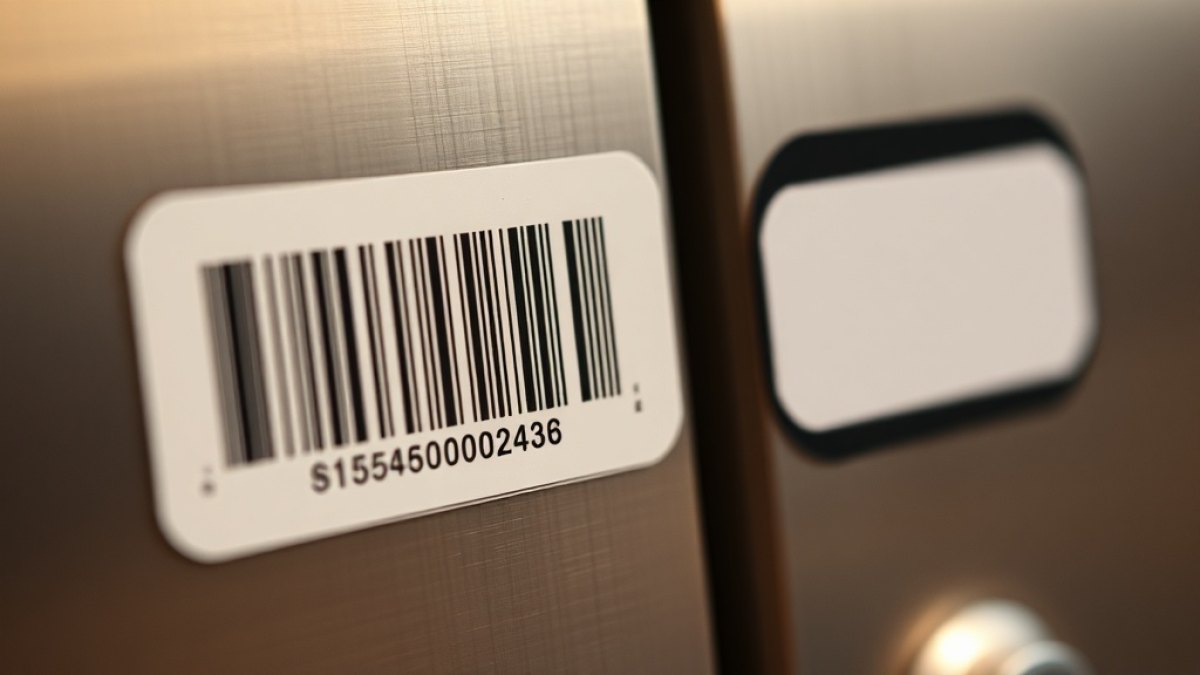
Walk into a warehouse in Tema or a hospital store in Kumasi and ask why the stock take takes three days, and you will hear the same answer everywhere: someone has to pick up each item, find the label, and scan it one at a time. That single constraint shapes budgets, staffing and how often anyone bothers to check the register at all. It is also the exact bottleneck that radio-frequency identification promises to remove.
But RFID is not a straight upgrade to the barcode, and treating it as one is how organisations end up with an expensive reader gathering dust in a cupboard. The honest answer to "RFID or barcode?" is that they solve different problems at very different price points. This guide walks through where each one genuinely wins, what they actually cost, and how to decide without being sold something you do not need.
How the two technologies actually differ
A barcode, whether a traditional 1D stripe or a 2D QR code, is a printed pattern that a scanner reads optically. It needs line of sight and it reads one code at a time. That sounds limiting, but it is also why barcodes are almost free: the "tag" is just ink on a label, and the reader can be the phone already in your pocket.
RFID stores an identifier on a tiny chip attached to an antenna. A reader energises the tag over radio waves and receives its number back, with no line of sight and no aiming. A passive UHF reader can capture dozens or hundreds of tags a second as they pass through a doorway or under a handheld wand. That is the headline advantage, and it is a real one.
The catch is that radio behaves badly around metal and liquids, both of which detune or absorb the signal. A drum of oil, a rack of steel tools or a saline bag will all interfere with a plain tag, which is why "on-metal" and specialist tags exist and cost more. Barcodes do not care what they are stuck to, as long as the surface is flat and clean enough to print on.
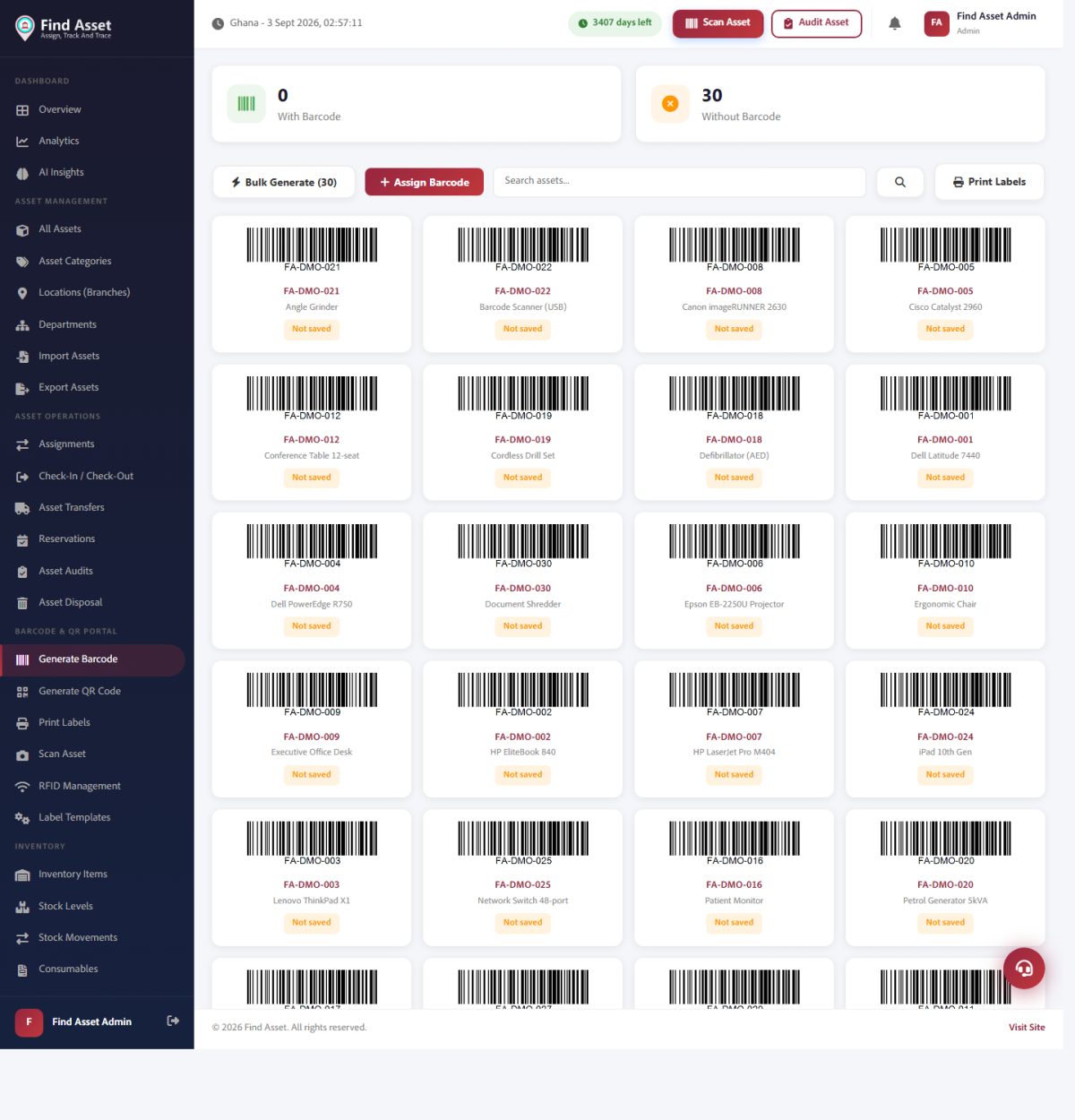
Whichever you choose, the tag has to be produced somehow. Find Asset's barcode generator (above) turns an asset's code into a printable barcode on demand — the practical companion to the RFID-versus-barcode decision, since a barcode tag costs almost nothing to make and reprint.
The cost picture, honestly
Cost is where most decisions are actually made, and the gap is wide. A printed barcode or QR label costs a few pesewas and can be produced in-house on a desktop label printer. A passive UHF RFID tag typically runs from roughly two to ten Ghana cedis each depending on type, and specialist on-metal or hardened tags climb higher. Multiply that across ten thousand assets and the difference is no longer a rounding error.
The reader side widens the gap further. A barcode scanner, or simply a smartphone camera, is inexpensive and familiar to staff. RFID handheld readers and fixed portal readers are a meaningful capital outlay, and they need configuring, positioning and testing for your specific environment. None of this makes RFID a bad choice; it makes it a choice you justify with volume and labour savings, not novelty.
When the RFID premium pays for itself
- You count the same large population of assets often, and the labour of one-by-one scanning is the real cost.
- Items move through fixed choke points such as gates, doorways or loading bays where a portal reader can capture them automatically.
- Assets are high value or high risk, so the cost of a tag is small next to the cost of losing the item.
- You need hands-free reads, for example counting a full trolley or pallet without unpacking it.
Speed and range: where RFID earns its keep
The clearest win for RFID is bulk reading. A cycle count that takes a team a full day with barcode scanners can drop to under an hour with a handheld RFID wand, because the operator simply walks the aisle while the reader captures everything within a few metres. For a store with thousands of line items counted monthly, that reclaimed time is the entire business case.
Passive UHF tags read at ranges from a few centimetres up to several metres depending on tag, reader power and environment. Barcodes, by contrast, need to be seen, which means clean labels, decent lighting and a person orienting each item. If your assets are packed tight, stacked, or awkward to handle, the line-of-sight requirement is a daily tax.
Durability and the environment
Neither technology is automatically tougher. A quality barcode label with the right facestock and a laminate can survive years indoors, but a scratched, faded or peeling label is unreadable, and in dusty or oily conditions that happens fast. RFID tags have no printed surface to damage, so a tag sealed inside a housing can keep working even when its outer label is destroyed, which suits harsh workshop and outdoor settings.
That said, RFID's radio weakness around metal and water is a genuine constraint in exactly the industrial settings where durability matters. The practical answer is often to encode both: an RFID tag for bulk reads plus a printed barcode or human-readable number on the same label as a fallback. If you are weighing label materials and adhesives, our guide on how to choose asset tags covers the surfaces and finishes that survive real conditions.
A side-by-side comparison
Laid out against one another, the two technologies stop looking like competitors and start looking like tools built for different jobs. The table below gathers the factors that most often swing a real purchasing decision, so you can hold each one against the way your own team works rather than against a vendor's highlight reel. Read down the rows and mark which advantages match a pain you feel week to week and which are simply nice to have; that quick filter usually tells you more than any single specification.
| Factor | Barcode / QR | RFID (passive UHF) |
|---|---|---|
| Tag cost each | A few pesewas | Roughly GHS 2–10+ |
| Reader cost | Low; a phone works | High; dedicated handheld or portal |
| Line of sight | Required | Not required |
| Read speed | One at a time | Hundreds per second, in bulk |
| Range | Centimetres, aimed | Centimetres to several metres |
| Metal / liquid | Unaffected | Needs specialist tags |
| Human-readable | Yes, prints text too | No, unless label added |
Read the table as a set of trade-offs rather than a scoreboard. Barcodes win on cost, simplicity and readability by eye; RFID wins on speed, bulk reading and freedom from line of sight. The right question is which of those advantages maps to the pain you actually feel each week.
Where each one clearly wins
Barcodes are the correct default for most small and mid-sized organisations. IT equipment, furniture, vehicles, lab instruments and general fixed assets are all served perfectly well by a durable QR or 1D label scanned on a phone. The tag is nearly free, staff already understand it, and you can start today. If you are unsure between the two label styles, our comparison of QR codes versus 1D barcodes is a useful next step.
RFID pulls ahead in a narrower set of cases: high-volume warehousing and retail stock, tool cribs where kit moves constantly, document and file tracking, and any operation with fixed gates where you want automatic reads as things pass through. It also suits fast-growing African logistics and manufacturing operations where labour to scan is scarce and the asset population is large enough to justify the infrastructure.
You do not always have to choose
The most pragmatic path is often hybrid. Tag everything with a printed barcode because it is cheap and universally readable, then add RFID only to the specific asset classes where bulk reading pays off, such as a busy tool store or a bonded warehouse. A single dual-technology label can carry both, so the same asset supports a quick phone scan and an automated portal read.
Whatever mix you land on, the technology is only the sensor. What turns a scan into control is the system behind it: one record per asset, a named custodian, and an audit history you can trust. The wider habits that make tracking stick are covered in our guide to asset tracking best practices, and the underlying discipline is the same whichever tag you choose. For the standards-minded, the international body ISO publishes the ISO 55000 asset management family as a reference framework.
Bringing it together
RFID is not better than barcode, and barcode is not simpler-but-worse. They are two tools for two jobs. If your pain is the slow, one-by-one stock take across thousands of items behind fixed gates, RFID will pay for itself. If your pain is simply not knowing what you own and where it is, a durable barcode on a mobile system solves it for a fraction of the cost, today.
Either way, the tag is worthless without software that reads it, records the movement and holds every custodian accountable. That is what Find Asset was built to do: it supports barcode and QR scanning from any phone, encodes and prints RFID smart labels from the same designer, and keeps one clean register behind them all. Start a free 14-day trial and tag your first hundred assets before deciding which technology deserves the premium.