
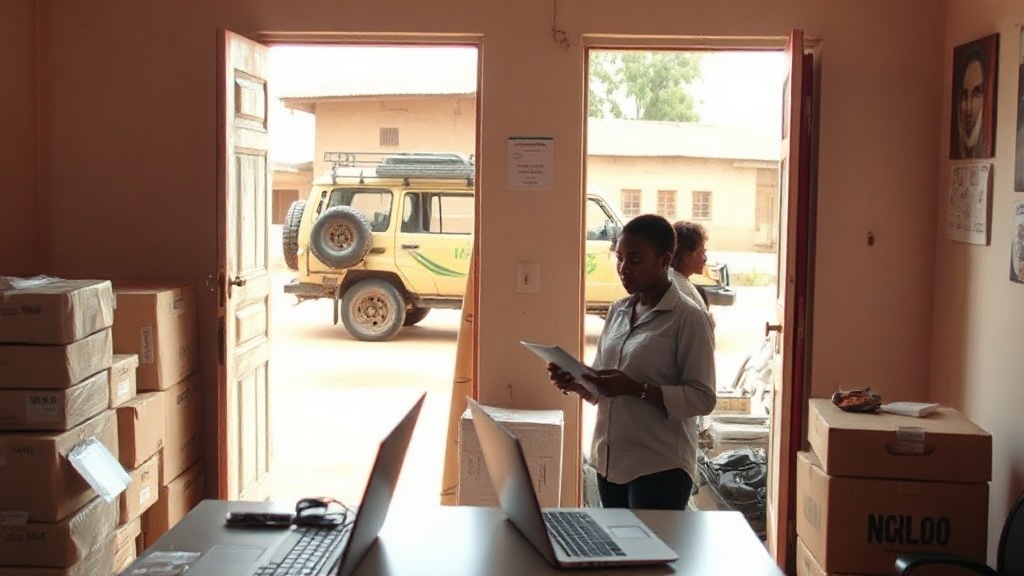
Every NGO finance officer knows the particular dread of a donor audit letter that asks, politely, for "a complete register of all assets procured under the grant, with current location, condition and custodian." The grant agreement signed three years ago said the same thing, but in the intervening seasons the vehicles have been reassigned, laptops have followed staff to new offices, and the generator that was bought for one project is quietly powering another. The list exists somewhere, usually in a spreadsheet, but nobody is confident it matches what is on the ground.
This gap is not a sign of poor stewardship. It is the predictable result of running multiple funders, multiple projects and multiple field sites through a register that was never designed to move at the speed of the work. The good news is that donor-compliant asset management is far more about discipline than about software budgets, and the habits that satisfy a USAID or FCDO auditor are the same ones that stop a field office losing a motorbike. This guide walks through what actually works.
1. Start from the grant agreement, not the storeroom
Commercial asset registers are built around accounting thresholds. Donor registers are built around ownership conditions, and those are stricter. Most major funders require you to track any item above a set value, commonly USD 500 or USD 5,000 depending on the agreement, and to record which grant paid for it. Title to that equipment often does not pass to your organisation until the project closes, and sometimes never does. If you do not capture the funding source at the moment of purchase, reconstructing it later is close to impossible.
Before you tag a single item, read the property clauses in each active agreement and list the fields the donor expects. Typically that means description, serial number, acquisition date, cost, source of funds, location, condition and custodian. Build your register to hold all of them from day one. Retrofitting the funding source onto two hundred existing assets during an audit is exactly the scramble you are trying to avoid.
2. Give every asset one permanent, scannable identity
The most common failure in NGO registers is that the same asset appears under three descriptions: "Toyota Hilux", "project vehicle GR-4821" and "the Tamale truck" are all the same object to three different people. A donor auditor sampling the register cannot follow that thread, and neither can your own finance team at close-out. The confusion compounds every time the item changes hands, until three separate half-records describe one truck and none of them can be trusted on its own.
Fix this by assigning each item a single asset tag the day it arrives, and bonding a physical label to the equipment itself. A number in a spreadsheet is a claim; a scannable barcode fixed to the chassis is evidence. In dusty, high-heat, high-humidity field conditions across the Sahel and coastal West Africa, tag durability matters as much as the numbering scheme, so choose labels rated for the environment rather than office paper stickers.
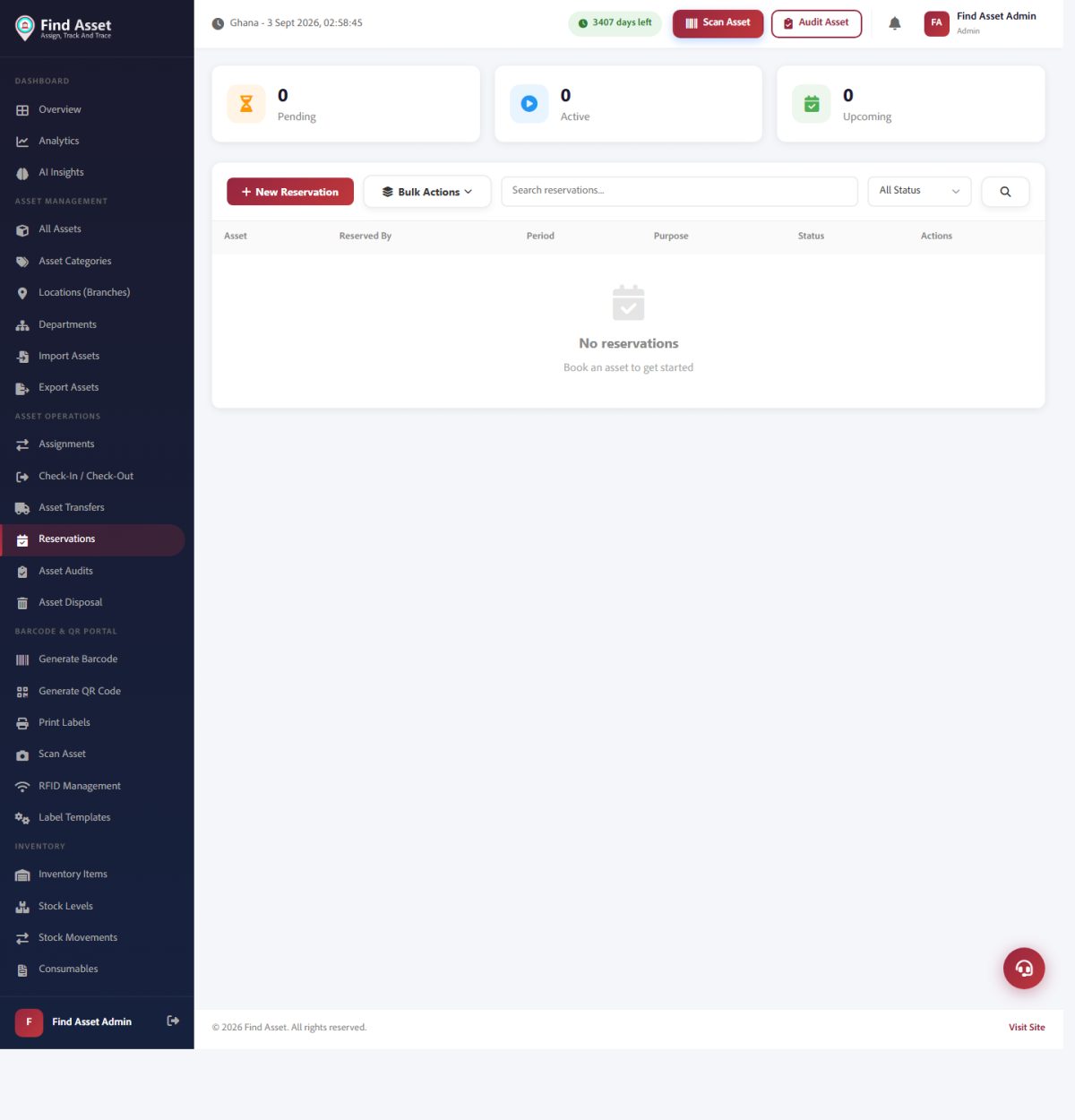
NGOs often share a small pool of equipment across many programmes. Find Asset's reservations (above) let teams book items in advance, so scarce resources are allocated deliberately rather than claimed first-come.
Consistency of the scheme matters more than cleverness. A simple sequential code prefixed by an office or project identifier is enough, provided every asset has exactly one and it never gets reused. If you are unsure which symbology suits your field kit, our guide on how to choose asset tags covers the trade-offs. What you want to avoid is a clever scheme that only its inventor understands, because the whole point of an identity code is that any field officer, store keeper or auditor can read it the same way without a manual.
3. Tag by project and funding source, not just by office
An NGO laptop is rarely just a laptop. It is a laptop bought under the health grant, in use by the WASH team, physically sitting in the regional office. Donor reporting needs all three facts at once, because each funder only wants to see the assets it paid for. If your register can only filter by location, you will be manually splitting the list every reporting cycle.
Record the funding source as a first-class field on every asset and make it non-optional at data entry. This single discipline turns the dreaded per-donor asset schedule from a week of spreadsheet surgery into a filtered export. It also makes shared-cost items honest: when a printer is split across two grants, the register shows exactly how. That transparency is precisely what a suspicious auditor is looking for, and being able to produce it on demand quietly converts a potential finding into a demonstration of good stewardship.
Fields a donor auditor will actually check
- Source of funds and the specific grant or award number that paid for the item.
- Acquisition date and original cost, matched to a procurement record.
- Current physical location and the named custodian responsible for it.
- Condition, and for disposals, the authorised approval and method.
4. Log custody at the point of movement
Registers rot because they are updated in batches, usually the night before a report is due. In an NGO the movement is constant: staff turnover is high, vehicles rotate between field sites, and equipment follows short-term project consultants. If updates wait for a quarterly reconciliation, the register is wrong for eighty-nine days out of ninety. And it is always wrong on the one day that matters, because donor letters and spot checks never arrive politely on reconciliation day; they land in the middle of the quarter when the record has drifted furthest from reality.
Assign a single named custodian to every asset and log the handover the moment it happens, ideally by scanning the tag on a phone in the field rather than emailing the store keeper afterwards. When a driver hands a vehicle to a colleague, that transfer should be a scan, not a memory. A mobile-first approach is what makes this realistic for staff who are rarely at a desk, and it builds the custody chain that auditors trace when something goes missing.
5. Audit little and often, not once a year
The classic NGO stock-take happens once a year and discovers, all at once, everything that drifted over twelve months. By then the trail is cold: the staff member who took the tablet has left, and nobody can say when the projector disappeared. Cycle counting spreads that effort into small, regular checks that catch drift while it is still traceable.
Pick a rhythm your field offices can sustain, such as counting one project's assets each month so the whole register is verified over a quarter. Each scan updates the "last seen" date and quietly closes the gap the annual count would otherwise expose. Our walkthrough on how to run your first asset audit turns a quarterly verification into a checklist.
There is a quieter benefit that field teams feel long before the auditor arrives. A rolling count means a field coordinator preparing a project report never has to freeze operations for a frantic full inventory; the numbers are already current because a slice was verified last week and the week before. It also spreads the sheer physical labour of counting across many pairs of hands and many ordinary days, rather than dumping it on one exhausted finance officer in the fortnight before close-out. Over a year the total effort is similar, but the stress, the errors and the surprises are a fraction of what the annual scramble produces.
6. Track the numbers that predict a bad audit
You cannot fix what you do not watch, and a handful of simple metrics will tell you months in advance whether a donor audit will go smoothly. None of these needs a data analyst; they fall straight out of a register that is kept current. The value of watching them is that they give you warning while there is still time to act, rather than confronting you with an unfixable mess in the final week of a grant when the trail has long gone cold.
| Indicator | What it signals | Sound territory |
|---|---|---|
| Located rate | Share of registered assets physically found and scanned | On an upward path |
| Assets without a funding source | Items you cannot attribute to any grant | Driving down to zero |
| Unassigned assets | Equipment with no accountable owner | Sliding toward nil |
| Stale records | Assets not scanned in 90 days | Falling |
| Pending disposals | Retired items still awaiting donor approval | Cleared before close-out |
Watch these monthly and the annual audit stops being an event and becomes a formality. A located rate creeping below ninety per cent is an early warning; a pile of assets with no funding source is a reporting bomb waiting for close-out. Treat each figure as a prompt for a specific, small action this month, and the numbers will trend the right way long before anyone from the donor side comes to check them for you.
7. Plan for close-out and disposal from the start
Every donor-funded project ends, and the closing property report is where weak registers finally break. At close-out the funder wants to know the disposition of every asset it paid for: transferred to a local partner, handed to government, sold with proceeds returned, or retained with title passing to your organisation. Each of those routes usually needs prior written approval, and disposing of an item without it is a finding.
Treat disposal as a logged, approved event in the register rather than an afterthought. Record the method, the approval reference and the date, and keep the asset in the history even after it leaves your custody. This is also where clear ownership rules protect you: many agreements draw on the OMB Uniform Guidance principles that govern how federally funded property is tracked and disposed, and a register that already holds cost, funding source and condition makes that report almost automatic.
Bringing it together
Those five habits hold up without a line of software in sight. They are about capturing the funding source at purchase, giving each asset one identity, logging custody as it moves, counting little and often, and never letting an item leave without an approved paper trail. Do those five things and a donor audit becomes a report you export rather than a project you dread. The technology only exists to make the disciplined path also the easy path.
Find Asset handles the paperwork side of that bargain: tag every item, capture its grant and custodian, let field staff update records by scanning a phone, and produce per-donor schedules on demand. If your registers are still scattered across spreadsheets and inboxes, you can start a free 14-day trial and bring one project's assets under control this week. For the wider policy background, the OMB Uniform Guidance on property standards is a useful reference for teams working with US federal funds.