

Every year the Auditor-General's report lands with a familiar set of findings: vehicles that cannot be traced, computers signed out to staff who left years ago, generators recorded in one district but physically sitting in another. These are not usually stories of grand theft. More often they are stories of institutions that simply lost track of what they own, because the record and the reality drifted apart and nobody reconciled them. In a public sector funded by taxpayers and development partners, that drift is expensive and, increasingly, politically costly.
The good news is that the fix is procedural rather than technological. A district assembly does not need a supercomputer to know where its motorbikes are. It needs a single register that reflects reality, a habit of updating that register when things move, and someone whose name is attached to each item. The institutions that get this right in Ghana are rarely the best-funded ones. They are the ones that treated asset control as a daily discipline rather than an annual scramble before the auditors arrive.
Start with one register that everyone actually uses
The most common failure in a Ghanaian public institution is not the absence of a register but the presence of several. The stores officer keeps a ledger, the accountant keeps a fixed-asset schedule for the financial statements, the IT unit keeps a spreadsheet of laptops, and the transport officer keeps his own list of vehicles. Each is partially right and collectively they agree on nothing. When the audit team asks for the master list, four documents appear and the reconciliation alone consumes a week.
A single register does not mean a single person. It means one source of truth that every unit reads from and writes to. Each asset appears once, with a permanent identity code that never changes even when the item is transferred, repaired or reassigned. The Public Financial Management Act and its regulations already require institutions to maintain proper asset records; the practical question is whether that record is one living document or a scattered archive that has to be assembled from scratch each June.
Tag the asset, not just the paperwork
A serial number written in a book is a claim. A durable, scannable label bonded to the equipment is evidence. When a physical tag carries the same identity code as the register, an auditor or store officer can walk up to any generator, scan it, and see its full history in seconds. This single change removes most of the ambiguity that lets assets slip through the cracks, because the item and its record become inseparable.
For public-sector conditions this matters more than it might in an air-conditioned office. Assets live in dusty stores, humid coastal offices and vehicles that bounce down unpaved roads. Paper labels peel and biros fade. Institutions that invest in proper tags, and think about where those tags are placed, avoid re-labelling the same fleet every two years. If you are choosing a scheme, our guide on how to choose asset tags covers what survives real conditions.
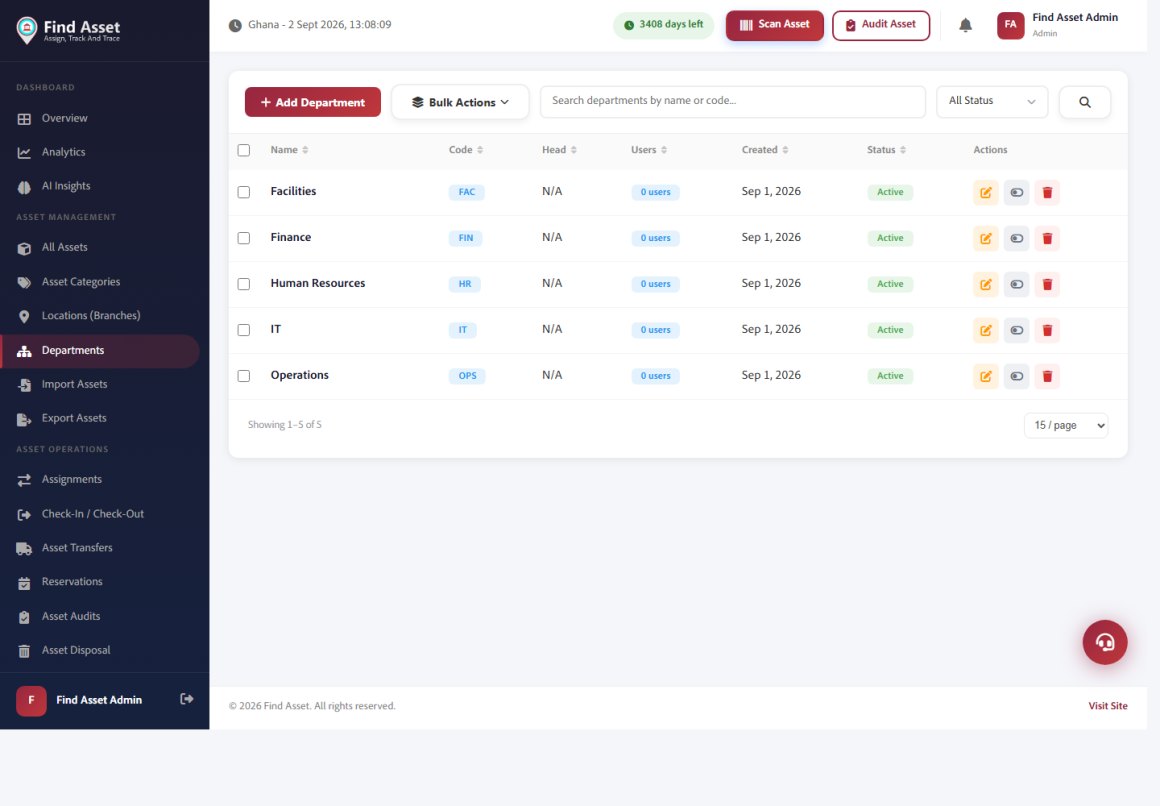
Public bodies are organised by department and unit, and Find Asset mirrors that. The departments screen below defines each unit — Finance, IT, Operations, Facilities, HR — so every asset is owned by a department and accountability is unambiguous. When an audit or a handover comes, you can see exactly which unit holds what — precisely the accountability a public-sector asset register is meant to provide.
Update the record at the moment of movement
Registers do not fall out of date all at once. They rot one un-logged transfer at a time. A projector moves from the head office to a district workshop for a training session and never comes back on paper. A vehicle is reassigned from one director to another and the log book is updated three months later, if at all. By the time anyone notices, the trail is cold and the item is effectively untraceable.
The remedy is to make updating the register part of the movement itself, not a separate administrative chore done later. When a store officer can scan an item on a phone and record the transfer on the spot, the record stays current because keeping it current takes seconds rather than a trip back to a desktop computer. Mobile-first tools matter here precisely because government assets rarely sit still in one office.
Give every asset a named custodian
An asset that belongs to "the ministry" belongs to no one. Accountability in the public sector only works when responsibility narrows to a person. Every laptop, vehicle, printer and generator should have one current custodian recorded by name, and every transfer should be logged so the history shows every hand the item has passed through. When a member of staff is transferred or retires, their assigned items should be formally handed over before the exit is cleared.
This last point deserves particular emphasis in Ghanaian institutions, where postings and transfers are frequent and rarely tied to any asset check. An officer moves to a new region and the laptop, the office printer and sometimes the vehicle simply travel with them, or vanish into an unrecorded limbo, and two years later the Auditor-General flags equipment signed to a name that no longer appears on the payroll. Making the return or reassignment of assigned items a mandatory step in clearance — no signed asset handover, no final clearance letter — closes that gap almost entirely. It costs nothing but a change of habit, and it turns the moment of a transfer from the point where assets disappear into the point where the register is corrected.
Custodianship, in practice
- Every asset has exactly one current custodian, recorded by name and not by unit.
- Transfers are logged at the point they happen, so the history is complete rather than reconstructed.
- Staff clearance on transfer or retirement includes a check that assigned assets have been returned or reassigned.
- Custodians can see the list of items they are personally accountable for at any time.
Audit little and often, not once a year
The annual stock-take is where institutions discover, all at once, everything that went wrong over twelve months. It is stressful, it is rushed, and it usually produces a list of discrepancies too long to investigate properly, so most are simply written off. Worse, it teaches everyone that asset control is an event rather than a routine. Once staff learn that the register only matters in the fortnight before the auditors arrive, they stop treating it as a living tool for the other fifty weeks of the year, and the whole institution slides back into the annual scramble it was trying to escape.
Cycle counting spreads that workload across the year. Instead of counting everything in June, a store officer verifies a small slice each week, perhaps one department or one asset class at a time. Discrepancies surface while the trail is still warm and can actually be resolved. By the time the external audit arrives, the register already matches reality and the exercise becomes a confirmation rather than an excavation. Our walkthrough on how to run your first asset audit walks the count from planning through to a reconciled register.
Track the numbers that predict a qualified opinion
You cannot manage what you do not measure, and a handful of simple figures will tell a chief director whether the institution is heading for a clean audit or an embarrassing one. None of these requires special software to understand; they are ratios any store or accounts officer can read at a glance. Reviewed together at a monthly management meeting, they turn asset control from something the institution thinks about once a year into a standing item that leadership actually watches, which is precisely the shift that keeps a clean opinion from slipping into a qualified one.
| Measure | What it reveals | Where healthy sits |
|---|---|---|
| Located rate | Share of listed assets physically found during counts | Climbing steadily |
| Unassigned assets | Records pointing at no owner | Trending to zero |
| Stale records | Assets not verified in the last 90 days | Falling |
| Undocumented transfers | Movements logged after the fact rather than at the time | Shrinking toward none |
| Disposal backlog | Obsolete items still carried on the register | Falling |
A rising located rate and a falling count of unassigned assets are the clearest early signals that control is improving. When these numbers are reviewed monthly rather than annually, problems get named while they are still small enough to fix without a committee. A single vehicle unaccounted for is a phone call this week; twenty vehicles unaccounted for at year end is an investigation, a query in the audit report, and a headline nobody in the institution wants to explain to a minister.
Plan for disposal before it becomes a liability
Public institutions are often better at acquiring assets than retiring them. Broken photocopiers, written-off vehicles and obsolete computers linger on the register for years because the disposal process is bureaucratic and nobody wants to initiate it. This inflates the asset base, distorts the financial statements, and gives auditors an easy category of findings. A good system flags items that have reached end of life and records the authorised disposal, so the register reflects what the institution genuinely holds today.
The discipline that keeps disposal clean is treating it as a documented, approved event rather than a quiet clear-out of the storeroom. In the Ghanaian public sector, boarding and disposal usually require a board of survey, valuation and formal authorisation before anything is sold, auctioned or scrapped, and skipping those steps is precisely what turns a routine write-off into an audit query or, worse, a suspicion of impropriety. Record the approval reference, the method and the date against each retired item, and keep it in the history even after it physically leaves the compound. Done this way, disposal stops being the murky corner of asset management where value and accountability both leak away, and becomes just another logged transaction that the next audit can follow without raising an eyebrow.
Bringing it together
None of these habits is really about technology. They are about discipline: one register, one identity per asset, one named custodian, updates at the moment of movement, and small frequent counts instead of one annual panic. An institution that adopts these practices will find that the Auditor-General's queries shrink year on year, not because the audit got easier but because there is finally nothing to hide. Public trust, and continued donor confidence, follow from exactly this kind of quiet reliability.
Find Asset condenses that discipline into a single mobile-first register — scannable tags, named custodians, transfer logs and rolling audits — drawn for the conditions African public institutions actually work in. If your ministry, district assembly or agency is ready to stop reconstructing its asset list every June, you can start a free 14-day trial. For wider context, the international standard on the discipline is worth a look in the ISO 55000 asset management standards.