

Walk into the biomedical workshop of almost any busy hospital and you will find the same quiet drama playing out. A ward has called down for an infusion pump, the technician is sure there were spares last week, and now nobody can say whether they are in storage, out on loan to theatre, or sitting broken behind a nurses' station waiting for someone to raise a fault. Meanwhile a service engineer is on site to calibrate a defibrillator that, it turns out, was moved to another building three months ago. The equipment exists. The knowledge of where it is, and whether it is safe to use, does not.
That gap is expensive in a way most hospitals never fully measure. It shows up as duplicate purchases, as machines that miss their planned maintenance and fail mid-shift, and as the frantic paperwork scramble that precedes every accreditation visit. The good news is that fixing it is far less about buying clever hardware than about building a few disciplined habits around identity, movement and service history. Done properly, the same register that keeps auditors happy is the one that keeps a ventilator working when a patient needs it.
1. Give every device a single permanent identity
Most tracking failures trace back to one problem: the same syringe pump is recorded as "Pump 4" on the ward, "Braun Perfusor" in the finance asset list, and by its serial number in the maintenance file. Three names, three systems, no way to reconcile them. Before you track anything, decide that each physical device gets exactly one identifier that never changes for the life of the asset, and that every other record hangs off that one number.
Physical tags make the identity real. A code written on a ward whiteboard is a hope; a durable label bonded to the chassis is a fact a technician can scan at two in the morning. For clinical settings the tag has to survive repeated wipe-downs with alcohol and chlorine, autoclave heat where relevant, and years of handling — so specify a proper polyester or polyimide label, not a paper sticker. Our guide on how to choose asset tags covers the materials that hold up in harsh environments.
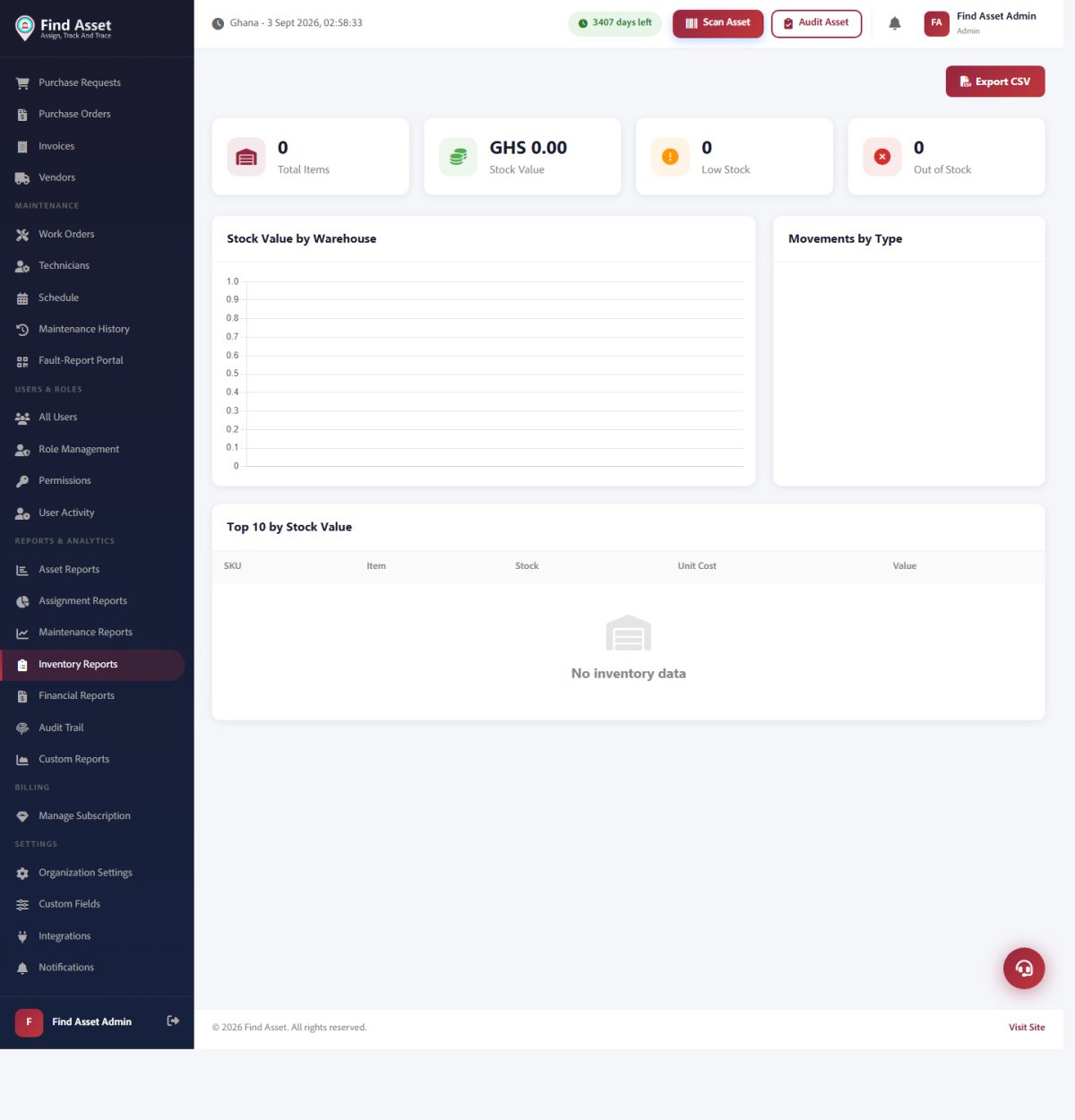
Hospitals cannot afford to lose track of equipment. Find Asset's inventory reporting (above) shows what exists, where, and in what state — the visibility this guide argues is non-negotiable in a clinical setting.
2. Record movement at the point it happens
Registers rot because they are updated in batches, usually by one overworked person days after the fact. In a hospital, where a portable ultrasound might visit four departments in a single day, batch updates are hopeless. The record has to change at the moment the device changes hands. By the time an end-of-week catch-up happens, the person doing it is reconstructing a chain of movements from memory and half-remembered phone calls, and the one device that genuinely went missing is buried among a dozen that merely moved and came back.
This is where a mobile-first system earns its place. A porter or nurse scans the tag with a phone, taps the destination ward, and the location is updated instantly — no forms, no return trip to a desktop. The friction has to be near zero, because anything slower simply will not happen during a night shift. When updates ride along with the physical movement, the register stops being a snapshot from last quarter and becomes something staff actually trust enough to check before they go hunting.
3. Assign a named custodian, not a department
A defibrillator that belongs to "A&E" belongs to no one in particular. When something goes missing or overdue for service, "the department" cannot be called, cannot be asked, and cannot be held to account. Every device needs one current custodian recorded by name — typically the ward manager or the biomedical lead responsible for that unit. That single named person becomes the thread that ties the equipment back to a human being who can answer for it, which is exactly what a department heading in a spreadsheet can never do when a machine is needed urgently and cannot be found.
Naming a custodian does something psychological as much as administrative: it converts a shared, diffuse responsibility that everyone assumes someone else is holding into a personal one that a specific person can see on their own list. A ward manager who can pull up the eleven devices signed to her unit, and notice at a glance that the spare feeding pump has not been scanned in six weeks, will chase it in a way that no department-level record ever prompts. The custodian is also the natural point of contact when a planned-maintenance date approaches or an external engineer needs access, so the chain of accountability and the chain of communication become the same chain. In a hospital, where equipment quite literally passes between hands around the clock, that single named owner is what stops a critical machine from quietly becoming nobody's problem until the night it is needed and cannot be found.
Custodianship on a hospital ward
- Every device has one current custodian, recorded by name rather than by department.
- Transfers between wards are logged, so the history shows every hand the equipment has passed through.
- When a machine is decommissioned or sent for external repair, the custodian changes to reflect who now holds it.
- The custodian is the first person notified when a planned-maintenance date approaches.
4. Tie maintenance to the asset record
Uptime is not luck; it is the visible result of maintenance that actually happened on time. Every biomedical device should carry its full service history on its own record: last planned maintenance, next due date, calibration certificates, and every fault logged against it. When that history lives on the asset rather than in a separate binder, a technician scanning the tag can see in seconds whether the machine in front of them is due, overdue, or safe.
The pattern that separates reliable estates from chaotic ones is scheduling by usage and criticality rather than treating everything the same. A ventilator or anaesthetic machine warrants a tighter interval and louder alerts than a waiting-room blood-pressure monitor. If you are formalising this for the first time, our walkthrough on preventive maintenance basics lays out how to build a schedule that people follow. It also creates the paper trail accreditation bodies expect to see.
5. Audit little and often
The annual stock-take is where hospitals discover, all at once, everything that drifted over twelve months — and by then the trail is cold. Cycle counting fixes this by spreading the work: a handful of wards verified each week, so the whole estate is covered over a quarter and problems surface while they are still traceable. A nurse scanning the crash-cart devices at shift handover is, in effect, running a micro-audit every single day.
For a clinical estate this rhythm matters even more than in an office, because a "missing" life-support device is not an accounting footnote — it is a safety issue that needs resolving now, not next December. Our guide on how to run your first asset audit sets out the process step by step. Building the count into existing clinical rhythms, such as the crash-cart check at handover, means the audit costs almost no extra time and yet quietly verifies the most critical devices far more often than any calendar-driven inventory ever would.
6. Measure the numbers that predict downtime
You cannot improve what you do not watch. A small set of metrics, reviewed monthly, tells you whether your estate is getting safer and more available or quietly slipping. None of these needs a data scientist — a competent system produces them automatically, and each one points at a specific corrective action. The point of watching them monthly rather than reacting to failures is that every one of these figures moves before a machine actually breaks down, so a manager who reads the trend gets to intervene in a planning meeting instead of at a bedside during an emergency.
| Metric | What it shows | Target zone |
|---|---|---|
| Located rate | Share of listed devices physically found on the last count | Climbing count by count |
| PM compliance | Planned maintenance completed on or before its due date | Creeping up toward full |
| Overdue services | Devices past their maintenance or calibration date | Dwindling to none |
| Unassigned assets | Devices without an accountable owner | Heading steadily to zero |
| Mean time to repair | Average days a device is out of service after a fault | Falling |
Watched together, these numbers turn a vague sense that "things are a bit chaotic" into a specific list of wards and machines that need attention this week. A rising overdue-services count is an early warning of the next mid-shift failure, long before it happens. Reviewed as a set at a monthly estates meeting, they let a biomedical lead point to the two or three wards that need a technician's attention this week, replacing the sense that everything is slightly out of control with a short, ordered list of things that can actually be fixed.
7. Make compliance a by-product, not a project
Accreditation and regulatory visits are where poor tracking becomes visible and embarrassing. When an inspector asks for the calibration record of a specific device and the maintenance history of every machine on a ward, a hospital running on binders spends days assembling evidence. A hospital where every device carries its own scannable record produces the same evidence in minutes. The compliance dossier is not a special exercise — it is simply a report drawn from data the team already keeps current.
This matters across African healthcare, where many facilities blend donor-funded, purchased and leased equipment from different eras and suppliers. A single register that captures ownership, warranty status and service history for every machine, regardless of how it arrived, is what lets a hospital in Accra or Kumasi answer both a Ministry audit and a donor's asset-verification request from the same source of truth.
Bringing it together
The habits matter more than the hardware here. They are about identity, discipline and visibility — one permanent tag per device, updates that happen where the work happens, a named person accountable for every machine, and a service history that lives on the asset instead of in a drawer. The software is only there to make those habits effortless enough that busy clinical staff will actually keep them up.
Each of those practices has a home in the product: every biomedical device carries a scannable identity, movements and custodians are logged from a phone at the bedside, maintenance is scheduled against each asset, and the whole estate becomes the audit-ready reports accreditation demands. If you want to close the gap between the equipment you own and the equipment you can actually account for, start a free 14-day trial. For wider background you can read the overview of medical equipment management.