

An asset that belongs to everyone belongs to no one. The laptop nobody is quite responsible for is the laptop that quietly disappears, the drill that never comes back from a site, the projector that three departments each assume the other one has. The moment you write down who holds a thing, and when they took it, that thing stops being a floating cost and becomes something a named person is accountable for.
Assignment is the small administrative act that turns an inventory into a system of responsibility. It costs seconds at the counter and saves hours of detective work later. This guide walks through how to assign and check out assets to your team in a way that is calm to run day to day and quietly protects the organisation when questions are asked.
Why custody is the quiet backbone of asset management
Most people think of asset management as a matter of knowing what you own. That is only half of it. Knowing what you own tells you the size of your estate; knowing who holds each item tells you whether that estate is under control. Custody is the link between a row in a database and a human being who can answer for the equipment in front of them. Without it, your register is an honest count of things you can no longer find.
Good custody records also change behaviour before anything goes wrong. When people know that an item is signed out in their name, they treat it with more care, return it sooner, and report damage rather than hiding it. The record is not there to catch people out; it is there to make the ordinary path the accountable one. A team that expects to check equipment in and out will look after that equipment differently from a team that grabs whatever is on the shelf and hopes for the best.
Person, department or location: choosing the right custodian
Not every asset wants to be assigned the same way. A phone, a laptop or a set of keys belongs to a person, because a person carries it, uses it and answers for it. A shared printer or a coffee machine belongs to a location, because it lives in a room and serves whoever is nearby rather than following anyone home. A fleet of hand tools or test instruments often belongs to a department, because the team draws from a common pool and the exact individual holding each one changes from shift to shift.
Choosing the right level of custody is really a question of who you would ask if the item went missing. If the honest answer is "a specific person", assign it to that person. If the answer is "whoever runs that room", assign it to the location. If the answer is "the workshop, and we will sort out which of us within it", assign it to the department and let the check-out loop record the individual for each spell of use. Getting this right depends on having tidy underlying data, which is why it pays to spend an afternoon organising your categories, locations and departments before you begin handing things out in earnest.
The check-out and check-in loop
Assignment answers the question "whose is this in general?" The check-out and check-in loop answers the sharper question "who has it right now?" A permanently assigned laptop rarely needs the loop; a projector borrowed for an afternoon absolutely does. Checking an item out records that a named person has taken temporary custody, along with the moment they did so and, ideally, when they are expected to bring it back. Checking it in closes that spell of custody and returns the item to the available pool.
The discipline of the loop is what keeps a shared pool honest. Every item is in exactly one of two states: available, or out with a named holder. There is no ambiguous third state where something is "probably around somewhere", because the last person to touch the record is the last person to touch the item. Run this consistently for a few weeks and the question "where is the good camera?" stops being a conversation and becomes a single glance at a screen.
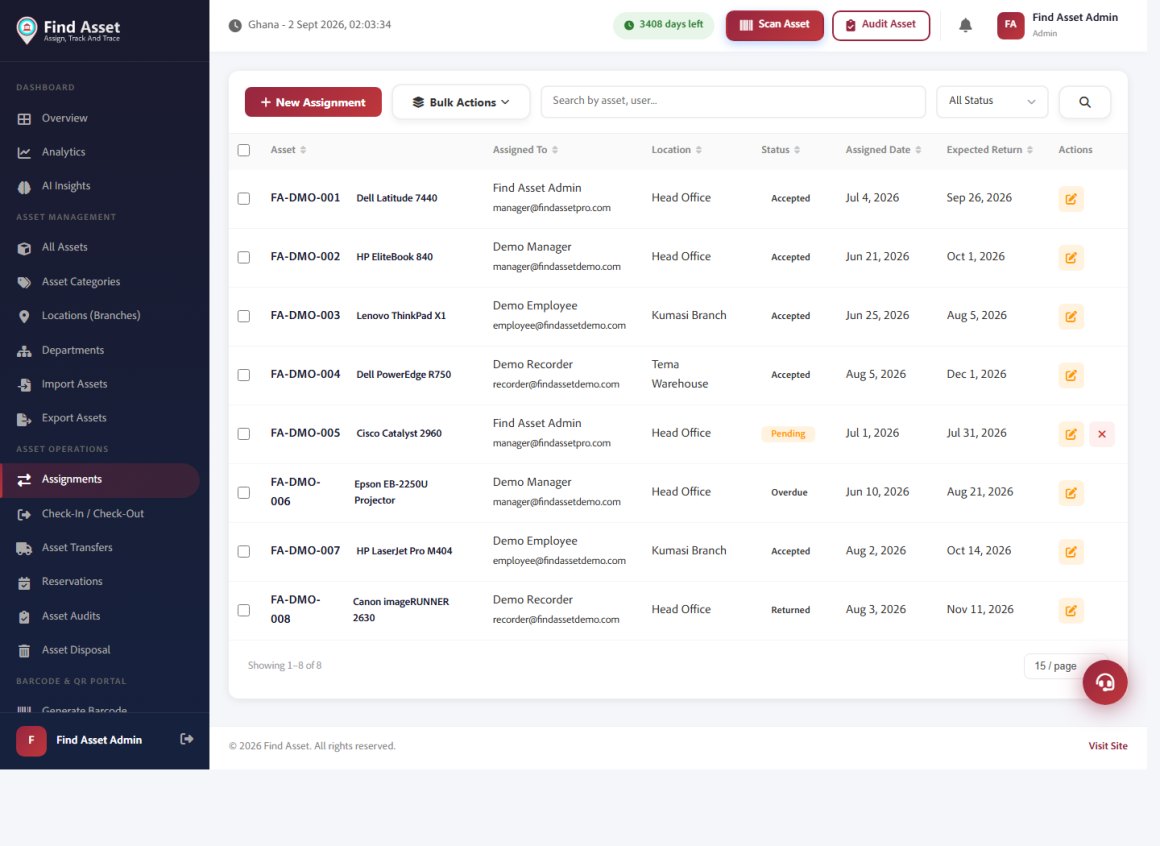
Assignment in Find Asset is a tracked record, not a note in a spreadsheet. The screen below lists who holds what: each asset, the person it is assigned to, their location, when it went out, when it is due back, and a live status — Accepted, Pending, Overdue or Returned. Because it is a record, an overdue item flags itself and a return closes the loop automatically.
Recording condition on issue and return
Custody is not only about location; it is about condition. An asset handed over with a cracked casing and returned with a cracked casing is a very different story from one that left in perfect order and came back damaged. Capturing the condition at the point of issue, even as a short note or a photograph, sets a baseline that both sides agree on. When the item comes back, a matching note on return tells you plainly whether anything changed while it was in someone's hands.
This small habit removes an enormous amount of friction. Instead of arguments that rest on memory and goodwill, you have two dated records that speak for themselves. It also protects the honest borrower, who no longer inherits blame for damage that predated them, and it lets you spot equipment that is quietly wearing out across many hands before it fails at the worst possible moment. Condition-on-issue and condition-on-return are two ends of the same sentence, and writing both down is what makes the sentence complete.
| Moment in the loop | What to capture |
|---|---|
| Assignment | Who is the ongoing custodian, and at what level: person, department or location |
| Check-out | Who is taking it now, the date and time, and the expected return date |
| Condition on issue | A short note or photo of the state it left in, agreed by both sides |
| Check-in | Who returned it, when, and whether it is back in the available pool |
| Condition on return | Any change since issue, so wear and damage are attributed fairly |
When returns run late
Sooner or later something will not come back on time. An expected return date is what turns that from an invisible problem into a visible one. Without a due date, an item is simply out forever until someone happens to ask; with a due date, it becomes overdue on a specific morning, and overdue is a state you can act on. The value of the date is not the deadline itself but the fact that it gives the system a way to raise its hand.
The right response to an overdue item is usually gentle and early. A quiet reminder to the named holder resolves most cases without any drama, because most late returns are simple forgetfulness rather than anything worse. Reserving firmer follow-up for the genuine outliers keeps the whole process humane while still ensuring that nothing drifts away unnoticed. A short, predictable escalation, from reminder to a word with a manager, is far kinder and far more effective than an annual panic when the auditors arrive and half the store is unaccounted for.
Offboarding: reclaiming assets when people leave
The hardest moment for any custody system is the day someone leaves. This is precisely when assets go astray, not through dishonesty but through oversight: the phone in a drawer, the laptop taken home to finish one last task, the access card that was never handed back. If you cannot say what a departing colleague holds, their leaving date becomes a small, silent write-off. If you can, offboarding turns into a simple checklist of items to collect and check back in.
This is where assignment quietly earns its keep. Because every item carries a named custodian, you can list in seconds everything a leaver is responsible for and work down it deliberately, checking each one back into the pool as it is returned. It closes the loop cleanly, protects the individual from being chased for something they returned months ago, and protects the organisation from paying twice for equipment it already owned. A leaving date should be a moment of tidy reconciliation, not the start of a search.
Bulk assignment and the audit trail that protects you
Handing things out one at a time is fine for a projector, but not for a roll-out. When a new team starts, or a whole department is issued the same kit, assigning items individually becomes a chore that people rush and therefore skip. Bulk assignment lets you issue many items to many people in one deliberate action, so that the record is created at the same speed the equipment actually moves. The point is not merely convenience; it is that the record only stays accurate if capturing it is easier than not bothering. If you are standing up a team from scratch, it helps to pair this with a clear first thirty days roll-out plan so nothing is issued before it is recorded.
Every one of these small acts, assigning, checking out, noting condition, checking in, quietly builds something valuable: an unbroken record of who held what and when. This is a form of chain of custody, and it is what lets you answer questions with evidence rather than recollection. When a piece of equipment is lost, damaged or disputed, the trail tells the story plainly, and the story is the same for everyone reading it. That is what an audit trail is for: not to assign blame, but to make the truth easy to find.
What to get right from day one
- Assign every asset to a person, department or location, based on who you would ask if it went missing.
- Use check-out and check-in for anything shared, so you always know who holds it right now.
- Record condition at issue and at return so wear and damage are attributed fairly.
- Set expected return dates so overdue items surface on their own and can be chased gently.
- Reconcile assignments at offboarding so nothing walks out the door when a colleague leaves.
Bringing it together
Assigning and checking out assets is not a bureaucratic overhead bolted onto real work; it is the habit that keeps your equipment findable, your people fairly treated and your register worth trusting. Custody records change how things are handled before anything goes wrong, and they give you a clear account of what happened when something does. None of it requires heroics, only a loop that is easier to follow than to ignore, run consistently across a whole team. It rests on tidy foundations, so it is worth making sure your people are set up correctly by configuring users, roles and permissions first, and worth testing the whole picture with your first asset audit once assignments are in place.
If you are ready to put this into practice, the simplest next step is to try it with your own equipment and watch the record build itself as things move. You can start a free 14-day trial and assign your first assets in an afternoon, then let the check-out loop do the quiet work of keeping everyone honest. The team that always knows who has what is not the lucky one; it is the one that wrote it down.